Then it gets much worse.
And by the end, it's catastrophic.
I white-knuckled my way through it, and any geo-inclined readers are advised to do the same. The educational value of this clip is incredible.
 Bif Naked

The Federal Bureau of Investigation warned Friday that con artists often prey on donors responding to charity calls in the wake of natural disasters. The warning comes as charities begin reaching out for contributions to help deal with the damage caused by Friday's tsunami.12:37- Commenter CJR points out an interview by Evelyn at Georneys with her father, a nuclear engineer, on the unfolding Fukushima reactor crisis. Due to noise here inside the Interzone, I haven't been able to listen to it yet, and I'm hoping Evelyn finds time to transcribe it. However, I've been reading so many positive comments on how her father explains the situation that I'm just going to pass it on to readers, even though I haven't listened to it yet.
The blast destroyed the building housing the reactor, but not the reactor itself, which is enveloped by stainless steel 6 inches thick.So it was hydrogen exploding (chemically, not fusion) that caused the blast, and the inner steel containment vessel was not breached. The article also confirms my unease with the lack of information and transparency: "But authorities did not say why, and the precise cause of the explosion and the extent of the ongoing danger were not clear."
Inside that superheated steel vessel, water being poured over the fuel rods to cool them formed hydrogen. When officials released some of the hydrogen gas to relieve pressure inside the reactor, the hydrogen apparently reacted with oxygen, either in the air or the cooling water, and caused the explosion.
GENEVA, March 12 (Reuters) - The World Health Organisation (WHO) said on Saturday that the public health risk from Japan's radiation leak appeared to be "quite low" but the WHO network of medical experts was ready to assist if requested.So is WHO making this judgment based on their own observations and data, or upon evasive statements by public relations officers? 'Cause, you know, that kind of matters.
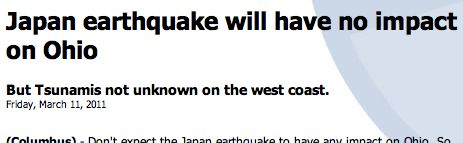 2:15- Whew! That's a relief! (What Would Jack Do?) In a non-ironic vein, it's too early to make any serious observations or predictions, but this may have negative consequences for the nascent economic recovery. So to say "no impact on Ohio" may be a bit premature... at least in terms of "secondary effects."
My email inbox has continued to flood with earthquake notifications, more than doubling yesterday’s tally. As of right now (15:00 GMT), Japan has experienced a total of 171 earthquakes greater than M 5.0.I'm having a really hard time getting my head around 171 M 5+ quakes, with 26 equal or greater than M 6, in less than 48 hours. Criminy.
Of those, 26 were stronger than M 6.0, including a 6.8 that occurred at 1:47 this morning and a 6.4 less than two hours ago. Incredible.
The reactor is shut down, so what’s the danger? The products of a fission reaction are typically radioactive, and subsequent decays also release energy. Shutting down the reactor reduces the fission rate by many orders of magnitude, so it’s effectively zero in terms of heat output, but the radioactive fission products still release up to 6-7% of the plant’s power output. The actual value depends on the operating history; the fission products with long half-lives take longer to build up to steady-state values. This value will drop fairly quickly as the short-lived isotopes decay, but it’s still significant — a reactor rated at 1000 MW will still be producing tens of MW of decay heat. The reactors in question at Fukushima Daiichi are rated at 460 or 784 MW.2:41-@argillic RT @ejgertz: "Personnel have flooded Fukushima reactor 1 w/ seawater & boric acid: 'throw in the towel' strategy that perm. damages reactor." So hopefully, that's that.
 3:49- Ben Travato, The Wulfshead: "We are all Springfielders now."
 4:37- Jessica Ball at Magma Cum Laude has a post that does a good job of getting at the complexities inherent in establishing a causal relationship between an earthquake and a subsequent volcanic eruption. I'd add that both subduction quakes and volcanic arcs result from (are caused by) subduction zones, so they are related, but as Jessica points out, only rarely will a quake actually trigger an eruption. The details of how a quake might trigger an eruption, though, are interesting.
A radiation leak and explosion at the Fukushima Daiichi Nuclear Power Station on Saturday prompted the government to expand an evacuation order to affect 170,000 people in the plant’s vicinity. And the plant’s operator issued an emergency notice early Sunday morning that a second reactor at the same aging plant was also experiencing critical failures of its cooling system, and that a way to inject water into the reactor to cool it was urgently being sought.Al Jazeera's liveblog:
6:29am [local time, UTC plus 9 hours]Also from the Al Jazeera liveblog, this eerie photo:
Fukushima nuclear plant - where a huge explosion yesterday blew the outer walls and roof off the No.1 reactor building - faces a new problem.
The emergency cooling system of No.3 reactor has now also stopped working, the Japan Nuclear and Industrial Safety Agency has announced.
Sea water is being pumped into the No.1 reactor chamber to cool its fuel rods - and officials are scrambling to secure a means of of supplying water to the No.3 reactor.
 5:06- great discussion at Boing Boing of what's happening in Fukushima's "black box," and what we can expect going forward. (spoiler: if it doesn't get worse, it'll get better.)
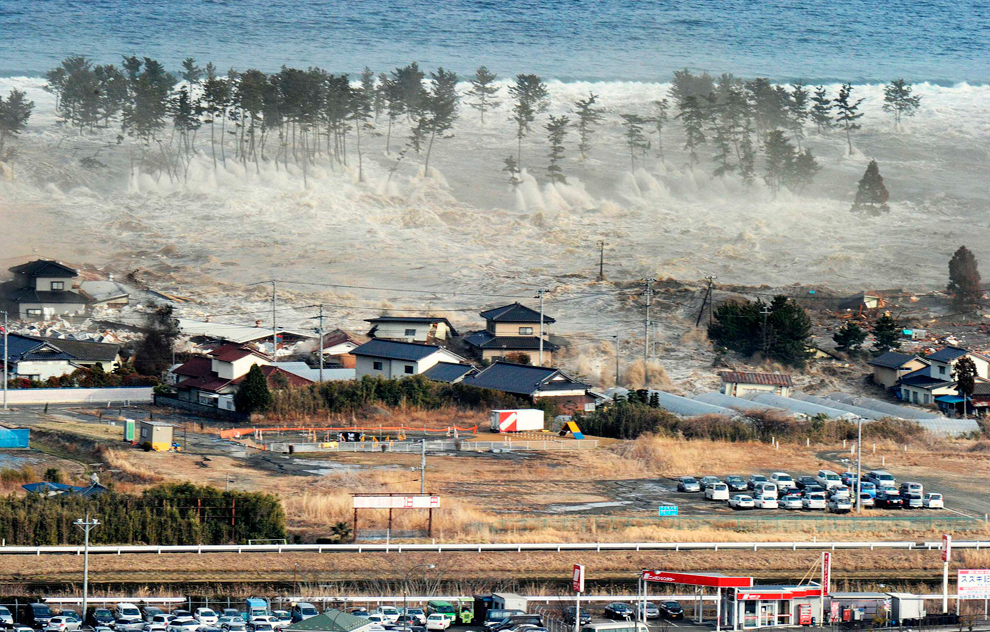 The Big Picture, #6
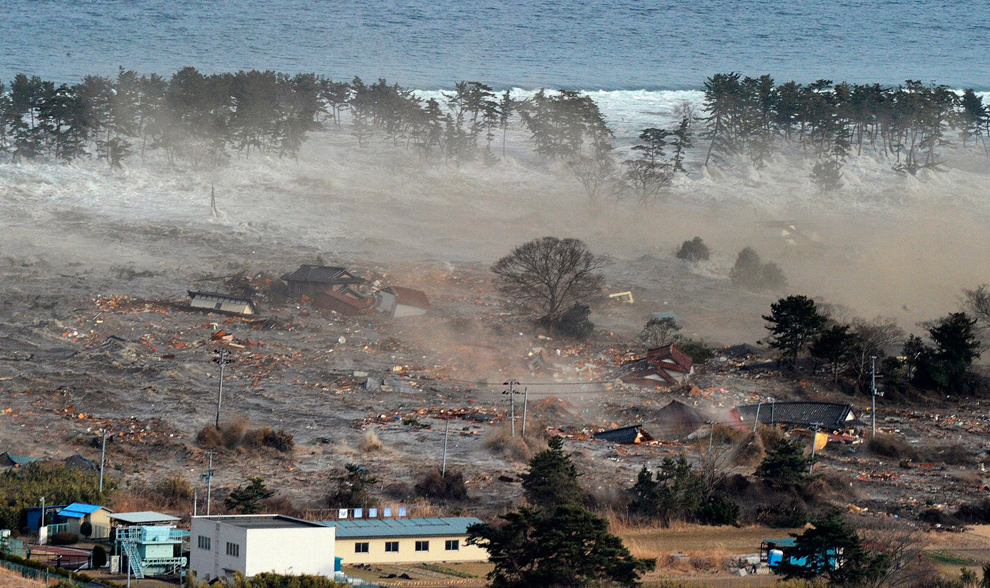 The Big Picture, #7
In the seven years I’ve been subscribing to the U.S. Geological Survey’s email alert system, I have never seen anything like what happened today. Between 5:46 GMT and the moment I’m writing this (twelve hours later), there have been 86 earthquakes stronger than M 5.0 off the northeast coast of Japan.Holy moley!
Robert Yeats, a professor emeritus of geology at OSU, agrees that Oregon is in better shape now than in 2005, when one of the last major tsunami warnings took place. “Then you had a bunch of people running down to the beach to take pictures, acting like idiots,” Yeats said. “It was sort of a fiasco. Oregon coastal communities seem to be better prepared now, even though there’s still work to do. Our building codes for new structures are much better than they used to be.I had Yeats for a number of classes... good guy. Speaking of which, he also leads the second piece, Pacific Northwest faces nearly identical risks to Japanese quake:
Yeats, a professor emeritus of geology at Oregon State University, said that if people didn’t already get the message from recent disasters in Sumatra and Chile, they should pay attention now. “This is an earthquake of the same type, with about the same magnitude and proximity that we face here in the Pacific Northwest from the Cascadia Subduction Zone,” Yeats said. “What you are seeing in Japan today is what you will also see in our future. Except they are better prepared than we are.”3:22- A gallery of coastal damage in southern Oregon and northern California at OregonLive.
"Basically, (the downgrade) means that we're still seeing wave energy from the tsunami, it's still affecting our coast, but it has less impact from before and there is not considered to be a major threat of damage," said Meteorologist Jeremiah Pyle.5:16- I'm getting mixed messages from this report on the ongoing emergency at the endangered
The shooting was widely reported to have taken place on Saturday February 11, 2006, based on the public statements of Katharine Armstrong, owner of the 50,000-acre (200 km2) Armstrong Ranch. However, in her written statement to the Sheriff, she said that the shooting happened on February 12.The shooting wasn't publicized for at least a day or two after it occurred, and many of us have assumed that was to give Darth an opportunity to sober up. That accusation has, of course, been strongly denied, with everyone involved insisting there was no alcohol.
Harry Whittington, in his only public statement, said that "accidents do and will happen – and that’s what happened last Friday" (February 10). Whittington has not made another statement or issued a written statement about the shooting.
Armstrong, the ranch owner, claimed that all in the hunting party were wearing blaze-orange safety gear and none had been drinking, and that at lunch they drank beer, which contradicts her later statement that "there may (have been) a beer or two in there [the coolers at lunch], but remember not everyone in the party was shooting." Cheney has acknowledged that he had one beer four or five hours prior to the shooting. Armstrong said she never saw Cheney or Wittington drink until later at the house, when Cheney had a cocktail. Armstrong did not actually see the incident happen, believing that the reason Cheney's security detail was running was that Cheney had a heart problem, although Cheney described her as an eyewitness in his Fox interview.So there is standard Cheney operating procedure: multiple conflicting stories, denial of responsibility, no consequences, and a heartfelt apology. No, not from Cheney, you silly person, you: Whittington later apologized to Cheney for getting shot.
 These and many more are at GeekoSystem.
 Followup: more examples and some actual Oh'Really statements here.


 Posts
All Comments
Posts
All Comments