Showing posts with label science. Show all posts

Friday, October 19, 2018

Upper McKenzie River/McKenzie Pass Guide

I promised a friend I would write up a self-guided tour of the area described in the title before this weekend, and if I'm going to get it done, it needs to be now. I don't have mileages, but I can post links that have lat/lon details embedded, and satellite imagery. Oh, and photos, of course. Oh, and links to old posts (maybe).

Before starting: Advice
  • Gas up before you leave Sweet Home (probably cheapest here or out at I-5). There's no gas for most of the trip until near the end.
  • Take food. There's a mom and pop burger joint at Clear Lake Resort, but it may be seasonal; I'm not certain it's open at this point.
  • Take layers and a windbreaker. It'll be a lot chillier at Pass levels, and it's often quite windy, so even if you don't need it, be ready to warm up.
  • I just checked: McKenzie Pass appears to still be open, which I expected, but for future reference, it's often closed at this point. It generally doesn't reopen until sometime in July.
Let's start with the Rte 34 crossing over I-5 as a beginning. Continue east through Lebanon, where 34 is rejoined by Rte 20, then on through Sweet Home. Stay on 20 until you come to McKenzie Junction. From I-5, I'm guessing this is a bit more than an hour, maybe 1:15 or thereabout. At the Junction with 126, there's a good pullout just after the turn. (Crosshairs on pullout here.) Walk back up the grade, west, along 20- there's a wide berm, and a great view of Three Fingered Jack.
Also, at this time of year, the vine maples are flaming red. Very evocative on the recent lava flow.
Speaking of lava flows, this is the first of many recent ones you'll see today. On the drive up from Sweet Home, you've been traveling through Western Cascades Volcanic rocks, which range in age from about 35 million to 5 million years old. Coming down this hill, you crossed from Western Cascades to High Cascades volcanics, which started about 5 million years ago, and continue to present. If I recall correctly, this flow is one of several from the Sand Mountain chain of cinder cones, at about 3000 years ago. More info here.

Head south on 126 to the Fish Lake parking area. Most of the year, this location is a meadow, but during late winter and spring melt and runoff, it fills with water and a native trout that resides in the creek most of the time occupies the lake. As it dries during the summer, they return to the creek. An interpretive sign describes their situation: apparently, they're reproductively isolated, and seem to be in the process of speciation- though that's my inference, and not explicitly stated on the sign.
Continue south, watching for signs to the Clear Lake Resort- it's a turn to the left, and always comes sooner than I expect.
A different lava flow than we saw at the junction blocked the McKenzie River about 3000 years ago. Most of the time, except for occasionally during peak melt-off, the lake is entirely spring fed, with no surface streams running into it. Nevertheless, the McKenzie River drains out of it, full-blown. There's a river's worth of springs under this lake! Also, you can see the trunks of trees drowned when they were inundated 3000 years ago!
Also, weird illusions... is this boat *in* the lake, or floating a few feet above it?
There are something like 18 lakes with the same name in Oregon, but to my mind, there's only one "Clear Lake." Note the drive in and out of the resort is south to north, so you passed the exit getting here, and you'll pass the entrance again once you leave. You have my permission to drive back through again. I mean, who could blame you? Continue south, and turn off (right) in a couple miles to Sahalie Falls.
According to the person who did her doctoral dissertation on the hydrology of this area, little or no water is added to the flow between here and Clear Lake, so this is a dramatic demonstration of just how much spring water flows into the lake.

Continue a few miles south to the Koosah Falls turn off, then drive in a ways to park. This is a frustratingly difficult waterfall to get a good view of, but there is a view area along the southern loop of the footpath.
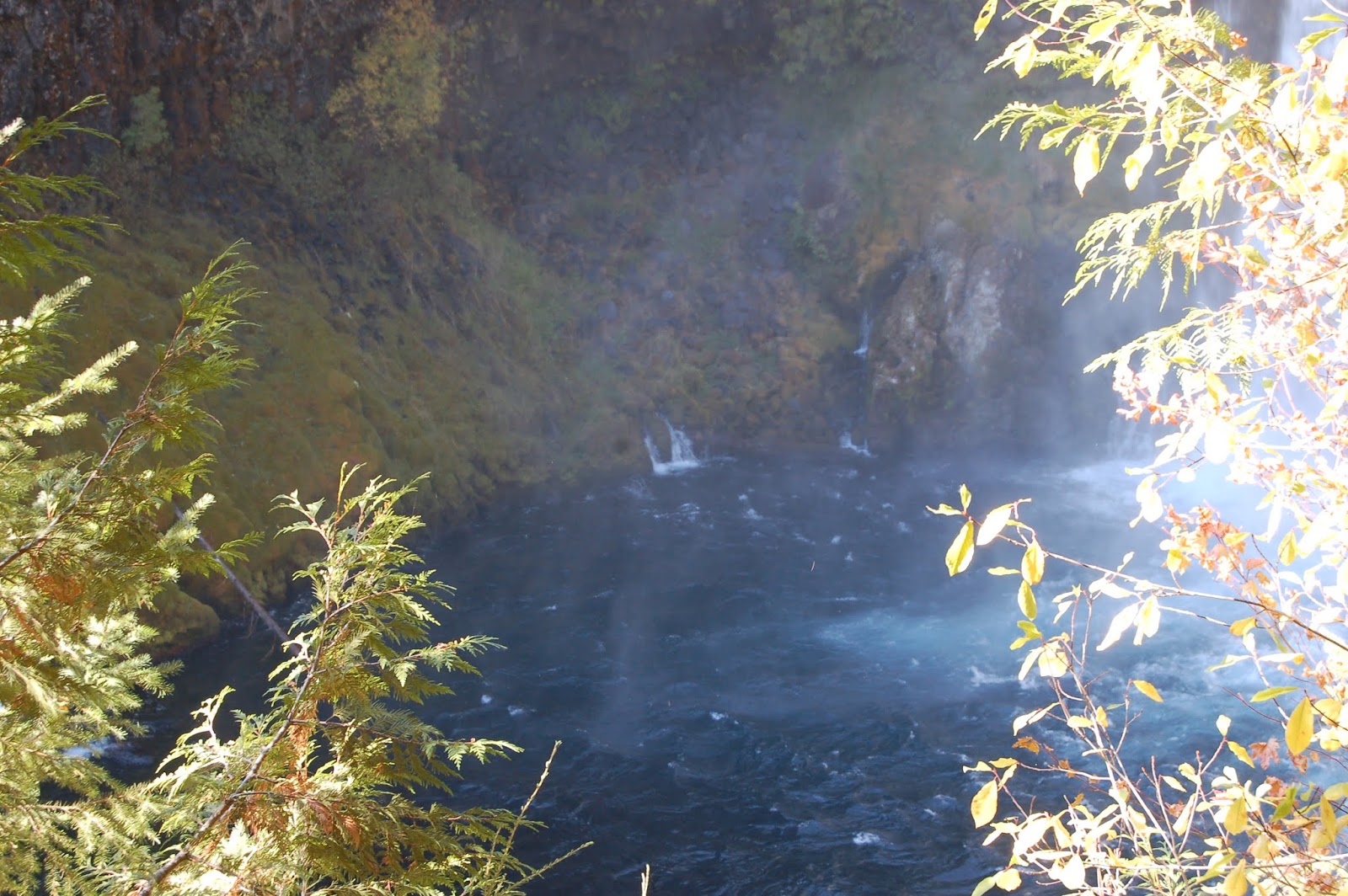
You can also see the brink from a viewpoint there, but you can't really see the falls themselves. The really interesting thing is all the springs coming out of the walls in the lower gorge.
Continue south on 126 to the junction with McKenzie Highway, 242, and turn east (left). This looks like it's about 14 or 15 miles from Koosah Falls. Head east on 242 to Proxy falls, and park in the pullout on the left. There's a nice ~1 mile loop trail to Lower and upper Proxy Falls. The lower falls are quite spectacular.
The upper falls aren't as grand, but they *do* offer a nice analogy for all the weird water goings-on in this area: They originate as springs above the cliff, fall over it, and the plunge pool sinks right back into the ground. I don't think this "stream" even has a name; it's only a few hundred feet long. Incidentally, this lava flow is from Collier Cone, up near the North Sister, and at only 1600 years old, is the youngest lava flow you'll see today.
Continue the loop back to your vehicle, then continue driving east. You're heading up a glacial valley that was incised into the High Cascades during the last ice age, and the road switches back and forth to climb up the headwall of that valley's cirque. It gets... hairy. Take it slow and easy- the road's in good shape, it's just kinda scary. You can see why they don't maintain it for winter travel, though.

When you come out on top of the plateau, the road straightens out, the trees are much more sparse, and the views open up. This is from the edge of the first lava flow you encounter on the roadside after you're up on the plateau.
It may not look like anything special, but this young volcanic landscape is why there are so many springs: hundreds of inches of snow fall up here every winter. When that snow melts, all the water just runs into the ground, then re-emerges as springs along the Upper McKenzie River. The almost entirely spring-fed nature of that section is also why the water quality is so stunningly high. Continue east toward McKenzie Pass. There are several pull-outs on the right, with nice views of the Sisters.

Then comes McKenzie Pass and the Dee Wright Observatory. This spot is an Oregon Gem, but I'm always surprised how few know of it.
The lower story is enclosed, and each of the windows faces toward a particular volcano. The labels under the windows aren't easy to read in some cases. But the upper story is open, and has a compass rose point out many visible peaks. If you have time and interest the trail out onto the flow has quite a few informative signs.

This is more or less the end, but you have a couple of choices here. First, continue east to Sisters, then Head back to Corvallis over 20 and Santiam Pass- more scenic, but longer. Second, you can turn around and head back on 242 to 126, then follow 126 to Eugene/Springfield, then take I-5 back north to 34. Shorter and quicker, but less scenic. Hope this was fun! Below, geologists in their preferred habitat.

Wednesday, November 12, 2014

Philae: "Hey Folks, I Got You a Comet"

At some point, I'll copy over some tweets and retweets from the past couple of hours, but for the time being, science people on Twitter are being like this. And I'm one of them. I'm not sure that anything else will be happening today. Thanks, ESA!


Saturday, June 15, 2013

Accretionary Wedge #57: Seeing Geology Everywhere!

Evelyn is hosting AW # 57, Seeing Geology Everywhere.

I see rocks. They're everywhere, in everything. And most of the time, people don't even know they're rocks.

This is a topic I've brought up more times than I can count at this point. (See "Show Me Your Sidewalk," "Geology is All Around Us!" "Geology at Oregon State University," "AW #52: Geology Dream Course," "The Geo Biz," "We Dohn' Need No Steenkin' Rocks," "98 102 97 88" "Cycles Without End (AW #30)," and, in particular, "A Worldview That Resonates With Me," as a few selected examples.) The question I keep getting stuck on is, "What can I say that I haven't said before?"

The only thing I can think of is to phrase it as a challenge: I defy you to find *anything* in your environment that isn't directly or immediately indirectly (by which I mean only one or two steps of remove) dependent upon, or shaped by, geological resources and processes. The thing is, there really isn't anything that doesn't fit that description. The landscape you live in (or vacation in, for that matter), however modified by human engineering, was created in its basic outlines by water, the solid earth, climate and biological interactions. The computer you're reading this on is a creation of a wide variety of minerals and petrochemicals, painstakingly fabricated, doped with extraordinary precision, and despite its incredible complexity, assembled and sold at a price people can readily afford. Almost everything in your home was delivered by (mainly) steel vehicles propelled by hydrocarbon combustion. It's a rare meal indeed, at least in the developed world, that doesn't have a healthy (or unhealthy) dose of table salt, NaCl, or halite. For the sodium sensitive, you can substitute in a certain amount of KCl, or sylvite. If you get heartburn after a hearty meal, you can take an antacid made of fine-grained calcite, CaCO3, or gibbsite, aluminum hydroxide, Al(OH)3, to neutralize the acid. Then you can relax with a glossy magazine or coffee table book. The reason the pages are glossy is that a mixture of clay minerals has been rolled and compressed into the paper; the tiny clay flakes are flattened parallel to each other, giving the paper the appearance of reflectivity. It's the man-made equivalent of phyllite.

Geology's ubiquity and importance in terms of materials and energy make it among the most economically important of the sciences. The fact that so few people seem to get that is frustrating. I am by no means arguing that everyone should be an expert in geology, but I would argue that nearly everyone would benefit by having a good high school-level, year-long, geology course. What rightly or wrongly is perceived as a recent spate of billion-dollar disasters have been in large part geologically mediated. It doesn't require a college degree to be able to pick out settings that are more or less susceptible to flooding, storm surges, wind damage, landslides, slumps, debris flows/lahars, tsunamis, earthquake damage and so on. In many cases, a minimum of education, rather than waiting for the intonations of experts, could help an intelligent consumer make better choices about places that are more or less safe to live.

And I haven't even touched (here) on the awe and amazement I feel when, with the help of both what I know, and research performed by others, I stand on an outcrop, and gaze clearly into the past, through an abyss that might measure billions of years in duration. I have felt nothing, and I mean absolutely nothing, that makes me feel one with creation, in the way that experience does.

So, yes. I see rocks. They're everywhere. Most people don't even know they're rocks. And from my perspective, that's an enormous loss on their part.

Saturday, May 25, 2013

Happy Towel Day!

Wisdom from Douglas Adams:
“Human beings, who are almost unique in having the ability to learn from the experience of others, are also remarkable for their apparent disinclination to do so.”
“I love deadlines. I love the whooshing noise they make as they go by.”
“The story so far: In the beginning the Universe was created. This has made a lot of people very angry and been widely regarded as a bad move.”
“There is a theory which states that if ever anyone discovers exactly what the Universe is for and why it is here, it will instantly disappear and be replaced by something even more bizarre and inexplicable. There is another theory which states that this has already happened.” 
“The fact that we live at the bottom of a deep gravity well, on the surface of a gas covered planet going around a nuclear fireball 90 million miles away and think this to be normal is obviously some indication of how skewed our perspective tends to be.”
"The major problem—one of the major problems, for there are several—one of the many major problems with governing people is that of whom you get to do it; or rather of who manages to get people to let them do it to them. To summarize: it is a well-known fact that those people who most want to rule people are, ipso facto, those least suited to do it.
To summarize the summary: anyone who is capable of getting themselves made President should on no account be allowed to do the job."
“Isn't it enough to see that a garden is beautiful without having to believe that there are fairies at the bottom of it too?”
“You know," said Arthur, "it's at times like this, when I'm trapped in a Vogon airlock with a man from Betelgeuse, and about to die of asphyxiation in deep space that I really wish I'd listened to what my mother told me when I was young."
"Why, what did she tell you?"
"I don't know, I didn't listen.” 
“If you try and take a cat apart to see how it works, the first thing you have on your hands is a non-working cat.”
“Now it is such a bizarrely improbable coincidence that anything so mind-bogglingly useful could have evolved purely by chance that some thinkers have chosen to see it as the final and clinching proof of the non-existence of God.
The argument goes something like this: "I refuse to prove that I exist,'" says God, "for proof denies faith, and without faith I am nothing."
"But," says Man, "The Babel fish is a dead giveaway, isn't it? It could not have evolved by chance. It proves you exist, and so therefore, by your own arguments, you don't. QED."
"Oh dear," says God, "I hadn't thought of that," and promptly vanishes in a puff of logic.
"Oh, that was easy," says Man, and for an encore goes on to prove that black is white and gets himself killed on the next zebra crossing."
“This planet has - or rather had - a problem, which was this: most of the people living on it were unhappy for pretty much of the time. Many solutions were suggested for this problem, but most of these were largely concerned with the movement of small green pieces of paper, which was odd because on the whole it wasn't the small green pieces of paper that were unhappy.”
“Don't you understand that we need to be childish in order to understand? Only a child sees things with perfect clarity, because it hasn't developed all those filters which prevent us from seeing things that we don't expect to see."
“Don't believe anything you read on the net. Except this. Well, including this, I suppose.”
Happy Towel Day!

Thursday, December 20, 2012

Bring on the Geopocalypse: Accretionary Wedge #53

Bizarro, via Julia Segal's Tumblr

We did get a few intentional submissions, but apparently many were sort of put off by expectation of humor. So I'm going to roll in a bunch of humor from other places, as well as some serious pieces debunking this whole doomsday nonsense- which apparently is de rigueur every few months in our modern society. "Chicken Little" used to be just a silly children's fable- now it appears to be taken seriously by more than a few people. And two or three times a year, my heart breaks, and my credulity strained, as I read about family wealth destroyed, lives ruined- and even ended- because some gullible nitwit believed the wrong hucksters, and paid heed to irresponsible news sources.
Historic LOLs

So let's see. Anne posted a kind of ice-nine scenario of Hell freezing over. "So that got me thinking about what would happen if hell really did freeze over when winter starts. We would be in a winter state all year long because there wouldn't be any ground heat to melt the snow away."

"That is not the action of a fully intact pot"

And Jazinator treats us to a catastrophic tossed salad. "The intense heat from the combination of the impacts and nuclear explosions is expected to cause a fissure along the center of the Earth forcing the Earth to fracture, much like a head of lettuce slammed into a table"
(Image from The Bad Astronomer, Phil Plait)

And mine involves something about broken Higgs Bosons and the earth turning itself inside out. "Now, on the downside, our calculations suggest we will be inundated with something approaching a 340-kilometer deep ocean of molten steel- that's about 210 miles, in English- extinguishing every trace of earth as we know it, not to mention all life on the planet. On the plus side, though, the initial migration of the molten core toward the surface will be even more effective at freeing up 'tight' shale oil and gas than current 'frakking' technology."
 (Image from The Bad Astronomer, Phil Plait)

Finally, and a bit belatedly, Hollis chimes in with a scenario that any card-carrying hippie would find groovy and really far-out, man: "After just a few days, Yellowstone will emit a gargantuan burp of euphoria-inducing gas.  We will all happily swoon and then be peacefully frozen stiff with the onset of a prolonged very cold and very dark volcanic winter.  In other words, I’m an optimistic person."
 (in reference to this)
Now, Phil Plait (linked three times above, to two different posts) and Erik Klemetti, source of the two tweets above, have been doing superb, if exasperated, work in debunking this nonsense. The bits from those two that I would consider their centerpieces are, from Phil, here, and from Eric, here. If you need convincing that this nonsense is, in fact, nonsense, these are very highly recommended.
Narcolepsy Inc.

In a related vein, Dana Hunter has an excellent bit that gets at a central problem in a tangential sort of way, though she starts off pounding the nail squarely on the head:
Please sit down. I have some news to break. It may be very difficult to hear, and it may shake your innocence and trust. But I need you to know the truth.
Are you ready? Have you braced yourself? Okay, let’s have it: sometimes, the media is really terrible at science reporting.
I’m so sorry. But it gets worse: sometimes, they tell you things that really aren’t true at all.
Some people will die because of these rumours, and we are trying our best to stop them.

A particularly depressing- though outstandingly important- site is here. Yes, I rely on humor to combat sadness, and I know for a fact some people think I (at least on occasion) go too far, too soon. I understand, and I'm sympathetic, but believe me when I say you'd like my potential other behaviors less. However, I've spent a lot of time with and around youngsters, and their well-being is always on my mind. I'm much more conservative in language and behavior around them. Scaring a 2nd grader into life-threatening depression is not okay. Got that?
Bits and Pieces

The fact is, there are too many unscrupulous people who wouldn't hesitate to take advantage of fear- however unwarranted- to make an easy buck. And that's especially true in the US, where, apparently, we value money and its acquisition over all else... and I do mean all.
As Callan at Mountain Beltway commented, "Why does our civilization keep believing in these stupid ideas? There are plenty of real things that could disrupt or end a civilization." Well put. There are indeed plenty of things rational minds should fear. Doomsday apocalypse scenarios, whether based on Mayan Calenders, astrology, Biblical "revelations," or any other source, are not among them. On Circulation also recently posted a run-down of potential catastrophes, with a discussion of why none of them constitute the "end of the world."
It's Funny to Me

Which is why articles like this, and the people whose work is to confront such things firmly and decisively, are so important.
La Figa

The fact is, for the foreseeable future, every living entity on earth is going to die eventually. I personally have little fear or problem with accepting that. The fact of my death means there will be resources for someone else, perhaps- I hope- someone better than me. That's why many choose to have children. That's why we struggle to make things better for those around us, despite knowing that, in the end, it's meaningless to us personally. Endings are sad things, yes. But as a wise man once said, "hope springs eternal."

And as moms have said, since, I guess, about forever, "Stop it. You're scaring the children."

Followup

Friday, October 5, 2012

OMN Willamette Valley Geology Presentation Part Five: Silver Falls

This is the final portion of the spoken presentation that I gave about three weeks ago for the Oregon Master Naturalist Program at Silver Falls State Park, east of Salem, Oregon. There was another planned portion, on non-tectonic geologic hazards- I had intended to focus mainly on mass movement, with some mentions of flooding, though I don't have any good photos or images of the latter. However, due to some issues with logistics, time became an issue, and we dropped that segment. I will cover it in much the same way as with this and the previous four segments. I should also do a quick and dirty summary of Bob Lillie's portion, on plate tectonics and the tectonic setting of the Willamette Valley. In addition, I had about 30 rock samples to illustrate typical kinds of geologic material one might find in and around our area. I don't have photos, yet, but I may get up the gumption to take some shots, and I've kept the sheets I placed the samples upon, with names and notes for each, so it shouldn't be too much trouble to transcribe those.

We had anticipated walking down the path to North Falls, which definitely has the most diverse and interesting geology in the park, but the smallish parking area there was almost completely full. While we had anticipated problems with everyone driving, and had arranged ahead of time for participants to pool into a minimum number of cars, we still had about 7 vehicles, and when we arrived, there was one parking spot available. So we regrouped at a nearby parking area with an overlook, and decided to bag North Falls. Parking at South Falls is much more extensive, so we headed there. We had planned on visiting the CCC building, with its marvelous fossils anyway, and while the geology exposed at South Falls isn't as in-your-face, we figured it would suffice... and it turned out better than we'd planned, for reasons I'll get to presently.

I'm also going to submit this as my entry for this month's Accretionary Wedge, hosted by Evelyn of Georneys, Fun Field Camp/Trip Moments, because this did indeed end up being a lot of fun.
 Bob Lille and his wife, on the scouting trip a couple weeks before our presentation, approaching North Falls. Silver Falls isn't exactly unique, but perhaps a bit unusual, in that there are a number of falls you can see from underneath and behind. The trails "cross' their respective streams not by going over, but under.
One thing I've particularly noticed about these photos is how difficult it is to appreciate the scale here; this alcove is simply huge! In the photo above, note the dark horizontal band of sediment...
...and again here, with some people for scale. The rock layers aren't terribly distinct, but the underlying resistant layer is Columbia River Basalt (CRB) of the Grande Ronde series, as is the upper shelf-forming layer. In between is a layer of stream-carried sediment. I had been under the impression this was marine- from when the Willamette Valley was a shallow embayment- but other sources say this was terrestrial, and that actually fits better with what you can see first hand.
Another shot showing the sheer scale of this overhang.
Light scratches are graffitti, dark lines are cross bedding in the sedimentary layer. The sediment, particularly the upper portions, have been somewhat cooked and hardened by contact metamorphism.
Looking up at the overlying basalt, there are numerous tree casts; we're standing in the root zone, looking up into where a pair of trees were swamped by a flood of basalt. Had this been a marine environment, there wouldn't have been trees growing here.
Looking out toward North Falls and down the gorge.
Almost out on the other side of the alcove.
And looking back at where we've been. The height of this waterfall is 136 feet, 23 times my height of 70 inches.
On our scouting trip, we walked the loop from North Falls, down stream to Winter Falls- so called because it merely drips during dry months- climbed out of the canyon there, then followed the rim trail back to the North Falls parking area.
Durning Dana's visit in March, the North Falls trail was closed due to snow and ice, so we spent more of our time at South Falls. For the OMN workshop, I told the participants that the sediment layer was clear at North Falls, but I hadn't looked carefully enough here to be certain whether there was a similar weak sediment layer responsible for the shelf, or if it was maybe a paleosol instead. Bob suggested that they look carefully to see if they could find evidence for one or the other. Sediment ought to be clearly layered, while a palesol ought to be more massive- perhaps with evidence of preserved roots. But the upshot is that we were quite up front and honest about what we didn't know, and gave the learners a chance to figure it out for themselves.
As you can see from the previous two pictures, much of the exposure is covered with lichen and moss, so finding clues consists in large part of gently pushing aside enough of the botany to see the weathered, crumbly geology underneath. But the students were successful, and we managed to find several spots where the weak horizon showed clear sedimentary layering. So the interflow sedimentation here is not as pronounced as at North Falls, but it clearly is a sedimentary interval, not just a weathering interval.
I also wanted to show the participants some of the other scenes in the park that we wouldn't have time to visit during the workshop, so above is Lower South Falls, a bit more than a mile below Upper South Falls, from the visit with Dana in March. Flow rates were much, much lower in mid-September.
 And this is Upper North Falls, about a half mile upstream from the North Falls parking area.
North Falls from the rim overlook in March. The wind wasn't too stiff, but from the cloud condensation, you should be able to infer it was from the left (west), moving to the right. I'll get back to this in a bit...
I think this may be from the chimney on the backside of the gift shop at South Falls, the other building at Silver Falls that used this fossiliferous siltstone/sandstone from the rock quarried by the CCC (Civilian Conservation Corps) in the 1930s
But the fossils are more abundant and more diverse in the CCC building itself- the above looks like a nice assemblage of filter feeders: clams and razor clams.
A view of the building.
 Fossils with lens cap, 52 mm diameter, for scale.
And another, zoomed in on the same spot. There are four major distinct rock groups in the park; the lowermost is this fossiliferous sediment. Next oldest is CRB flows of the Grande Ronde group, and interbedded with those is the stream sediment so nicely exposed at North Falls, and above that are some tuffs from Cascades volcanism. We found that examples of the three other than the interbedded stream sediment are used either in or very close to the CCC building, making that location a very good spot to summarize the overall geologic history of the area.
 A block of the tuff, used as a landscaping stone, near the South Falls parking area.
I concluded this portion of the workshop by mentioning that even if you know nothing about the rocks, even if you know nothing about what types are around, or what processes formed them and put them where they are, the simple fact of two enormous piles of them in parallel north-south ridges have a profound effect on us here in western Oregon. The town where I live gets about 42 inches of rain on average per year. If I traveled up to the Coast Range Crest, that number can get as high as 160 to 200 inches per year. Maximum annual rainfall in the Cascades doesn't get quite as high, but can still go over 150 inches per year. Those extreme differences are due to rapid elevation changes- that is, rocks. These variations in rainfall create huge differences in vegetation. Even after more than 30 years in this area, I still find myself gasping at our rich, luxurious vegetation, especially at the epiphytes, as shown by the moss growing on the maple above.
And all animal life ultimately depends on the plants they live upon and around, which in turn depend on rocks for nutrients and as a substrate. Geology is a sadly ignored discipline, often treated as a remedial subject for those too "dumb" to "get" "real" science, or, at the other end of the absurd preconceptions spectrum, as hopelessly nitpicky: "Why so many different names and terms? I mean they're just rocks! How much detail can there be?"
But the fact is, if you love forests and plants and wildlife, you can thank the rocks that underpin it all.