Showing posts with label Economy. Show all posts

Monday, November 3, 2014

Geo 730: November 3, Day 672: Rooted in Geology

The factor that drew settlers to Oregon was its rich farmland, but the factor that shaped the first incorporated city west of the Rocky Mountains was geology. Skipping inland and north from the previous post, we find... Yes! More basalt. Specifically, more Columbia River Basalt. Here it forms a resistant lip over which the Willamette River pours, creating the largest waterfall by volume in the Pacific Northwest (see note). That sort of hydraulic head is a wonderful source of cheap power- early on, mechanical, later, as you can see from the sign, electrical.

Note: Celilo Falls, in the Columbia River Gorge, was the most voluminous in the PNW, and it certainly deserves the title, but it was inundated by the construction of the Dalles Dam. I'm very sorry to have missed it. Among other interesting trivia, "Celilo was the oldest continuously inhabited community on the North American continent until 1957..."

Photo unmodified. October 10, 2012. FlashEarth Location.

Wednesday, February 5, 2014

Geo 730: Feb. 5, Day 401: Wave Goodbye

Actually, I was probably trying to block the glare from the sun as I peered up at the open pits shown in yesterday's photo, judging from the apparent direction of my gaze. This is an interesting spot, unique in the US, which is probably little-known, and certainly not well remembered. While visitors can't get a very good sense of the now-defunct nickle mine, they can find the occasional souvenir from that operation in the form of a pretty green nickle mineraloid. And the peridotite is as nice and fresh as any I've seen anywhere, including labs. It's a quick and easy stop off I-5 in southern Oregon, and I recommend it.

Photo by Dana Hunter, unmodified. May 9, 2013. FlashEarth Location.

Tuesday, February 4, 2014

Geo 730: Feb. 4, Day 400: Open Pit

Looking up Nickle Mountain from the entry area to what is now the Green Diamond operation, you can see one of the enormous trenches where the garnierite nickle ore was excavated. As is the case with many mines, the Hanna Nickle Mine had its own unique engineering problems. In this case, the mountain is so steep that getting the ore down safely was difficult. This problem was overcome by building a tram to carry it down the mountainside. Generators converted the energy of descent into electricity that supplemented the smelting process. (This information comes from a Flickr photo set I browsed through a couple days ago, but I can't get it to load right now... perhaps the site is having problems. I'll try to link the set later.) Follow up: The photo set is here, but doesn't mention the power generation aspect of the tram. Not sure where I got that tidbit, or if it should be considered accurate.

Photo by Dana Hunter, unmodified. May 9, 2013. FlashEarth Location.

Monday, February 3, 2014

Geo 730: Feb. 3, Day 399: Garnierite

The greenish splotches are the nickle mineraloid, garnierite. Samples aren't trivial to find- that is, expect to spend some time looking and "getting an eye" for them, but neither are they terribly difficult to find. My main problem is that I don't see greens (or reds) very well, though in this case, the bright sunshine helped. And I was able to pick out bits that looked like the right texture and luster, and as if they *might* be green, and tote them over to Dana to get her opinion. That way, she began to be able to find bits on her own.

This is by no means an important or "should be known" geological resource, but it's rare, an oddball with an interesting story. And that goes a long way with me.

Photo unmodified. May 9, 2013. FlashEarth Location.

Saturday, February 1, 2014

Geo 730: Feb. 1, Day 397: Green Diamond

Despite yesterday's jokey title, "Prospecting Lot," I'd like to make a point very clearly: this is private property. As I mentioned in that post, I've stopped here several times now, and no one has made an issue of it. But industrial rock companies/mines such as this are quite rightfully worried about liabilities with respect to people who do dumb things on their property. You'll notice beyond the sign, there's a security checkpoint. I have not pestered those folks, just pulled out in the flat area closest to the main road, and picked around in the spoil piles for a while, then left. Certainly, if someone approached and asked what I was up to, I could give a true and well-spoken explanation of why I find this spot of interest, but if they asked  me to leave, I would do so without a fuss. Visiting sites like this is a privilege, not a right. I do think if I was planning on visiting this site with a group I might use the contact information above to get an ahead-of-time okay. Who knows? They might actually like to show off their work to a bunch of aspiring geologists- though I make no promises.

I should point out that operations like this, supplying sand and other aggregate, are largely off of geologists' radar in terms of geologic resources: we tend to think of fossil fuels and metals. However, the net expenditures on "mundane" resources such as this probably approach those of everything else combined. By their nature, bulk resources like aggregate tend to be localized: they aren't amenable to transport over large distances. Thus they tend to be dispersed in smaller businesses in smaller markets. There will never be an "Exxon" of sand and gravel, but that doesn't mean that these innumerable smaller businesses are insignificant or unimportant. They're just smaller and don't pick at the consciousness in the way larger companies do.

I was browsing around yesterday, and found an interesting article on the resource being acquired here: apparently, Green Diamond is processing the Hanna Nickle Mine's slag- waste from smelting- into commercial sand products. I find great satisfaction in the idea that one operation's garbage has become another's bread and butter.

Photo unmodified. May 9, 2013. FlashEarth Location. Indexed.

Followup: I've been meaning to mention for a couple days, Ron Schott has updated the Geo 365 Map with this years' posts- up through yesterday (at 2 PM PST).

Friday, January 31, 2014

Geo 730: Jan. 31, Day 396: Prospecting Lot

A pair of stitched photos showing the parking area at the former Hanna Nickle Mine west of Riddle, Oregon. To the far left, that pile of rocks is worthwhile picking through for two reasons. The eye-opener on this trip, for me, was realizing how exemplary and fresh the peridotite was. I've also stopped here briefly a couple times (in addition to the formal field trip/tour with Cy Fields, in about 1986) and have been able to reliably find little fragments of the ore "mineral." The reason for the quotes is that garnierite is a mish-mash of other minerals and amorphous solids. It has some fairly consistent physical properties- notably its green color- but its composition is not defined; it's not a true mineral.

Photo unmodified. May 9, 2013. FlashEarth Location. Indexed.

Thursday, January 30, 2014

Geo 730: Jan. 30, Day 395: Riddle Me This...

We're at the base of Nickle Mountain, west of Riddle, Oregon in this photo. The lens cap (52 mm) is resting on a block of fresh, unaltered peridotite, and the lighter rock to the upper left is probably mostly silica/quartz.

The Hanna Nickle Mine, closed in 1987, is an oddball. The short and sweet description that will be easy to understand for geologists is that it's a nickle-rich laterite. However, I imagine that's completely opaque to most people, so a longer-winded explanation is in order. The bedrock here is Josephine Ophiolite peridotite, composed mostly of olivine and pyroxene. The general formula for olivine is (Fe,Mg)2SiO4. That means that any proportion of Fe to Mg can exist along that continuum, from 100% of one to 100% of the other. Now, what that general formula doesn't tell you is that other metals can substitute in for either the Fe or Mg, generally in small amounts, but up to maybe 5 or 6 percent of the total, which is exactly what happened with nickle here.

Millions of years ago (I don't know if a date was ever assigned with any confidence), a deep bedrock slump took place on this mountain, creating a depression near its summit, and a slump plane (technically, a shallow fault) that allowed internal drainage. So weathering took place as usual, but "erosion" occurred only by complete solution; no clastic material was transported off the area.

We tend to think of silica/quartz as insoluble at ambient surface conditions, but of course, everything is soluble to some degree. And there are a number of metal oxides that are even less soluble than that of silicon. Among them are aluminum, iron and... nickle! (As an aside, cobalt is another one these highly insoluble oxides; I was involved for a period of time in assessing the feasibility of a cobalt laterite prospect.) As I've mentioned before There's precious little alumina in peridotite, which is why weathering it does not produce clay minerals. However, there's plenty of iron oxides, and after dissolution of silica and magnesium oxides, a commercially attractive concentration of nickle oxides as well. Deposits such as this, where the bulk of the initial rock composition has been removed by solution, leaving behind only the most insoluble components, are referred to as laterites. The most commonly mined laterites are, in fact, bauxites, or aluminum ore. In this case, as I recall, the smelting process resulted in a pair of mutually immiscible mattes, one iron rich, the other nickle rich. The two were separated, and sent elsewhere for further refining.

For many years, the nickle mine at Riddle was the only one operating in the lower 48. I've never been certain whether there are or were any operating in Alaska. In the years prior to its closure, I know the company was looking at importing a similar ore, I think from New Caledonia. At the time, I thought the idea of transporting bulk ore across the Pacific, and inland across the Klamaths, for the initial smelting and refinement, didn't make much sense. Apparently I was correct in that assessment.

By the way: the greenish splotches on the lighter rock? That's the nickle ore: garnierite.

Photo unmodified. May 9, 2013. FlashEarth Location. Indexed.

Thursday, November 21, 2013

Geo 365: Nov. 21, Day 325: Port Orford's "Port"

The "port" at Port Orford consists of a high dock, with a pair of cranes to physically lift boats out of the water. It appears that there are a pair of boats queued up for their turn, but despite waiting in the chilly wind for some time, we didn't actually get to see the feat accomplished. At a certain point, despite sheltering behind a concrete wall/windbreak, it was just too frigid to wait any longer.

This is certainly an odd situation, and it's related (unsurprisingly, if you know me) to the geological setting of this area. The coast side of the Coast Range and Klamath Mountains get tremendous amounts of rain, so coastal streams and rivers tend to be common and closely spaced, with a significant river every 30 miles or so as one travels north or south. As a result, the drowned estuaries of these drainages make for excellent ports. The typical range for a fishing boat is 30 miles in a day- as much as 15 miles out and 15 miles back to port. But in this area, there isn't a large river and natural port. Bandon to Gold Beach, Oregon, is about 55 miles. This means without an "artificial" port such as this one at Port Orford, a fairly large segment of our rich coastal fishing would be inaccessible. Given that reality, the construction of this dock in a relatively sheltered cove makes good sense.

Photo unmodified. May 7, 2013. FlashEarth location.

Saturday, June 15, 2013

Accretionary Wedge #57: Seeing Geology Everywhere!

Evelyn is hosting AW # 57, Seeing Geology Everywhere.

I see rocks. They're everywhere, in everything. And most of the time, people don't even know they're rocks.

This is a topic I've brought up more times than I can count at this point. (See "Show Me Your Sidewalk," "Geology is All Around Us!" "Geology at Oregon State University," "AW #52: Geology Dream Course," "The Geo Biz," "We Dohn' Need No Steenkin' Rocks," "98 102 97 88" "Cycles Without End (AW #30)," and, in particular, "A Worldview That Resonates With Me," as a few selected examples.) The question I keep getting stuck on is, "What can I say that I haven't said before?"

The only thing I can think of is to phrase it as a challenge: I defy you to find *anything* in your environment that isn't directly or immediately indirectly (by which I mean only one or two steps of remove) dependent upon, or shaped by, geological resources and processes. The thing is, there really isn't anything that doesn't fit that description. The landscape you live in (or vacation in, for that matter), however modified by human engineering, was created in its basic outlines by water, the solid earth, climate and biological interactions. The computer you're reading this on is a creation of a wide variety of minerals and petrochemicals, painstakingly fabricated, doped with extraordinary precision, and despite its incredible complexity, assembled and sold at a price people can readily afford. Almost everything in your home was delivered by (mainly) steel vehicles propelled by hydrocarbon combustion. It's a rare meal indeed, at least in the developed world, that doesn't have a healthy (or unhealthy) dose of table salt, NaCl, or halite. For the sodium sensitive, you can substitute in a certain amount of KCl, or sylvite. If you get heartburn after a hearty meal, you can take an antacid made of fine-grained calcite, CaCO3, or gibbsite, aluminum hydroxide, Al(OH)3, to neutralize the acid. Then you can relax with a glossy magazine or coffee table book. The reason the pages are glossy is that a mixture of clay minerals has been rolled and compressed into the paper; the tiny clay flakes are flattened parallel to each other, giving the paper the appearance of reflectivity. It's the man-made equivalent of phyllite.

Geology's ubiquity and importance in terms of materials and energy make it among the most economically important of the sciences. The fact that so few people seem to get that is frustrating. I am by no means arguing that everyone should be an expert in geology, but I would argue that nearly everyone would benefit by having a good high school-level, year-long, geology course. What rightly or wrongly is perceived as a recent spate of billion-dollar disasters have been in large part geologically mediated. It doesn't require a college degree to be able to pick out settings that are more or less susceptible to flooding, storm surges, wind damage, landslides, slumps, debris flows/lahars, tsunamis, earthquake damage and so on. In many cases, a minimum of education, rather than waiting for the intonations of experts, could help an intelligent consumer make better choices about places that are more or less safe to live.

And I haven't even touched (here) on the awe and amazement I feel when, with the help of both what I know, and research performed by others, I stand on an outcrop, and gaze clearly into the past, through an abyss that might measure billions of years in duration. I have felt nothing, and I mean absolutely nothing, that makes me feel one with creation, in the way that experience does.

So, yes. I see rocks. They're everywhere. Most people don't even know they're rocks. And from my perspective, that's an enormous loss on their part.

Thursday, May 9, 2013

Geo 365: May 10, Day 130: May 9 Teasers

Soda straws in Oregon Caves National Monument, early in the on-trail tour. (They now have an off-trail tour, which looks like it is an add on to, and near doubling of the length of, the other one) I like how this photo caught the droplets of water hanging on the ends.
Paradise Lost, near the end of the cave tour.
Dana highlights a recumbent fold on the road between the parking area and the park offices at OCNM. We managed to arrive here a bit before 10 AM, when registration began for the tours, and got onto the first tour at 10:45. The tour was to last 90 minutes, but may well have gone on a bit longer, due to questions and comments from Dana and I. So by the time we got back to the car (see above for one of several distractions along the way) it was well past 1 PM.

BTW, if you're ever passing through Cave Junction- not even, necessarily, on your way to OCNM- and you're not a strict vegetarian, Taylor's Sausage and Country Store has some of the finest and most reasonably priced lunches you could ever hope to find. I've eaten there the last two days, and can't say how jealous I am of that tiny little community.
Finally, the green patches are garnierite, which Dana was able to find in modest quantities near the entrance to the decommissioned mine at Riddle, Oregon. I'm somewhat red-green colorblind, and was having a devil of a time, though I could find enough likely samples that I could take them to her and ask, "Is this green?" and get her started to recognize the material (like bauxite, not a true mineral). There is also very abundant, lightly weathered and mostly untectonized peridotite here, which was a kick for me. The only times I've visited before, I've been focused on the ore, and paid no attention to the surrounding ultramafics. Incidentally, this is the NNE extension of the same Josephine Ophiolite in and on which we spent the bulk of the day yesterday.

Photos unmodified. May 9, 2013. Locations will be specified when I post on these spots in more detail.

Wednesday, November 28, 2012

AW #52: Geology Dream Course

Note: This wedge has now been accreted at Agile Geoscience.

For Accretionary Wedge number 52, Shawn asks us to expound on a dream course in geology. I'll start by pointing out I've already taken quite a few courses that were ever so much more exciting and engaging than I could have imagined they might be. One that comes to mind is "The Tectonic Evolution of Western North America," by Bob Yeats, which was both far more complex and far more fascinating than I had any inkling it might be. And the Petrography/Petrology Sequence by Harold "Sharkey" Enlows... perhaps the best indicator for that one is that we were expected to spend 6 hours of scheduled lab time per week on that one, and I regularly spent 12 or more hours, just so I could see and learn more. It seems selfish to ask for other courses I might take.

One option offered is to design a course we might like to teach. I'd been contemplating sitting this one out, but a confluence of factors has forced me to choose otherwise. First, most geology people love their subject, and I'm no exception. Second, as I've said before, first and foremost, I consider myself to be a teacher. I can't help it. If geology comes up in conversation, I'm going into teaching mode. Internally, the discussion goes, "What do they know? What do they want to know? How do I get them there? What is the minimum of new information I need to bring up to accomplish that?" Then off I go. Third, another point I've made repeatedly is that I'm often appalled at the lack of regard and respect for the earth sciences, especially given our dependence on both the planet's resources and comparative peacefulness, even as we deplete the first and disturb the second. Finally, and I don't know that I've mentioned this, the main work I've actually done in science education involves curriculum design and evaluation. I don't bring it up much, even in face-to-face conversation, because I find it extremely tedious. It also happens to be in high demand, but people don't want to pay for the background, effort and patience it takes to do it right- much like the rest of education.

So it seems obvious I should come up with a course that helps address my concerns in point three, while enjoying aspects of points one and two, and taking advantage of my skills in point four. What I've come up with is a class with the working title, "Earth Systems and Society." As an overview, it would provide a minimal background with respect to geology and other earth sciences- notably oceanography and meteorology; it's focus, as the title indicates, is really more on the interactions of earth's systems and the human population those systems support.

I've spent enough time on this that, while the outline is more telegraphic than I might like, I think it's fairly clear what I might do with a class like this. This is by no means developed to the degree I would normally expect, but I do think it works as an outline.

Prerequisites: {What I consider to be a basic high school math education:] Algebra I and II, geometry and trigonometry. Basic skills in written English and expository and persuasive communication.

My philosopical positions/assumptions:
  • Western culture generally, and US culture particularly, does not grasp the intimacy and necessity of human interaction with earth systems, let alone the complexity and feedbacks that can make those relationships profoundly difficult to grasp in their entirety.
  • This is particularity true of people in non-science disciplines.
  • Too few people are well-educated in science to substantively shape national and international debates on issues that not only affect all of humanity, but in fact make the medium to long term survival of Homo sapiens a question of real concern.
  • Despite the overall complexity of interactions between Earth systems and society, individual components are intuitive and easily grasped. The difficulty lies in trying to plausibly project the outcome of simple processes and actions interacting with innumerable other processes and actions.
  • Science does not reach social decisions, but informs them. Thus other social skills- including communication, argumentation, processes of political valuation, along with the values of disparate interest groups and individuals- are of great importance in applying and using scientific results
  • To address the problems outlined in the above points, I propose a class focusing on 1) Simple facts regarding earth systems and processes, 2) opportunities to think about and practice projecting how different processes can and do interact to create outcomes that might not necessarily be intuitive, but nevertheless can be foreseen.
To assure the broad goals of this class are addressed and achieved, the following approaches will be important:
  • Start with broad frameworks and the most familiar aspects of earth processes.
  • Move into less familiar processes, but still focus on broad frameworks.
  • Work toward more specificity in various earth system/resource knowledge as term proceeds, while at the same time frequently tying new knowledge back to broad frameworks.
  • Revisit earlier topics frequently and explicitly, to illustrate interactions, reiterations.
  • Expect students to be able to use basic algebraic skills; simple mathematics will play an important role in homework. Students should be able to work with scientific notation.
  • Expect students to show competence with written English.
  • Ramp up critical thinking, evaluation and critical skills expectations as course proceeds, with extensive feedback to written assignments ahead of two major written works, along with at least one required review of each draft of latter, and other reviews as requested by students.
  • Given my background, the solid earth will ground the course [heh], and other component systems will be related to that foundation. However, those based in other science disciplines should have no problem approaching this from another basis, for example bio-science, oceanography or atmospheric science.
  • Above all, keep it exciting. There is much that can be frightening in this topic, but always balance potential scares with potential solutions, alternatives and adaptations.
General Outcomes: Students will be able to
  • Review and analyze environmental risks of a small (>50 km sq, about the area of a medium-sized town) area of their choosing, using historical media reports, skills and knowledge developed in class, along with information from relevant local to national level government agencies. Other source materials should be cleared with instructor. (This will be the final project, and I want to avoid asking S's to go to primary literature.)
  • Recall fundamental terminology and concepts accurately, and use it appropriately in context.
  • Give multiple examples of the concept of opportunity cost, and explain factors that can lead to forgoing more valuable opportunities for less valuable opportunities in terms of earth resources.
  • List ways to increase preparedness, and decrease risks of injury and mortality, with respect to a number of different natural hazards (e.g. floods, earthquakes, tidal surges, tsunamis, lahars, volcanic hazards, etc.)
  • For selected hazards, describe methods of avoidance (e.g. floods, tidal surges, tsunamis, lahars, etc.)
  • Given examples of common household items, describe earth resources used in the production of each.
  • Describe current thought regarding global climate change. This is not intended to be ideological, and I don't care whether you "Believe in it." Even if you don't, you should be able to explain accurately why others do, and in general terms, what their predictions are.
  • Describe feedbacks that could worsen or moderate climate change.
  • List and explain examples of resources whose availability may potentially be affected- for better or worse- by climate change.
  • Keep a log (or blog, preferably) of media stories about earth resources, hazards, processes, and other stories relevant to the content of this class. Include comments, which should note strengths and weaknesses of the story, "flashing lights," that is, evidence that the story should treated with caution or skepticism, and thoughts of how the topic covered in this story relates to other topics relevant to this class.
  • Given hypothetical situations (or generalized portrayals of real situations), create an argument to support one of two or more options. The point here is not to have the "right answer," but to muster pertinent information to argue for one choice from what might be a number of options. As an example, Federal, state and local governments heavily subsidize rebuilding after floods and coastal storms. This encourages people to rebuild/use resources in areas that have in the immediate past been proven vulnerable. Potential options for this problem include 1) The system works as it is, albeit with weaknesses. Don't change anything. 2)a] Require those in vulnerable areas to purchase government-subsidized insurance; 2)b] Require insurance coverage that reflects the best assessment of real risk; 2)c] Require insurance that is overpriced with respect to real risk, thus discouraging development in vulnerable areas. 3)a] Prohibit rebuilding in areas that have been proven by experience to be high risk for calamitous disasters; 3)b] Prohibit rebuilding in areas that have been proven by experience to be high risk for calamitous disasters, with exceptions on a case-by-case basis [e.g, sites of historic importance]. 4) Some combination or variation of the above possibilities, or [an]other[s], suggested by student.
  • An important component of the course will be a summary and conclusions essay. This should be about 3 pages long, and discuss the following: 1) What topics regarding resources, risks, and earth systems should be addressed by your state and/or local government in the near future? 2) In what ways do you think this course may affect your thinking and future decision-making with respect to natural and man-exacerbated risks and hazards, and consumption of resources? 3) What topics in this course did you find of particular relevance or interest? 4) What aspects of this course were less interesting or less relevant? 5) Overall, how would you rate this course? As with the previous point, I'm not looking for any particular answer, but rather your choices regarding the pertinent information you bring to bear and the coherence with which you frame your answer. I'm thick skinned, so don't be afraid to be critical where it's warranted. I suggest you start keeping notes in whatever format is convenient and effective for yourself from early in the term.
[I've spent my career and entire college student-hood in a quarter system- my feeling is that this might be too much for what I think of as a ten-week term, but it might work better in a semester system. Nevertheless as an outline, here's a general overview of what I'd like to tackle. Each bullet represents a lecture & discussion- format class period, with the exception of assignments due at the ends of weeks 8 and 9.]

Week 1
  • Intro, rationale, overview/outline, "deep time" and intro to surface processes
  • Fluvial processes
  • Mass Movement
Week 2
  • Internal processes: plate tectonics and the big picture. Global outline of active areas
  • Seismicity
  • Volcanism. Focus on North American tectonics.
Week 3
  • Integrating surface and internal processes: the consequences of an active planet
  • Exam
  • Geosphere-atmosphere interactions
Week 4
  • Geosphere-hydrosphere interactions
  • Interactions [of previous 3] with the biosphere- elemental cycling
  • The centrality of life in creating earth as we know it today: the importance of microbes and "The age of bacteria."
Week 5
  • Living on a limited planet: risks, hard walls, options, and choices
  • A delicate balance: to use or not to use.
  • It's complicated. Land and resource use versus natural, man-made, and man-exacerbated hazards
Week 6
  • Exam
  • Stuff we take for granted I: energy resources
  • Stuff we take for granted II: metallic resources
Week 7
  • Stuff we take for granted III: industrial and construction resources
  • Stuff we take for granted IV: water and land
  • Stuff we take for granted V: an unchanging planet [climate and other large-scale environmental change]
Week 8
  • Site-specific risks: thinking about risks from floods and mass movement. [do so before land purchases!]
  • Site-specific risks: thinking about risks from seismicity and volcanism. [and special associated mass movement risks]
  • Site-specific risks: atmospheric phenomena and erosion
  • Final project due
Week 9
  • A culture blind to earth systems
  • How to talk to others: dos and don'ts
  • Reasons for optimism: it's too easy to be fatalistic. Life is and has always been a puzzle with lives at risk.
  • Summary and Conclusions essay due
Week 10
  • Study session, Q&A
  • Final Exam
Now, in honesty, I don't have the stamina to teach anymore- I get tired too quickly, and apathy can shut me down without warning. Even if I was offered a generous salary to teach something like this, I would be hesitant to accept it. I'm very reluctant to take a job I'm not certain I can complete. But the fact is, I think this would be a very good experience for non-science folks: enough science to be a valid science "credit," but at the same time, drawing in aspects of life most people wouldn't think of as "hard science." Geo-types get exposed to this kind of uncertainty and ambiguity over and over again throughout their education and career. The thing that I'm curious about is can a similar education be condensed into a one-term class for non-science folks?

Thursday, May 31, 2012

AW #46: Geology, Life and Civilization- Chaotic Feedback

Cat at Knowledge Flocs is hosting this month's Accretionary Wedge with a topic that looks relatively simple and straightforward, unless it's a topic you've spent some serious time contemplating, as I have. To wit: "How has life or civilisation been affected by geology or how has geology been affected by life?" With the provision that I'm going to change the last "or" to "and," here are some conclusions I've come to over the years, with a prefatory tangent.

The concept of "chaos," as it was developed during the late 70's and early 80's, and coming to public attention particularly in the late 80's, is at once fairly simple and straight-forward, but at the same time, I think, widely misunderstood. The important idea is that arbitrarily small differences in starting conditions of a particular system can lead to arbitrarily large differences in outcomes given enough time or iterations of the equations that describe said system. The iconic images illustrative of the concept, those of the Mandelbrot set, are the result of iterating a single simple equation (albeit one using complex numbers) to determine which starting conditions do not result in tending toward infinity after approaching infinite reiterations. Even very simple systems can exhibit chaotic behaviors, such as one of the ones first recognized as such, the Lorenz attractor. Note that while this is described as "a system of three ordinary differential equations," it isn't necessary to think of them as differential equations; one could consider them as a set of iterated steps:
  • Using current x, y, z positions, calculate new velocities (dx/dt, dy/dt, dz/dt).
  • Add new velocities to current positions to get new positions, and go back to beginning to reiterate.
Simple, huh?

The point is, the earth's components/systems, which because of my background, I tend to compartmentalize as geosphere [solid], hydrosphere [liquid], atmosphere [gaseous], and biosphere [living], with additional influences from the environment in which it rests ["space"], are each, in and of themselves extremely complex chaotic systems, involving huge numbers of variables. The above two examples are chosen to illustrate the simplicity of systems in which chaos can arise. Any one of earth's component systems is many magnitudes more complex than these... and when one tries to integrate all five into a unitary "Earth System..." well, speaking for myself, my mind just boggles. It's not a "complete fail;" I can dimly perceive patterns, trends, I can sensibly speculate, but I feel I'm relying more on constrained imagination than data, logic, and reason. My confidence in the "conclusions" I reach is best described as "minimal."

The focus of much popular science in the public mind is on things that are simply not understood by the vast majority of us (and yes, I intentionally include myself). Ask a group of random (or selected- I doubt it makes much difference) people, "Based on what you know and read, what are the most important questions science is trying to address?" I would be willing to wager responses that come up most frequently would include:
  • What is the nature of the Higgs Boson? Does it exist?
  • What is Dark Matter?
  • What is Dark Energy? Does it exist?
  • What sources of non-fossil energy are practical, and how can we transition to them with minimum effort?
  • Does life exist elsewhere in the cosmos? Where might it?
  • What is the cure for cancer/HIV/the common cold (Yes, I understand that the first and last are nonsensical, the second might too, and that's kind of the point.)
And while you might occasionally get something along the lines of "What are the consequences of global warming?," or "Is global warming real?," I'd also be willing to wager that an answer you would almost never get is along the lines of, "How can we better understand the dynamics of the total earth system, and make better predictions of the consequences of our interactions with it, in order to maintain our civilization without putting ourselves and important aspects of the earth at risk?"

And I ask, in all sobriety, "Can there be a more important question than that?"

The focus here is intended to be geology, but if you've read this blog for any length of time, you know I tend to flog the point that the solid earth is, directly or indirectly, the source of almost every single resource we use. I was going to say, "excluding air," but realized even that is in part a result of solid earth interactions with the biosphere. (Plants require phosphorus, potassium and magnesium, as well as a variety of micro-nutrients, that are available over the long term only from the solid earth.) I see no real point in beating on that theme again.

However, for those a little newer to OTI, here are a couple of older pieces that address this month's theme. The first, "Geo-Biz," focuses on some geology/economics news over a period of just a few days- and those few days were by no means atypical. Keep in mind "money" is at best a symbol of value, at worst an illusion. The real issue is the central consequence of being a living organism: the necessity to acquire resources. Economics is the study of how we as a species and a culture exchange resources we have in excess for those of which we are experiencing a deficit, with some other entity for which/whom the opposite is the case. Money is merely a consensual illusion that facilitates such exchanges.

The second, "Unanswered Questions," considers one aspect of a question that fascinates me deeply, and has for many years: "How has the presence and ongoing evolution of life influenced the overall evolution of the planet?" Specifically, the question I address is "how would the earth be different if life had never existed on it?" Spoiler: my conclusion is that for all practical purposes, it would be completely unrecognizable.

To end on an optimistic note, there are uncountable numbers of people working to make sure that we as a civilization continue to acquire the resources we need, and similarly uncountable numbers trying to assess, predict and avoid chances of environmental problems, disasters, and catastrophes. In other words, the scientific question I regard as most important is being addressed. I'll grant we're a long way from definitive answers on many important aspects of that question, and further still from integrating component answers into a broad understanding of "the Earth System," but the lack of discussion in most sources does not mean no one is working on it. Millions are. Many of these are scientists, many are not. Of the scientists, many are geologists. Many are computer scientists, chemists, atmospheric scientists, climatologists, astronomers or physicists in other sub-disciplines, biologists, and so on. But it bothers me, as a matter of pride, as a matter of pragmatism, and as a concern for the future, that the media, and as a result, the general public, is essentially blind to the fact of how fundamentally civilization is grounded (pun intended) in understanding, and understanding how to responsibly use, the solid earth.

Tuesday, September 13, 2011

A Modest Proposal

Several of us have been discussing this at IZ this afternoon. Just thought I'd toss it out there... any GOP nomination candidate who wants to run with this, I won't even ask for credit. But given your target audience, on second thought, you might want to go pay-per-view.

Thursday, March 24, 2011

Answers To a Couple of Long-Standing Questions

A couple of questions that have nagged me for a while- but for which I haven't bothered to track down answers- are "What is the rate at which we are using oil compared to the rate at which it forms," and "When was the last formally (i.e. Congressionally) declared US war?" On the surface they're unrelated, but looking at our current conflicts, I think you can make a case for an important relationship. Even Afghanistan, which has little in the way of fossil energy resources, can be interpreted at least in part as a manifestation of Muslim anger at perceived exploitation by western corporate interests.

Yesterday, I came across a quote in an interview in Der Speigel claiming "...we consume as much oil in one year as was created in 5.3 million years." I have guesstimated that our rate of consumption is about a million times greater than the rate of generation, but that was just an off-the-cuff stab at the magnitude. While I'd sure like a citation or link to how the method by which "5.3 million" was calculated, it sits comfortably in the range I'd expect, and I'm pleased (though uneasy) to finally see an estimate.

I just Googled the second question, and found this in a PDF (817 kb) from the Congressional Research Service: "The last formal declaration of war was enacted on June 5, 1942, against Rumania during World War II." I had thought maybe Grenada or Panama (during the Reagan administration) had been formally declared wars, but I wasn't sure. Nor was I sure about Desert Storm under Bush Senior. I guess I'm kind of surprised that there has never been an "official" US war during my lifetime.

Thursday, March 10, 2011

If You Have to Ask...

...you can't afford it. And if you're reading this, you almost certainly have to ask. Move along, peasant. (Photo from Demeur)

Thursday, March 3, 2011

Chromite Mine to Open on Oregon Coast

Back at the beginning of the year I saw an article in OregonLive about fears of a chromite operation slated to begin near Coos Bay. Much of it was allegations and refutations of potential contamination by hexavalent chromium (the "bad" kind, as opposed to trivalent chromium, the "harmless" kind). I'm not an environmental chemist, so I can't say whether these allegations are valid or not, but I can point out that the chromite is already there in unconsolidated sands. I'm not sure how removing it will change its chemical behavior for the worse- not saying it won't or couldn't, just saying I'm not sure how. A photo caption from The Coos Bay World claims zircon and garnet will be extracted as well.

I saw a talk at OSU during the mid-late 80's, toward the end of my degree, on the potential for offshore mining operations in wave- and current-sorted sands, as well as some onshore prospects in uplifted terrace deposits of the same nature. I don't remember if the Coos Bay prospect was one mentioned, but I do know there were a few on the southern coast, and that chromite was the primary mineral of interest at these sites. (There was also some interest at the time in a titanium mineral- ilmenite, I think- in some areas of the northern coast.) I don't know whether minerals sorted and concentrated by marine shore processes are properly referred to as placers, or if that word specifically implies stream deposits, but the result is the same: heavy minerals become concentrated in certain areas where the competence of flowing water drops off.

The Coos Bay to Bandon stretch of the Oregon Coast is a particularly exciting one, being the transition zone from the Coast Range sedimentary sequence to the Klamath Mountain terranes. A local equivalent to the Franciscan Melange crops out at Bandon, and I have talked about the blueschist I associate with that town here.
(In the Google Earth image above, I have copied and moved the scale bar so I could crop out much of the ocean.) That ragged bit of shoreline to the SW of the location named Barview is the site of my three favorite parks on the Oregon Coast: Sunset Bay, Shore Acres and Cape Arago. I'm not going to go into their geology in any detail here, but they sit upon folded and faulted Eocene Coaledo Formation, of Coast range affinity. The blueschist at Bandon is reported to have a Jurassic to Cretaceous age. I don't know if the contact between these two provinces is exposed anywhere; I've never seen it, though I'd love to.

Along with a wide variety of other rocks, one of the notable components of the Klamath Mountains are several ophiolite sequences (the serpentine I posted on a couple of years ago came from the Josephine Ophiolite, which extends from northern California northward quite a way into Oregon) and their associated ultramafic rocks. A common accessory mineral in these rocks is chromite- which in some cases can actually form a fairly large portion of the rock by volume. There are some nice layered chromite/gabbro outcrops at Strawberry Mountain in central Oregon. But in the Klamaths, chromite can be concentrated as stream placers- there were some small, scattered operations in the region during WWII- or as in the case near Coos Bay, concentrated by shore processes.

It may seem like a lot of fuss, but the reason that this is important is that as far as I've been able to tell, the US has no chromium mines at this point, and it is an important metal, both industrially and strategically. Unlike some of the resources I pointed out yesterday, I don't have the sense that we're "running out." The primary world producer is South Africa, followed by India and Kazakhstan. Canada is not listed at that link, but according to an article at Cleveland.com a month ago, that may be about to change. However, for a metal as critical to industry and defense as chromium, to have no domestic source is not a desirable state of affairs. I suspect, given the size of the area under discussion, that the actual production rate will be a mere drop in the bucket compared to total US demand, but it's better than nothing.

The Coos Bay area- much of the Oregon Coast, really- has been under severe economic pressure basically since I moved out here. The decline of the timber industry and restrictions on fisheries to prevent overfishing, combined with high property values, have made life difficult for many coastal workers. While this mine will not profoundly impact US industry, I hope it offers a decent living for a few of my fellow Oregonians. Speaking of which, they're looking for workers.

Wednesday, March 2, 2011

Running on Empty

Cracked has a list of "6 Important Things You Didn't Know We're Running Out Of." I generally don't look to that website for substantive news- more specifically science news- but they often have things of interest. As long as you take the information there as primarily anecdotal, and don't simply accept their claims at face value, there's plenty of articles that can lead down thought-provoking paths.

Of the three earth material resources they mention (helium, phosphorus and water) only phosphorus is one that wouldn't have come immediately to mind. I think I would have come to it eventually, but there are a number of others that might have come up faster for me. The key qualifier is "things most people wouldn't know we're running out of." So oil, for example, is not on the list. Neither are rare earth elements (REE's). The latter may not be included because they've received a fair amount of publicity over the last year or so (but then, so has fresh water in recent years), or because the issue is not running out, but competitive supplies to counterbalance China's economic lock on these strategic materials.

Likewise in opposition to REE's, we're not going to "run out" of phosphorus- there's an enormous amount of it both in the solid earth and in the hydrosphere (not to mention the biosphere). The issue is that the relatively cheap and easy to extract sources we've become dependent upon are being depleted. There are other sources, but they are more expensive to utilize. The same holds true, albeit with perhaps greater urgency and proportionally less public awareness, with fresh water.

So the issue, such as it is, is not that the earth is going to "run out" of these materials, but that between prices being kept artificially low, a lack of broad awareness of the limited nature of these resources, or at least the cheapest to use sources of them, and what strikes me as a particularly American outlook, that resources have no value unless someone is directly making money off of them, we are facing bottlenecks in a number of materials that have become indispensably important to a modern quality of life. Continuing to use these materials at our present rate is sustainable only by increasing the amount of energy and effort- that is, cost- to concentrate them into usable form.

My main concern is not so much that we will "run out" of these substances, but the profligate and irreversible ecologic damage that is likely to accompany efforts to minimize cost increases. For example, it would be comparatively cheap to augment our electricity generating capacity with coal power; coal is one resource the US is not going to run out of soon. However, even overlooking climate change- likely the most dangerous consequence of over-reliance on coal- the devastation caused by fly ash containment ponds, mercury contamination, particulate pollution, mountain-top mining, and so on and so on, should raise concerns with anyone who likes the idea of a livable environment.

So to geobloggers: What other resource(s) can you think of whose main sources are not going to last too much longer? I nominate boron, which is not an abundant element to begin with, and whose main source is evaporite deposits. It is used in glasses, ceramics, semiconductors, chemical processing, and has a very broad neutron capture cross section, which means it's good at capturing neutrons. Those of you who are old enough may remember that in the aftermath of the Chernobyl disaster, the news reports talked quite a bit about helicopters dumping sand and borax on the exposed ruin of the core. I didn't understand at the time, but the idea was to block thermal neutrons from reaching more uranium fragments, thus suppressing runaway fission. I don't know what estimates are for how long known boron resources will last at current rates of consumption, but since learning how restricted its economic occurrence is, and learning how many uses it has, it's been an element of concern for me.

Wednesday, February 23, 2011

Not At All

funny pictures history - "If you're happy and you know it, clap your hands!"
see more Historic LOL. This is in no way intended as a metaphor for the rich and powerful of the 21st century. They don't destroy infrastructure, crush the little people, wield overwhelming might, and ignore the reality that their behavior is ultimately self-destructive while enjoying every moment of the ride. And they don't breathe fire either.

Monday, February 7, 2011

Gravel and Cobbles

There are days when it feels like there is an unusual amount of geology and earth science related stuff in my reader. Today was one one of those days. Calamities of Nature
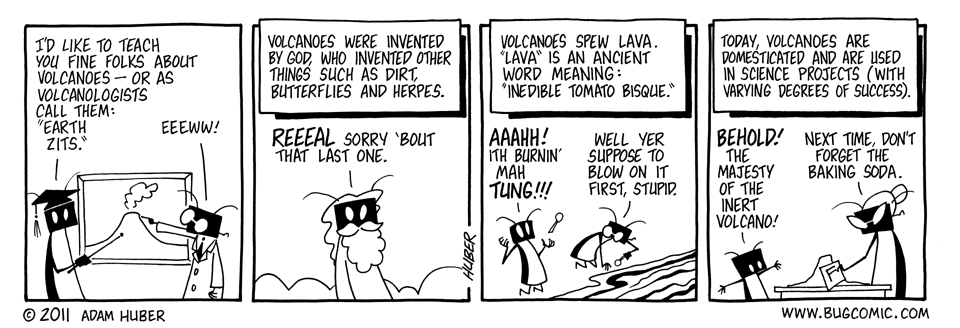
Introduction to Volcanolgy, G411, from Bug. (Click to enlarge)
So CSM, could you, say, qualify that a little more carefully? For example,"Apophis asteroid will likely probably almost certainly not smash into Earth, unless it does, but that's doubtful, say most scientists, at least those we talked to."
funny pictures history - Yes, but how do we  get it on a ring?
see more Historic LOL. I really enjoy seeing people wearing rocks as decorations- that is, jewelry. I can't really wear it myself because I tend to smash things- not so much clumsy as forgetting that bumping into that wall may not hurt me, but it'll play havoc with the bracelet/watch/ring. And oversize jewelry can be a fun and attractive tongue-in-cheek joke. But this is a bit much.
demotivational posters - ROCK SMASH
We've seen this flick before: in rock Vs. car, rock wins. see more Very Demotivational

And there's some serious news, too!

Oobleck could've made all the difference. Why didn't the pin-heads in their ivory towers figure this out? Oh, that's right! They did! Saving BP all the tedious hassle of figuring out how to deal with deep water spills, and making sure the profits went to the right people.

The Earth... for Physicists. The BIG events in earth history, via Kottke.org.

Krugman is shrill again... crop failures and climate change? Followup- forgot I set this aside a couple of days ago: The Guardian paints an even gloomier and scarier picture than Krugman.

A bit behind the curve on this one, but it's mostly because I assumed those who might be interested had already seen it elsewhere; some conversations today and yesterday indicate I'm mistaken in that assumption. The Kepler orbital telescope has identified over 1200 candidate exoplanets- that is, each will need to be confirmed by further observations, but it's believed that most will be confirmed. This effectively triples the number of known exoplanets!

The sex life of anchovies. Isabella Rosselini was, half my life ago, what is known in the male biz as "hawt." (see, for example) And here's the thing: in my experience, once you've decided someone is beautiful, they always will be. Over the last few years, she has been getting quite a bit of acclaim for her work describing and popularizing the sex lives of various creatures. And this is relevant to earth science how? Sex and evolution are inextricable, and biological evolution is one of the major narratives (to some, the major narrative) in our planet's history. Plus, I have to applaud an iconic sex symbol using her fame to promote science education.

Monday, December 27, 2010

Sand Through the Hourglass: Bits of Geoscience

I'm feeling pretty uninspired. Between staying up too late reading (for several nights running) and what might be a mild cold- which may or may not be part and parcel with the weird, mild headaches that make me feel as if my skull is deforming like a kneaded lump of clay- I just want to go home and go to bed. But I have a backlog of interesting geology and earth science posts I've been meaning to get to, plus a couple more that came up today, so with a minimum of fuss here are some recent bits from the geoblogosphere and related news.
  • Silver Fox spent much of the weekend tracking down the original Dutton quote poetically describing Basin and Range as an army of caterpillars crawling north out of Mexico. Like Ron Schott, I'm most familiar with this from the sign at Dante's View in Death Valley, but this has clearly been misquoted many more times than quoted.
  • Callan has a slew of mashed-up rocks (what I personally think of as metacrappite, in my own mental categorization of rock groups, without the slightest bit of derogatory intent), in his continuing series on the geology of San Francisco. Also check out the mashed cherts; these are some of the hardest and most competent sedimentary rocks that exist, and to see them folded, spindled and mutilated like taffy should give you a profound respect for the power of the earth.
  • Christmas day's EPOD was a stereopair of a beautiful snowflake. I've been meaning to transform this into a wobble-gif, but haven't got to it. I may not. Like I said at the outset...
  • Cian at Point Source summarizes her highlights from the recent AGU conference. I'm intrigued by the emphasis I've seen, and not only in her post, on scientists taking a lead role in communicating on their disciplines. As I and numerous others have repeatedly noted, the journalists just aren't getting it done.
  • Evelyn at Georneys has a wonderful post about a wonderful map. As familiar as this beautiful bit of cartographic art is to me, I had never realized its importance, nor how recently (alright, okay, I get it, I'm old.) it had been completed. Heartfelt thanks for clarifying, Evelyn.
  • Bryan at Hot Topic summarizes a recent interview of James Hansen by Bill McKibben, highlighting the degree of confidence felt among climate scientists regarding global warming, its consequences, and how to ameliorate its effects.
  • NatGeo has a gallery of images of what are thought to be collapse pits over lava tubes... on Mars.
  • The Guardian has the most complete article I've seen on the reopening of Molycorp's Mountain Pass rare earths mine.
  • In a semi-related bit of economic news, Krugman's column today deals with rising commodity prices in a recovering economy, on a finite planet. As I've noted before, geology and economics are much more intimately related than I think most people recognize.
  • Also at The Guardian, an article that largely dismisses concerns over the recent news about Cr VI in US drinking water. He makes some valid points, and in my reading, I had already come to much the same conclusion- that the panicky reaction was overblown. However, I think the middle ground is more appropriate here. There's no reason to panic, but his level of dismissiveness is unwarranted as well. This should be of concern, and should be studied more carefully.
  • Louisiana will be coming to Oregon to study hurricane storm surges. Huh? Oregon State University has one of the largest wave tanks in the world: The Hinsdale Wave Research Laboratory.
  • The explosion and subsequent destruction of the Deepwater Horizon, and the ensuing oil spill, made the new chairman of The House Science and Technology Committee, Ralph Hall (R-Texas), feel all warm and fuzzy inside.
    "As we saw that thing bubbling out, blossoming out – all that energy, every minute of every hour of every day of every week – that was tremendous to me," he said. "That we could deliver that kind of energy out there – even on an explosion."
    You probably don't want to read that entire article if you would prefer to be optimistic regarding science in the US in the near future.