Wednesday, August 6, 2008
Lighting and Economics
The first story is on lighting. I was just talking to a friend here at my favorite coffee shop about the forecast that we might get a thunderstorm tonight. In fact, the weather forecasters mention that just to cover their butts: maybe one time in 15 or 20 that they predict thunderstorms do we actually get any here on the valley floor. But the Coast Range and the Cascades do get much more violent weather than we do, so the butt-covering forecasts are not just teasing to people that live in more rugged terrain. Growing up in Ohio, summer thunderstorms were the one part of the season's weather I looked forward to. I miss them here- are summers are dry, dry, dry. We actually had a few minutes of drizzle in the early morning, about 6:00, late last week, and the sound and smell were delicious to me, even though there wasn't enough rain to more than dampen the pavement. So I miss lightning, and this article was a fun read for me. I would take issue with some of the author's science factoids, but they're minor in context. An aspect that I enjoyed is that much of the narrative takes place in the Georgian Bay/Parry Sound area of Ontario, Canada, an area in which I've spent a fair amount of time.
The second story is on "what we know for sure" in the discipline of economics. I took the intro year of econ as an undergrad, a decision I've never regretted. That series didn't leave me strongly knowledgeable about econ, but it left me with a strong enough background that I can understand journalism aimed at an educated layperson, and with a little effort, unravel the logic behind the conclusions that experts come to without explaining intermediate steps. The author here is clearly a follower of Friedman's free-market-is-god school of thinking. As I've noted before, I'm a strong supporter of free-market ideals, but in it's current incarnation (in my opinion), the main cause of free market failure is the fact that it's too easy, in fact accepted and promoted, to exclude and ignore real costs that don't have an immediate free market dollar cost, but that do impose real costs down the line. For example, cutting down a stand of trees interferes with the availability of clean water. But that cost is not figured into the cost of producing lumber. A coal fired power plant produces enormous amounts of carbon dioxide that is interfering with our ability to count on a consistent climate, but as things stand now, those costs are ignored.
With all that said, the article on economics was quite interesting to me, in that while I recognized I was inclined to disagree with the author on many points at a fairly fundamental level, I found myself for the most part agreeing with his basic conclusions- there were a couple that I have a hard time accepting, but again it gets back to what essentially amounts to philosophy as opposed to empiricism. I don't think on these points he's relying on empiricism as much as he thinks he is- there is less consistent agreement then he seems to be claiming amongst experts. Nevertheless, if you are interested in economics, and you should be, I recommend this article. I have purposely omitted the points I take issue with, but I would be interested in your take.
Late-Summer Ice Cubes
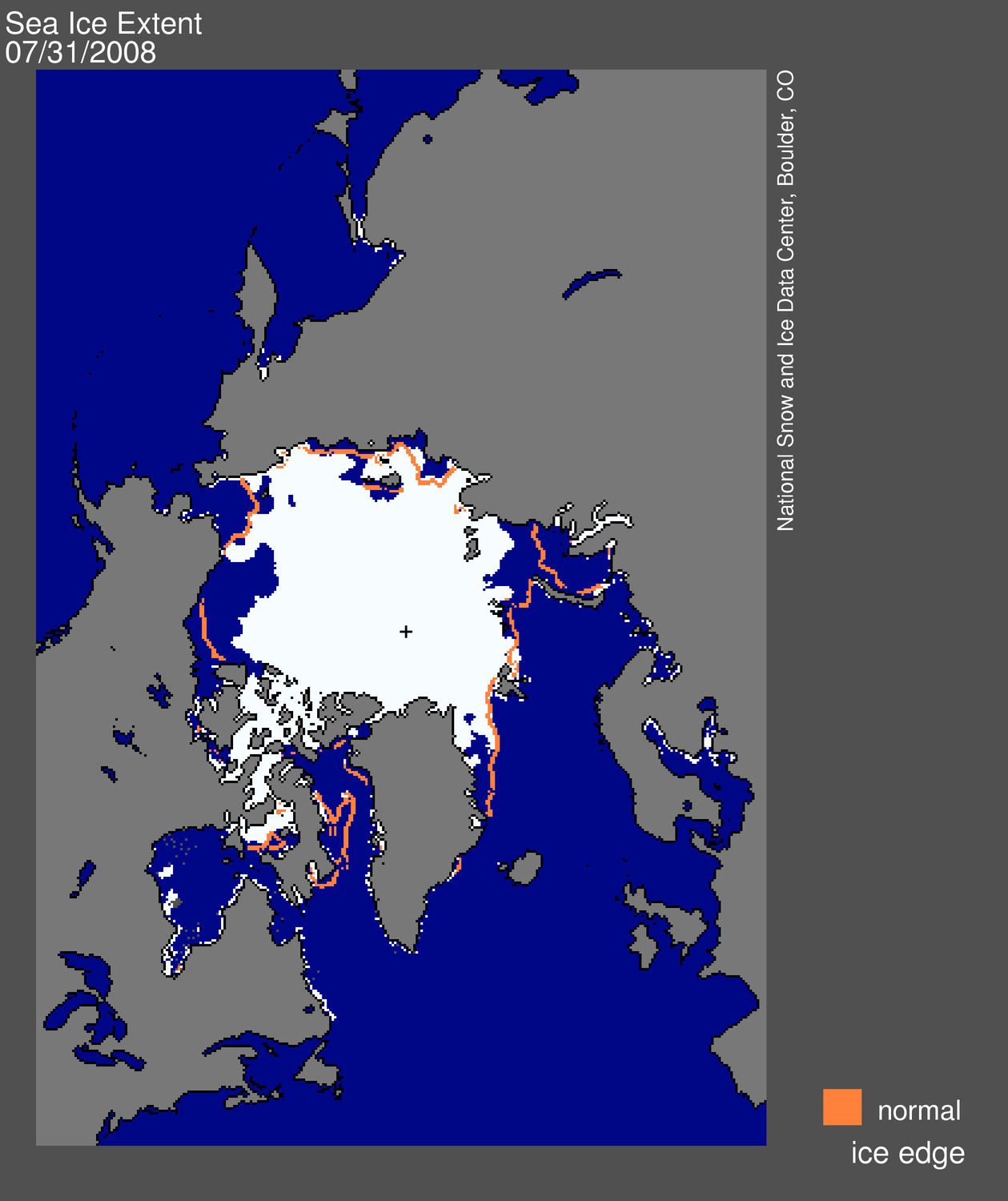
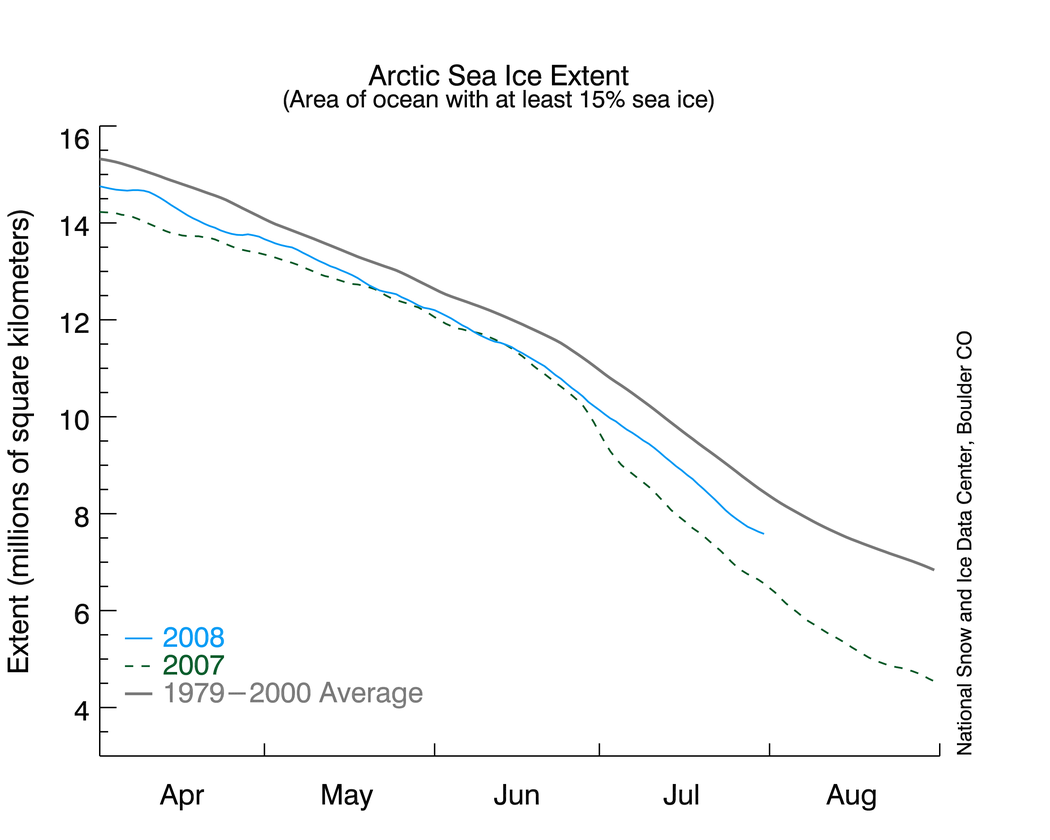
The August report from National Snow and Ice Data Center (NSIDC) is now available, and it appears that this year's melt back will not be as severe as last year's. The average area considered ice-free (maximum of 15% ice) since 1979 is 8.88 million square Km; this year the ice free area is 7.71 million square Km. Last year at this time, the ice free area was 6.82 million square Km. Couple of interesting pictures: a map shows the ice cover as of August 1 compared to the average, and a diagram shows the historical average of ice coverage by date compared to this summer and last summer.
In other news, a British scientist warns his country to prepare for a 4 degree Celsius rise in temperature (7.2 F). According to the article, this would be roughly equavalent of moving the climate of Morroco in Northern Africa to Great Britain.
Hope your Hummer has air conditioning.
Tuesday, August 5, 2008
Meteor!
Like other meteor showers, it's not a one night show. The number of meteors will slowly ramp up over the next days, peaking Monday night and Tuesday morning, then taper off over the following week. The hours between sunset and midnight see fewer meteors, but the ones that are visible tend to be quite spectacular as they skim across the upper atmosphere. They tend to be more numerous and shorter lived after midnight. Spaceweather.com does a good job of following these sorts of events, and posts pictures (sometimes even videos; today there's a short clip of a fireball over New Mexico; use the archive tab upper right on the page to get to August 5) and skywatching tips for you. Another good resource is NASA's 2008 Perseid Meteor Shower page. The sky maps you see on pages such as this can be a little misleading; the meteors don't necessarily start in the constellation Perseus, but if you trace the paths of the streaks back, they tend to radiate from that direction. Keep an eye out!
Monday, August 4, 2008
Because Sharing is Nice
But another item of interest, which I'm about to start exploring is "shared items." Any post showing up in the feed can be marked as of interest- "starred." This allows the user (me in this case) to mark things that are longer than I want to deal with at any particular moment, for example, but to go back and find it quickly and easily. I can also mark it as "shared." All shared items get posted to a page called (oddly enough) "Lockwood's Shared Items." If you click on that, it should take you to that page. These are generally things that I think are interesting enough to write a post on, but when all is said and done, either don't have the time or motivation to post. If you generally enjoy the stuff I post here, you'll probably generally enjoy the items I've shared. Do you have a shared items page? Let me know in comments.
Followup: Okay, interesting. Apparently, the items are posted in the order that I clicked on them to share. And just as with the feed, many of them are just the first couple of lines- if you're interested in reading the full post, you'll need to click through to the original posting site. And it seems only 10-12 items get posted per page, so you need to look at a number of pages to see the whole list. Have fun!
Sunday, August 3, 2008
Press "Enter" to Continue
I'd rather press "Return" and just do the last 8 years over. From Spook and Muffin's Relaxed Politics.What Our Spider Friends Teach us about Drugs
So Long Mom (A song for WW III)
Saturday, August 2, 2008
Rumor, Rumor (Oh it's Gotta be True!)
Here's what we know: The TEGA instrument may be capable of recognizing organic material, but it's not capable of detecting life. We've already determined that the soil chemistry is such that it could support some kinds of plants (asparagus was the example given repeatedly). The microscope is of sufficient power and resolution that it would be able to identify bacteria if they were present, but spokesmen are saying that bacteria have not been spotted. Water was positively identified in the TEGA earlier this week. That can be taken as exciting, but it's really just a final confirmation of something we knew pretty well from a number of other lnes of evidence. So what's the upcoming announcement? Aviation Week weighs in with a reasonable take. The article says the announcement will probably about the middle of the month, or possibly as late as early September if further confirmation and testing is required.
BTW, anybody recognize the source of the post title?
In which RSS leaves me ReSSt deprived
I just need to set aside a little time for, you know, little stuff like sleeping and eating and breathing. But I think all that trivia is less important than keeping up with a dozen newspapers and 70 or 80 blogs.
August 21, 2017

On August 21, 2017, a total solar eclipse will cross the entire US! I was excited to see how close the line of totality came to Oregon; perhaps, I thought, I would only have to get to Portland...
So I went looking for a more detailed map. Turns out, I don't have to go anywhere; I can just sit outside my favorite coffee shop and watch. Wow! (Full size image here)
I guess this means I gotta keep myself alive for another 9 years. For those who don't live in Oregon (sorry 'bout that), here's a full US thumbnail showing the path of totality.
You can find the full sized US map and more detailed regional maps here, and the site's home page has lots of great information. Also, check out the Google map the author has created. It's a wait, but it ought to be worth it!

Friday, August 1, 2008
Test
OK, there's apparently some sort of corruption going on with site meter right now, and I wasn't able to access the blog. So temporarily, I've taken the counter down. Leave a comment so I know you visited!