I've been meaning to mention this for a while, but all sorts of news has been all sorts of crazy for the past week and more. On top of that, Interzone has (finally) switched ISP's, but the wifi is still buggy for long stretches at a time. To describe browsing as glacially slow would malign the celerity of glaciers. But in about two hours, the MESSENGER probe will fire its main engines for 15 minutes, allowing itself to be gravitationally captured, and become the first man-made object to orbit Mercury. The Planetary Society Blog has the time line and web resources (as well as the image above at a larger size) to follow it live, if that's your thing.
Even though Mercury is one of the closest planets, it's poorly known and studied. It's too close to the sun, from the earth's point of view, to get detailed telescopic images, and it's so deep in the sun's gravity well that spacecraft from earth have gained enormous speed after "falling" toward it from earth. That speed has to be nearly matched to Mercury's for the probe to orbit the planet. The MESSENGER probe has used a series of planetary flybys, over fifteen orbits of the sun, to bleed off some of its excess speed. Tonight's burn will be the conclusion of one voyage and the beginning of another, if all goes well.
Mercury is an important key to understanding the early evolution of the solar system, and I have little doubt there will be images and discoveries that flabbergast me. I'm pretty excited about this, and I'm keeping my fingers crossed.
Followup, 6:50 PM PDT: Reports coming from NASA say the orbital insertion maneuver has been successful; expect first imagery in a couple of weeks. Congratulations, NASA and MESSENGER!
Followup 2, 7:28 PM PDT: The MESSENGER news service I subscribe to just sent me this report, titled "MESSENGER Begins Historic Orbit around Mercury" Full text of report:
At 9:10 p.m. EDT, engineers in the MESSENGER Mission Operations Center at the Johns Hopkins University Applied Physics Laboratory (APL) in Laurel, Md., received the anticipated radiometric signals confirming nominal burn shutdown and successful insertion of the MESSENGER probe into orbit around the planet Mercury.
The spacecraft rotated back to the Earth by 9:45 p.m. EDT, and started transmitting data. Upon review of these data, the engineering and operations teams confirmed that the burn executed nominally with all subsystems reporting a clean burn and no logged errors.
MESSENGER’s main thruster fired for approximately 15 minutes at 8:45 p.m., slowing the spacecraft by 1,929 miles per hour (862 meters per second) and easing it into the planned eccentric orbit about Mercury. The rendezvous took place about 96 million miles (155 million kilometers) from Earth.
“Achieving Mercury orbit was by far the biggest milestone since MESSENGER was launched more than six and a half years ago,” says MESSENGER Project Manager Peter Bedini, of APL. “This accomplishment is the fruit of a tremendous amount of labor on the part of the navigation, guidance-and-control, and mission operations teams, who shepherded the spacecraft through its 4.9-billion-mile [7.9-billion-kilometer] journey.”
For the next several weeks, APL engineers will be focused on ensuring that MESSENGER’s systems are all working well in Mercury’s harsh thermal environment. Starting on March 23, the instruments will be turned on and checked out, and on April 4 the primary science phase of the mission will begin.
“Despite its proximity to Earth, the planet Mercury has for decades been comparatively unexplored,” adds MESSENGER Principal Investigator Sean Solomon, of the Carnegie Institution of Washington. “For the first time in history, a scientific observatory is in orbit about our solar system’s innermost planet. Mercury’s secrets, and the implications they hold for the formation and evolution of Earth-like planets, are about to be revealed.”
(The Daily What) I had to read this one twice to catch the gag. Once while working in the forest soils lab, I spilled some lab grade (37% -home use formula is 2%) hydrogen peroxide on my wrist- I hadn't properly pulled my glove up. Within seconds, I was rinsing it off, so there was no serious damage, but even those few seconds was enough to bleach my skin utterly white. And there's nothing like having a white blotch an inch or so across on your wrist for a couple of weeks to convince one's self that Caucasian people aren't actually white. Also, to be convinced that if you read or are warned a particular reagent is much more dangerous than you might think, it's a good idea to simply accept it, and not to test the claim empirically.
Evelyn at Georneys is hosting a book contest: you can win a copy of the recent book by Gillian Turner called "North Pole South Pole: The Epic Quest to Solve the Great Mystery of Earth’s Magnetism" by submitting your most side splitting, eye wincing, mind rending geology pun. I linked to a somewhat obscure mineral pun I devised a couple of years ago as a place holder, but it was not intended to be an actual submission. The comments have been pretty busy, but I wanted to come up with something original. The result actually takes me a while- I want to try to craft it into a relatively short set-up, and order everything for best comic effect. Here's my final submission:
A stone mason with a powerful phobia of indoor lighting was accused of misrepresenting the "black granite" he used in a counter top. He was charged with basalt, but when his condition came to light, the charges were dismissed due to lamprophyre.
Geologists have a perennial gripe with the phrase "black granite," which is like a furry fish: there ain't no such thing. "Charged with basalt" seems obvious, but I don't think I've ever heard this pun before. And I got a giggle out of "lamprophyre" interpreted as a phobia of indoor lighting. Lamprophyres are weird, obscure rocks that no normal person would ever need to know about, therefore, I'm very fond of them. My favorite was an outcrop near the eastern end of lake Nipissing in Ontario with awesome veins of barite, which has sadly been mostly obliterated by road construction.
After spending pretty much the whole day yesterday, and making what felt like very little progress through all the information flying through teh innertubz, I promised myself I wouldn't do the same thing today. Yeah, well... promises are made to be broken, right? I'm just finding too many frightening and amazing things this morning to ignore them. For example:
Mary at Geographile found this amazing video of liquifaction and mud volcanoes on reclaimed ground after the quake. I don't think I've ever seen footage of this phenomenon active before; many photos of the aftermath, but it's pretty interesting to see the actual process.
This clip has been all over the place this morning: the nuclear emergency that was widely reported yesterday has culminated (hopefully) in an explosion at the Fukushima power plant:
Many of the usual suspects are treating this as apocalyptic, Chernobyl-level or worse news, and I'm still trying to unravel exactly what happened. My current understanding, which to be clear may be incomplete or incorrect, is that this is a steam explosion. It clearly is not a core explosion. Some radiation has been leaked, but officials are claiming it is not intense. Still, I find the lack of details in official reports troubling. I'll add on additional information as I find it.
So as I did yesterday, I'll add items as I continue reading. The times I post with each represent the time I found it, not the time it was originally posted... there's still an enormous backlog from yesterday, some of which may be dated at this point, but some of which will undoubtedly provide some important background.
12:27 PM, PDT (UTC minus 8 hours)- Oregon Live lists seven reputable organizations that are accepting donations to aid the victims of the quake. In another article, the same source notes that the FBI is warning the public to be wary of scam artists posing as aid organizations.
The Federal Bureau of Investigation warned Friday that con artists often prey on donors responding to charity calls in the wake of natural disasters. The warning comes as charities begin reaching out for contributions to help deal with the damage caused by Friday's tsunami.
12:37- Commenter CJR points out an interview by Evelyn at Georneys with her father, a nuclear engineer, on the unfolding Fukushima reactor crisis. Due to noise here inside the Interzone, I haven't been able to listen to it yet, and I'm hoping Evelyn finds time to transcribe it. However, I've been reading so many positive comments on how her father explains the situation that I'm just going to pass it on to readers, even though I haven't listened to it yet.
12:46- OregonLive catches an AP story that reiterates some of what I've read elsewhere, and clarifies some points on the Fukushima story:
The blast destroyed the building housing the reactor, but not the reactor itself, which is enveloped by stainless steel 6 inches thick.
Inside that superheated steel vessel, water being poured over the fuel rods to cool them formed hydrogen. When officials released some of the hydrogen gas to relieve pressure inside the reactor, the hydrogen apparently reacted with oxygen, either in the air or the cooling water, and caused the explosion.
So it was hydrogen exploding (chemically, not fusion) that caused the blast, and the inner steel containment vessel was not breached. The article also confirms my unease with the lack of information and transparency: "But authorities did not say why, and the precise cause of the explosion and the extent of the ongoing danger were not clear."
1:01- Susan at Geology in Motion works toward an order of magnitude estimate for the amount of energy the tsunami imparted on the Japanese coast, concluding that the value is somewhere in the range of 1 to 100 times that of (sum total of) the bombs dropped on Hiroshima and Nagasaki. She concludes with the comment, "My 'gut feeling' from looking at the number of completely devastated cities is that these higher numbers are very likely."
GENEVA, March 12 (Reuters) - The World Health Organisation (WHO) said on Saturday that the public health risk from Japan's radiation leak appeared to be "quite low" but the WHO network of medical experts was ready to assist if requested.
So is WHO making this judgment based on their own observations and data, or upon evasive statements by public relations officers? 'Cause, you know, that kind of matters.
1:38- Callan has a good piece on so-called "secondary effects," or follow-on consequences of earthquakes, which often kill many more people than the quake itself. As he points out, few people die directly from the quake. Have you ever heard of quake-induced whiplash?
1:46- Yesterday we saw aerial footage of the tsunami sweeping through the Sendai Airport. Today Bits and Pieces finds footage shot from inside the terminal:
2:08-OregonLive: $10 million in damages to Port of Brookings alone. I've read of serious damage to harbors and ports in Coos Bay, Port Orford, Depoe Bay and Gold Beach in Oregon, and Crescent City and Santa Barbara in California. I'll keep an eye out for sources and links as I go- those are just from memory, which is most certainly not flawless. 3:18- here's the article I read last night discussing the some of the tsunamis' impacts on the OR coast. 2:15- Whew! That's a relief! (What Would Jack Do?) In a non-ironic vein, it's too early to make any serious observations or predictions, but this may have negative consequences for the nascent economic recovery. So to say "no impact on Ohio" may be a bit premature... at least in terms of "secondary effects."
My email inbox has continued to flood with earthquake notifications, more than doubling yesterday’s tally. As of right now (15:00 GMT), Japan has experienced a total of 171 earthquakes greater than M 5.0.
Of those, 26 were stronger than M 6.0, including a 6.8 that occurred at 1:47 this morning and a 6.4 less than two hours ago. Incredible.
I'm having a really hard time getting my head around 171 M 5+ quakes, with 26 equal or greater than M 6, in less than 48 hours. Criminy.
2:36- A very helpful post from Swans on Tea discussing the issues with the Fukushima reactor (with the amusing title, which at first I didn't get, "I stayed at a Holiday Inn Express last night"):
The reactor is shut down, so what’s the danger? The products of a fission reaction are typically radioactive, and subsequent decays also release energy. Shutting down the reactor reduces the fission rate by many orders of magnitude, so it’s effectively zero in terms of heat output, but the radioactive fission products still release up to 6-7% of the plant’s power output. The actual value depends on the operating history; the fission products with long half-lives take longer to build up to steady-state values. This value will drop fairly quickly as the short-lived isotopes decay, but it’s still significant — a reactor rated at 1000 MW will still be producing tens of MW of decay heat. The reactors in question at Fukushima Daiichi are rated at 460 or 784 MW.
2:41-@argillic RT @ejgertz: "Personnel have flooded Fukushima reactor 1 w/ seawater & boric acid: 'throw in the towel' strategy that perm. damages reactor." So hopefully, that's that.
2:47- Chris Rowan at Highly Allochthonous put up some background information in a post from yesterday. For me, the most helpful bit was on some of the reasons that modern moment magnitudes (estimates of total energy released, as opposed to Richter magnitudes, based on ground motion) frequently get revised upwards in the hours and days following very large quakes. I haven't seen any resolution to this yet, but while the MSM news sources are still reporting this as an 8.9, the geoblogosphere was reporting fairly early yesterday that USGS had upgraded it to a 9, and some other agency (which one?) to a 9.1. Again, Chris titled his piece with an eye to humorous tongue-in-cheek recognition of this.
3:26- I, Cringely gives a good rundown on "How Flea Powder May Be Saving Lives in Japan," highlighting a use of boron (in the form of borates, or more likely, sodium polyborate) that I mentioned just ten days ago. As I noted at 2:41, there are now reports that the borate coolant has been injected into the reactor, which is apparently a permanent killer.
3:40- If you've spent any time reading this blog at all, you know I don't have much use for religion or prayer. That doesn't mean I don't entertain benevolent thoughts and wishes for those suffering and endangered, just that I don't have any belief that there's a great sky wizard waiting around pensively to find out what I'm going to blow out the candles and wish for today. I like hope, and I like this (Sober in a Nightclub):3:49- Ben Travato, The Wulfshead: "We are all Springfielders now."
3:52- I sometimes forget why I subscribe to The Telegraph (UK). Then they remind me. They print some of the stupidest, overblown, sensationalistic headlines this side of the Weekly World News: "Earthquake like 'dropping boulder the size of the Isle of Wight into the ocean.'" All of it from sea level up, or from the ocean floor up? Maybe including the whole of the crust, or the mantle as well? And, uh, dropping it from how high? Sigh... nitwits.
4:12- NASA provides side-by-side before and after images (2/26/11 & 3/12/11) of the flooding near Sendai, Japan:4:37- Jessica Ball at Magma Cum Laude has a post that does a good job of getting at the complexities inherent in establishing a causal relationship between an earthquake and a subsequent volcanic eruption. I'd add that both subduction quakes and volcanic arcs result from (are caused by) subduction zones, so they are related, but as Jessica points out, only rarely will a quake actually trigger an eruption. The details of how a quake might trigger an eruption, though, are interesting.
4:41- Silver Fox at Looking For Detachment has added many, many more links to her post from yesterday, so if you're wondering how the geoblogosphere is responding to the news, this remains the most comprehensive list of Japanese quake/tsunami posts that I'm aware of.
A radiation leak and explosion at the Fukushima Daiichi Nuclear Power Station on Saturday prompted the government to expand an evacuation order to affect 170,000 people in the plant’s vicinity. And the plant’s operator issued an emergency notice early Sunday morning that a second reactor at the same aging plant was also experiencing critical failures of its cooling system, and that a way to inject water into the reactor to cool it was urgently being sought.
Fukushima nuclear plant - where a huge explosion yesterday blew the outer walls and roof off the No.1 reactor building - faces a new problem.
The emergency cooling system of No.3 reactor has now also stopped working, the Japan Nuclear and Industrial Safety Agency has announced.
Sea water is being pumped into the No.1 reactor chamber to cool its fuel rods - and officials are scrambling to secure a means of of supplying water to the No.3 reactor.

 So now we know.
 I've been meaning to mention this for a while, but all sorts of news has been all sorts of crazy for the past week and more. On top of that, Interzone has (finally) switched ISP's, but the wifi is still buggy for long stretches at a time. To describe browsing as glacially slow would malign the celerity of glaciers. But in about two hours, the MESSENGER probe will fire its main engines for 15 minutes, allowing itself to be gravitationally captured, and become the first man-made object to orbit Mercury. The Planetary Society Blog has the time line and web resources (as well as the image above at a larger size) to follow it live, if that's your thing.
 (The Daily What) I had to read this one twice to catch the gag. Once while working in the forest soils lab, I spilled some lab grade (37% -home use formula is 2%) hydrogen peroxide on my wrist- I hadn't properly pulled my glove up. Within seconds, I was rinsing it off, so there was no serious damage, but even those few seconds was enough to bleach my skin utterly white. And there's nothing like having a white blotch an inch or so across on your wrist for a couple of weeks to convince one's self that Caucasian people aren't actually white. Also, to be convinced that if you read or are warned a particular reagent is much more dangerous than you might think, it's a good idea to simply accept it, and not to test the claim empirically.
 Maneggs
 Firedoglake
 "The Stalker" Bits and Pieces
 What Would Jack Do?
 Alphaville


 The High Definite

 Bad Astronomy
 Darius Whiteplume's Tumblr
 Very Demotivational
 Surviving the World

 E.B. Misfit
 Bits and Pieces


 Criggo
 The High Definite

 Blackadder
 Balloon Juice
 Blackadder
 Blackadder
 Alphaville

 Hipster Hitler

 Double take, from Sofa Pizza
 Eff yeah: ROCKS! EpicPonyz
 Luke Surl
 Alphaville1
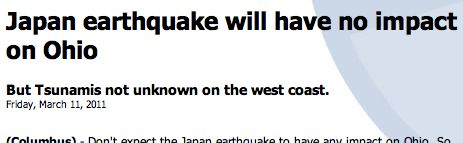 2:15- Whew! That's a relief! (What Would Jack Do?) In a non-ironic vein, it's too early to make any serious observations or predictions, but this may have negative consequences for the nascent economic recovery. So to say "no impact on Ohio" may be a bit premature... at least in terms of "secondary effects."
 3:49- Ben Travato, The Wulfshead: "We are all Springfielders now."
 4:37- Jessica Ball at Magma Cum Laude has a post that does a good job of getting at the complexities inherent in establishing a causal relationship between an earthquake and a subsequent volcanic eruption. I'd add that both subduction quakes and volcanic arcs result from (are caused by) subduction zones, so they are related, but as Jessica points out, only rarely will a quake actually trigger an eruption. The details of how a quake might trigger an eruption, though, are interesting.
 5:06- great discussion at Boing Boing of what's happening in Fukushima's "black box," and what we can expect going forward. (spoiler: if it doesn't get worse, it'll get better.)


 Posts
Posts