Showing posts with label Education. Show all posts

Saturday, August 2, 2014

Geo 730: July 30, Day 576: Student for Scale

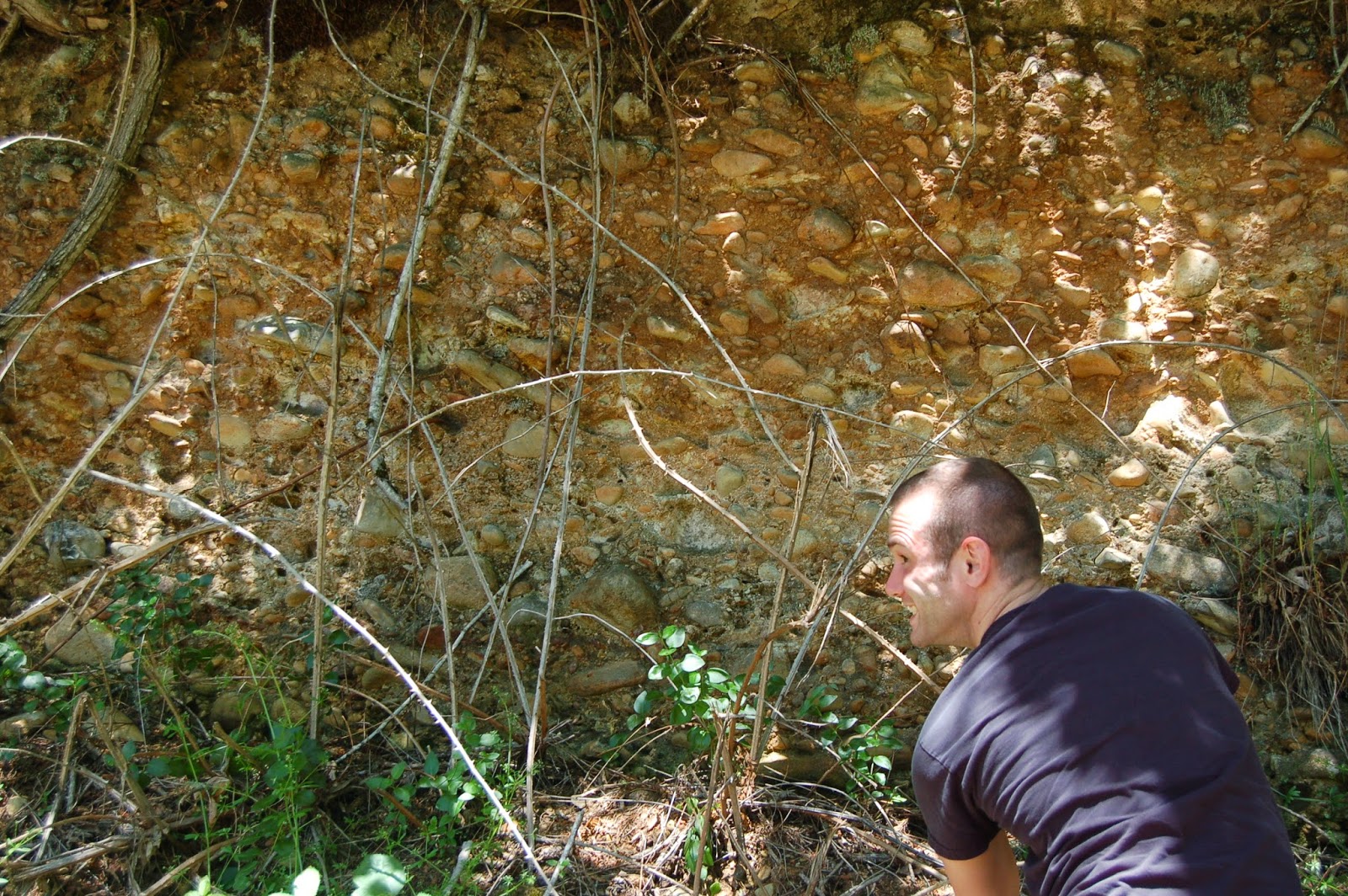
Another shot of the imbrication near the beginning of Quartzville Road, with Bobby for scale. I didn't feel nimble enough to climb up through the briars to put my hammer on the outcrop, so he volunteered. Once he got up there, we realized we didn't really need to worry about the hammer. Bobby has been getting his intro to geology courses at a community college, and is transferring to OSU this fall. He doesn't blog (Yet. I'll work on that.), but I think his intelligence and enthusiasm will carry him through his geo major well. It'll be interesting for me to see how the structure of the major has changed over the last 30 years.

Photo unmodified. June 19, 2012. FlashEarth location.

Saturday, August 24, 2013

Geoblog Resources for Geology Undergrads: An Addendum

I realized that I should have posted an argument for just why geology undergrads should be trying to find time to read geoblogs in yesterday's post. There are a lot of reasons.

Interest: Most geologists are truly passionate about their subject area- more uniformly and more so than in any other field of which I'm aware. Perhaps I'm biased and/or naive, but I don't think so. The more you delve into it, the more fascinating it becomes. The more you understand, perversely, the more you realize you don't understand, but the more you want to understand. Blogs offer bits and pieces freed of academic structure- which I believe is a necessary part of getting the edumaction (The structure, to be clear)- and are pressure-free. None of this is going to be on the final. On the other hand, you might accidentally learn something that does show up on a test eventually. Geobloggers do this because they're interested, and it can be infectious.

Enthusiasm: Like interest, geologists and geobloggers just glow with enthusiasm, and that too can be catchy. When you read a post that comes across as breathless, you want to go see that spot. You want to share that experience. You want to solve that puzzle. I could also call this "motivation." We all want to feel that way. See Dana's Rosetta Stones post from earlier today; she really wants to visit that beach... don't you? (I actually have visited that beach a number of times in the seventies, sadly before I knew what I was looking at.)

Support: Everyone has times they're down, or times when something just seems overwhelmingly confusing. I'd say we as a community are extremely supportive of others. We empathize with the plights of students- geology students in particular. I can't offer much beyond empathy to, say, a physics student. But for undergrad geologists, I can be very helpful. I can't tell you more accurately than "a couple dozen" the number of times people have been in here studying something geology related. Geologic terms to me are like hearing your name spoken in a crowded, noisy room. My ears perk up, and I want in on the conversation. I'm not rude about it, but I definitely make my interest known, then offer my help. There have been study groups that return regularly, hoping I'll be here (I generally am). Same thing online. Twitter is even better than blogs for this- you can crowdsource a question, and often have an answer (or a PDF) in minutes. There have even been a few times when I've written extensive posts discussing complex issues that don't have single or simple answers (for example).

Learning: Whether it's a concept you're unfamiliar with, or a location you decide to visit later, one inevitable consequence of reading geoblogs is that you're going to learn something unexpected. As a student, you should jump at every low-cost opportunity you get for learning. And it just doesn't get lower-cost than blogs.

Contacts and community: Every field relies heavily on who you know. This is not always a good thing, but it's a fact. And often, it is a good thing. When Callan Bentley's student Aaron Barth moved to Oregon to attend OSU, the former sent me a note, and I suggested a number of places in the Eugene area (where he lives) to the latter. And when Dana came down in July, we took him along on a field trip to the Quartzville area. When Anne Jefferson and Chris Rowan were out earlier this summer, I spent a couple of days showing Chris around the Neogene sediments of the Coast Range. And if I was to visit the stomping grounds of any number of geobloggers, I know exactly who I'd go to to get oriented to local rocks.

Communication: One aspect of my undergrad career that might have been problematic if I personally (not the curriculum) hadn't taken steps was that of communication. It baffles me how many people think clear, low-error communication isn't important in science classes. Communicating well is perhaps even more important than core competencies; if you can't effectively pass your knowledge on to others, what's the point of generating it in the first place? Geobloggers provide numerous daily examples of clear, effective (and often, delightful) communication every single day. I also think that reading well-written material is an important component of learning how to write well. Writing poorly can kill a career. Everything from getting grants to writing company reports or peer-reviewed articles depends on your communication skills. The time to get those down pat is during your undergrad career.

Models: Every geoblogger provides a model I would encourage you to emulate: start a blog! It's fun (if not always easy), and it takes exactly the amount of time you want it to. Want experience talking about (and thinking about and tentatively solving problems in) geology? Start a blog. Want to show off photos from a field trip? Start a blog. Want to polish up your writing skills? Start a blog. Want to be a part of a supportive community? Start a blog. Want a place where you can get thoughtful feedback and commentary on a geoconjecture? Start a blog.

Geoblogging and geoblog reading: It really is all that.

Friday, August 23, 2013

Geoblog Resources for Geology Undergrads

Follow up: Before you even read this, go read this addendum on WHY you should read this.

I promised this to a student who was along on the trip to Sand Mountain a couple of weeks ago, and I've been kind of tangled up thinking about what criteria to employ. I'm still not entirely settled, but roughly in order, here's what I'm going with:
  • Focus heavily, though not necessarily exclusively, on geology and related earth sciences 
  • Ones that I personally enjoy on a regular basis
  • Ones that post new bits fairly regularly
  • Don't involve too much in the way of advanced concepts- that is, appropriate for those with less background.
  • Have a "voice" that sounds accustomed to helping out beginners
In no particular order, here are some suggestions:
  • Outside the Interzone (but of course, if you're reading this...)
  • Geotripper- has been doing a series of posts on the Colorado plateau this summer.
  • Mountain Beltway- Heavy on structural geo, but wide variety of topics
  • En Tequila Es Verdad- Dana Hunter's geology, with outspoken social issues mixed in.
  • Rosetta Stones- Also Dana's:"Adventures in the good science of rock-breaking"
  • Highly Allochthonous- Co-bloggers Chris Rowan and Anne Jefferson take on rocks and water
  • Looking for Detachment- Travel and exploration geology, most often in Nevada.
  • Emily Lakdawalla at The Planetary Society Blogs- a number of bloggers here. Some get pretty technical, but Emily's contributions are particularly fascinating and accessible.
  • Eruptions- The go-to blog for current volcanism and volcanology generally.
  • The Landslide Blog- Pretty much exactly what it says. Frequent awesome video clips.
  • Glacial Till- Ryan Brown is an undergrad at Portland State, who has become involved with meteoritics.
  • Cascadia Blog- Inactive since January, but the best list of PNW geobloggers is near top of the right sidebar. And I suspect he'll be back sooner or later.
  • The Accretionary Wedge- The geobloggers' semi-monthly "festival." It's behind, but the AW still limps along. See the "Who's Hosting page" (button upper right) for what's going on where, and read some older entries for the general gist.
  • Geology is Hard- The lighter (and MUCH funnier) side of being a geo student. Caution: addictive.
  • And finally, All-Geo, Chris Rowan's geoblog aggregator, is a good one for finding other geoblogs.
Suggestions for others are welcome in the comments. Most blogs also have lists of blogs the author(s) follow. It should be no surprise most geobloggers have lists of geobloggers they suggest. I do too, somewhere down there, but mine really needs to be updated.

I also want to make a case for Twitter, in addition to the geoblogosphere. There are quite a number of geologists on Facebook, but that stream is "cluttered" with people I know from actual meatspace, and events or publications in the geo on-line community are more likely (for me) to be caught either through my RSS service or Twitter. Furthermore, I and others frequently come across random articles relevant to geology that *I* might see in RSS, but others won't. I'll then post it to Twitter. Here's an example from earlier today. There's no way I can post a good list of who to follow; there are just too many options. My suggestion would be to look through the list of who I follow (Click "Following" in the upper left), jump over to timelines that look interesting to see if they are, then follow that person or not, as you see fit. Twitter is by far and away the best way to keep your finger on what's happening right now, often with people you follow close to the scene. Following the real experts also means you don't have to worry whether they've mucked up the facts, which you do when following MSM science reporting.

Monday, August 12, 2013

25 Minutes of Agonizing Helplessness

A recently found and released video of the 2011 Japanese tsunami has got to be seen to be believed. I generally don't watch clips longer than a few minutes, but what this one illustrates is just how unbelievably long the tsunami advances. I can think of no other way to show this than actually seeing that duration. And there are some cuts, so it's not clear if we're actually seeing the whole thing.

The first arrival is about 3 minutes in, and at first it doesn't look all that bad, though the boats being swept up and along are dramatic. Obviously, the onlookers are unimpressed at first, as well; they're remarkably nonchalant. Then it gets worse.

Then it gets much worse.

And by the end, it's catastrophic.

I white-knuckled my way through it, and any geo-inclined readers are advised to do the same. The educational value of this clip is incredible.

Saturday, June 15, 2013

Accretionary Wedge #57: Seeing Geology Everywhere!

Evelyn is hosting AW # 57, Seeing Geology Everywhere.

I see rocks. They're everywhere, in everything. And most of the time, people don't even know they're rocks.

This is a topic I've brought up more times than I can count at this point. (See "Show Me Your Sidewalk," "Geology is All Around Us!" "Geology at Oregon State University," "AW #52: Geology Dream Course," "The Geo Biz," "We Dohn' Need No Steenkin' Rocks," "98 102 97 88" "Cycles Without End (AW #30)," and, in particular, "A Worldview That Resonates With Me," as a few selected examples.) The question I keep getting stuck on is, "What can I say that I haven't said before?"

The only thing I can think of is to phrase it as a challenge: I defy you to find *anything* in your environment that isn't directly or immediately indirectly (by which I mean only one or two steps of remove) dependent upon, or shaped by, geological resources and processes. The thing is, there really isn't anything that doesn't fit that description. The landscape you live in (or vacation in, for that matter), however modified by human engineering, was created in its basic outlines by water, the solid earth, climate and biological interactions. The computer you're reading this on is a creation of a wide variety of minerals and petrochemicals, painstakingly fabricated, doped with extraordinary precision, and despite its incredible complexity, assembled and sold at a price people can readily afford. Almost everything in your home was delivered by (mainly) steel vehicles propelled by hydrocarbon combustion. It's a rare meal indeed, at least in the developed world, that doesn't have a healthy (or unhealthy) dose of table salt, NaCl, or halite. For the sodium sensitive, you can substitute in a certain amount of KCl, or sylvite. If you get heartburn after a hearty meal, you can take an antacid made of fine-grained calcite, CaCO3, or gibbsite, aluminum hydroxide, Al(OH)3, to neutralize the acid. Then you can relax with a glossy magazine or coffee table book. The reason the pages are glossy is that a mixture of clay minerals has been rolled and compressed into the paper; the tiny clay flakes are flattened parallel to each other, giving the paper the appearance of reflectivity. It's the man-made equivalent of phyllite.

Geology's ubiquity and importance in terms of materials and energy make it among the most economically important of the sciences. The fact that so few people seem to get that is frustrating. I am by no means arguing that everyone should be an expert in geology, but I would argue that nearly everyone would benefit by having a good high school-level, year-long, geology course. What rightly or wrongly is perceived as a recent spate of billion-dollar disasters have been in large part geologically mediated. It doesn't require a college degree to be able to pick out settings that are more or less susceptible to flooding, storm surges, wind damage, landslides, slumps, debris flows/lahars, tsunamis, earthquake damage and so on. In many cases, a minimum of education, rather than waiting for the intonations of experts, could help an intelligent consumer make better choices about places that are more or less safe to live.

And I haven't even touched (here) on the awe and amazement I feel when, with the help of both what I know, and research performed by others, I stand on an outcrop, and gaze clearly into the past, through an abyss that might measure billions of years in duration. I have felt nothing, and I mean absolutely nothing, that makes me feel one with creation, in the way that experience does.

So, yes. I see rocks. They're everywhere. Most people don't even know they're rocks. And from my perspective, that's an enormous loss on their part.

Saturday, April 13, 2013

AW #56: Photos From a Geologist's Perspective

This is a tough one, but important.
What makes a landscape beautiful, or a rock beautiful or a fossil beautiful, is more than just its superficial attractiveness. These things also have geological information. In documenting them, the geologist's task is like that of the portrait photographer: to show the beauty in the true.
Why tough? I got my first SLR camera in the early 1980's, after I'd already started on my geology degree. So, basically, I've been taking photos from a geological perspective from the outset of really trying to do serious photography (as opposed to random snapshots of friends). Thus it's difficult to contrast what's different in my perspective; it's the only one I know.

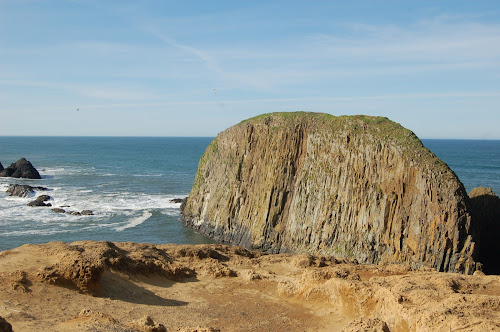
What I can say is this: I definitely think about the esthetic aspect when I'm framing a shot. I'm not really sure exactly what it is I think about, but I often try several different frames and zooms to get a shot that I like. The advent of DSLR's has made that much easier: with film, each shot was a bit less than a dollar taking into account film and developing costs, so a roll of 36 slides was not a cheap proposition. These days, I can fire merrily away, then pick the one or few shots I like. But I definitely want the photos to look appealing.

I tend to focus mostly on outdoor photos, at the scale of a cobble or boulder, to outcrop, to landscape scale. My photos of hand samples tend to be uninteresting, to me, at least.

But it's the comment "These things also have geological information," that resonates with me. There are two broad "topics" that I tend to focus on: things I know and understand, and want to share, and things I don't know or understand, and want to look at more carefully, or perhaps ask others what they think. Time is a huge limit on field trips, but not such a limit in looking carefully at photographs. As an example of the former, here's a recent one from "Islands of Seals:"
Now the fun thing about that one was that it was in that post I came up with a plausible explanation for a photo I'd taken moments earlier of a feature I thought, at the time, I understood, Elephant Rock:
I, like Silver Fox, am definitely thinking about what features are visible in the viewfinder before I press the shutter button. And one nice thing about digital photo technology is that it's easy to mark up and highlight the features I was looking at when I shot the image, as In the Neighborhood of the Splort:
And of course "The Splort" itself is likely my favorite photo I've taken on my new camera. I certainly did not understand WTF I was looking at with this one at the time, mostly because I was focused mainly on what had gone where, rather than looking at and thinking carefully about the faults that accommodated those motions. What I "saw" was a plug intruding down into the surrounding rock, and that just didn't make sense. So, get a picture of it.
A couple of other nice options with digital photography are the options to easily create panoramas, such the not-quite normal normal faults...
(this version has also been annotated) ...and animated gifs: Heeere's Water!
Snow Melt
My feeling about gifs is that they offer an ability to photographically illustrate another dimension beyond the two of traditional photography. Rotating the view can offer a visceral sense of the depth in a view, or as here, the third dimension illustrated is change through time.

So in the end, I think what influences my perspective as a photographer of geology is an imperative to communicate the nature of the planet we live on. The esthetic, emotional aspects are important to me, too, but I guess even if a shot is gorgeous, if it's not telling a story, or part of a story, it's not one I'll be likely to take.

Saturday, February 23, 2013

Outreach Blogging on Blogging Outreach

Yesterday, @eruptionsblog retweeted @JacquelynGill, and I responded thusly. Erik, turn replied:
Now this was illuminating to me. I recall some years ago, maybe eight or nine, another coffee drinker at The Interzone commented that I should blog, because I was constantly making amusing snark about the Bush Administration. At the time, I was employed at OSU, so I certainly had computer access, but I hadn't really started reading blogs yet, outside of a few political blogs. Most of those had purchased or rented their own domain, and I really couldn't afford to do that. And yes, the idea of grappling with HTML was intimidating. I really expected a steep learning curve, with lots of stupid errors on my part at the outset.

It was only later that I discovered Blogspot and Wordpress (and there are others, too) that provide free hosting, within limits. At that point, I was no longer at OSU, but I had inherited my own laptop from my brother, and Interzone had wifi, so I decided to jump in. I had started reading more blogs in the previous months, and it looked like fun. Not only that, I had a growing awareness of others' interests in blogging about geology, and hoped eventually to be able to make some small contribution to that community.

So on May 11, 2008, I registered a blog name with Blogspot, and posted an introduction. Immediately afterward, I started composing a piece on the actual idea that had inspired me to start, which, oddly, was on a math trick I had discovered: a way to determine whether a number is divisible by 11. You can see in those two posts that I could be awkward, long-winded, and funny all at the same time. See, in particular, the disclaimer at the end of the second post.

I actually ended up doing five posts, just that first day. The one on why I decided to call the blog "Outside the Interzone" may be of interest, to those who don't know. As I reread that, I can see I was still feeling awkward in the medium, and I was struggling to find what I now know as "my voice." But that's okay... I can also see (and vividly recall) that I was having fun. I expected few if any visitors, but having a forum to express myself publicly, and others could read or ignore as they chose, was enthralling. I was hooked from day one. And I hadn't even touched geology yet. Though my first post on the 12th was not tagged with the Geology Label, it clearly shows I was thinking about geologic resources. And my first full-on geology post (also the first use of the Volcanoes label) was the following day.

That first week alone, I posted here 28 times. There have been weeks since when I posted more, but not many. Clearly, I jumped in with both feet, and had no shortage of things to write about. Some posts are short, maybe just to share a fun picture, others are longer, and meant to convey some convoluted thinking and ideas. The medium offered me not only a chance to share my stuff publicly, but in what ever form and format I chose.

As far as choosing a platform, I went with Blogspot, because I had a Gmail account already, and that made sign-up easy. But I've worked on Wordpress blogs as well, and find them nearly as intuitive to use in compose mode. If you already know HTML, you're ready to go. I didn't (and still don't, really), but the interface takes care of the code-writing for you. I have learned some tricks over the years, some on my own, and some when I asked for help (Yes, you're allowed to do that.).

As @rschott pointed out,
The geoblogging community loves new members. It's kind of traditional to stop by and give a warm "Howdy neighbor!" to newbies when we find them, and I suspect that's likely true of other disciplines as well.
I've already addressed the above sentiment in passing, talking about my own experience getting started. I commented further, in the conversation yesterday, that it's hard to see, before you start, that blogging takes exactly the amount of time you want it to. Found a cool image, post or site you want to pass along? Type a sentence, load the picture or link, come up with some simple title (I often go with puns, which can lead to problems later, trying to track down an older post, but it's fun for me, and that's the whole point), type it in, and hit "publish." Blam. One-minute blog post. Come across a really terrible bit of journalism you want to spend a couple hours going through with a fine-tooth comb and ripping to shreds? Have a couple hours to spare now? Do it. Have a couple hours to spare later? Do it then. If you have time when you won't be connected, make a text copy to save to your hard drive, write a text copy of your critque in any editor, then copy and paste it when you're connected again. Add any associated links and/or associated graphics, and there's another "quick" post. I've actually done that a number times- I don't have internet at home, for the most part, and that's probably a good thing.

So the effort and time that go into blogging, as I said above, is exactly what you want it to be. Tumblrs are another increasingly popular micro-blogging platform, that is, they tend to be single images or video clips with a short caption, and nothing else. I can't imagine most of those take more than a minute per post (Fair disclosure: I read a fair number of Tumblrs, but I haven't used the platform myself, other than as a consumer).

So whether you use Twitter, long-form blogging, or a Tumblr style format, is entirely up to you. And there is absolutely no reason you can't work on multiple platforms. I know plenty of people who use two of the above, and a few who use all three.

Now while it may seem as if I'm focused on the geoblogosphere on this topic, I'm merely emphasizing that because that's the community with which I'm familiar and can draw from for examples. I'm sure there are similar communities and experiences for every discipline and human endeavor: supportive people sharing similar interests, passions, and who feel strongly about the importance and the need to share that area with others. This post is just my attempt to encourage you, if you aren't active in social media, to set your worries aside and just jump in. Give it a try. If you're truly unhappy with the results, you can delete it. In blogging, you can leave posts saved but unpublished, or schedule them for a future date and time. So if you have cold feet, you can write up your first post (or first few posts), show them to someone you trust, or come back to proofread and edit with fresh eyes. I give myself permission to edit out typos and grammatical errors any time, if they bug me enough. Factual errors, I prefer to strike out, then add a correction after. This acknowledges that yes, I said that, and your memory isn't playing tricks, but it's wrong and here's what I now think is right. But the point is, you get to make your own decisions.

And that, after the strictures of trying to conform to others' expectations of how you "should" write, is an enormously liberating and rewarding experience.

I haven't finished everything I want to say on this topic, but the post is long enough, and I'll come back and finish up with some comments on things that, in my experience, have made me and my readers happy, and perhaps increased my readership.

Thursday, January 31, 2013

When Am I Thinking of the Thing, Itself?

The above just came through my Twitter feed. It's a retweet by someone I do follow, from someone I don't, so I've anonymized it.

When I was working in science ed, one of the things I think was valued about my input to discussions was my persistent need to tease out meanings of words, concepts, things. There are often meanings that are presumed by groups that go beyond formal definitions, and formal definitions often do not evolve to keep up with shifting nuances of meaning. I can't help but poke and prod at things like that.

One extended conversation, over several days, seemed to have most people either stumped, or bemused about why I thought it was important- and have no doubt, I did think it was important. It was my comment and question, "When I reflect on my own thinking, I find that when I think about a thing, I think in terms of images, metaphors, and similes. In other words, I think about the thing in terms of other things, not the thing itself. When am I actually thinking about the thing itself?"

Now that was a puzzler. Some suggested it might be that we do in fact think of all things in terms that are simply relational- that is, nothing has meaning except in terms of other things. I wasn't really satisfied with that; to me, it seems tautological. As I mentioned, some shrugged the question off as not very important, but it seemed to me that questions of individuality and uniqueness required a thinker to know what was distinct about "the thing itself." And that was what led me to a satisfying answer.

My solution? "I'm thinking about the thing itself when I'm thinking about how the thing is different from the images, metaphors, and similes I use to think about it."

Thursday, January 17, 2013

Up-Goer 5

In homage to Randall Munroe's brilliant, now-classic, comic, Up-Goer Five, the Geoblogosphere's meme du jour is to write about what each of us does using only the 1000 (10 hundred) most common words in (I presume, American) English. The Up-Goer Five text editor makes the job pretty painless. Here's my entry:
I like rocks. Also high places that sometimes act like they're on fire. But what I really like is sharing what I know about rocks and high places, and how those things came to be. What made them? What moved them? Why are they the way they are? I think the answers to these questions are important, and I think people should know more about them. So I use words and pictures to show everyone how beautiful and amazing rocks and high places are, why they're important to us, and why it's important to know about them. Sometimes I even get to take people to see rocks in real life, which is the best part of what I do.
When I saw the first example, from Anne Jefferson (@highlyanne) yesterday, I dismissed the exercise as frustrating, and very time consuming, as I expected to burn hours trying to find synonyms. But when I finally decided to give it a shot, it only took a few minutes- I probably spent more time on the second sentence than the rest of the paragraph, when I tried to find some way to say "volcanoes."

Highly Allochthonous is keeping a running list, with new additions coming into the comments. So additions will be rolled into the list later this evening. If you haven't already, give it a shot!

Update, Jan. 18: Anne Jefferson and Chris Rowan have created a Tumblr, "Ten Hundred Words of Science," to archive all the terrific entries, which have come in torrents. And not just earth science, but across the board. Don't miss it!

Saturday, January 12, 2013

Teaching Controversial Topics 101

Jessica Ball, AKA Tuff Cookie, AKA the author of Magma Cum Laude, earlier asked a question to which I can relate: namely, how does one approach teaching a (potentially) controversial subject?

First, you want to make sure you know your stuff. Students can smell instructor uncertainty. Definately familiarize yourself as well ahead of time as you can with the textual material your students will be using. I've seen a decent student in science ed get chewed up and spat out because he was really not qualified to TA the subject matter- he didn't have to take that position, he had other options, but thought it would be "fun." I was teaching a different section of the same course, and in some ways was a bit better prepared- though not academically. The difference was I had an interest in the material, I had done plenty of reading about it on my own, and I made sure I understood it better than the students were going to be expected to. I can honestly say the same would be true on the topic of climate change- I've had little formal classwork on the subject, but it's very interesting to me, and I've done a lot of independent reading on it. Below is a list of climate and related blogs/sites I follow in RSS, and a brief sketch of the value I get from each.

Arctic Sea Ice News & Analysis- This may seem like a very esoteric topic, but Arctic sea ice appears to be the most sensitive component of out planet with respect to climate change. It can be viewed as the "canary in the coal mine" or "bellwether" for the rest of the planet. And this is the go-to site for data tracking daily to long term trends in the ice pack up top. Their monthly, seasonal, and annual summaries are don't miss. And their coverage of the approach to least extent in mid-September is stunningly good and gripping.

Arctic Sea Ice Blog- This guy makes no pretense of being an "expert" (do take a moment to read the disclaimer) but he's clearly no slouch, and clearly finds the topic fascinating. He's also very good at finding important statistics and data.

Real Climate- Gotta be honest, this one is generally a bit too wonky for me. I generally skim the posts enough to get the general gist, then skip the gory details. Still, it's a good one for keeping abreast of current news.

Open Mind- One of my favorites of the bunch. There are times when the detailed approach to stats is more than I want to wade through, but generally readable. In particular, Tamino goes out of his way to bluntly take down nonsense from deniers, with Anthony Watts front and center (See "Dishonorable Mention," below).

Jeff Master's Wunderblog- Not a "climate blog" per se, but weather-focused. I think Masters would be among the first to point out meteorology and climate science are different (if related) disciplines. However, news related to climatology pops up there regularly- such as today's post on billion-plus dollar disasters and top ten meteorological events of 2012.

Dishonorable Mention: Watts Up With That? Not recommended as regular reading, but you should know what the deniers are up to... and Anthony Watts is probably the highest-profile denier out there. I often find his posts through links from take-downs, and there is a certain pleasure in reading one and spotting the fallacy (or fallacies) on one's own. The errors take on a few standard forms: misrepresentation or faulty selection of data, misunderstanding or faulty implementation of statistical methods, conflating adjustments to data (which have been debated, discussed, and finally accepted among a large community of qualified scientists as providing better accuracy) as "fudging" or "making up" data and so on. And when all else fails, fall back on ad hominem attack, which in some circles is apparently a valid debating tactic.

Continuing, it also helps to have enough confidence to flatly state "I don't know," when that's accurate. And if the question is important enough to merit it, follow though and find out- then share the answer with the class and/or questioner as seems appropriate. On the other hand, do not promise to follow through on every question. Many are trivial (there's no harm in curiosity, but it can waste a lot of time), and in many, many cases, it's as easy for the student to Google the answer as it is for you. (I love LMGTFY, but it's a bit too snarky to use on any but the most pesky student.)

Don't proselytize. Your job is to inform, not convert. My attitude with respect to evolution was "I don't much care if you 'believe in' evolution or not, but I expect you to understand why most scientists do." For example, I *understand* the tenets of Christianity pretty well- enough to discuss them intelligently- and I think that's important due to the profound cultural impacts of that belief system. That doesn't mean I believe it. Likewise, I understand the ideas, and wonderful twists of logic in "Alice in Wonderland." We each have the freedom to choose what we do and don't believe, but in an academic setting, choosing not to know the consensus in terms of facts has a price- several prices, actually. Grades, advancement, and future performance are all at stake. Letting students know you're looking for understanding, not agreement, can defuse an urge to "push back" against a perceived "agenda." Along similar lines, accept dissent calmly, but ask for reasoned supporting evidence. [Followup: was just outside for a smoke, discussing this with another IZ patron. His comment: "It's like a comparative religion class. The goal is obviously not to convert anyone to any particular religious belief system, but to get everyone to a certain level of understanding."]

I just went back to figure out exactly what the position was; don't be afraid to ask your team-teaching prof- who presumably has much more expertise and experience- for advice, especially when/if sticky situations come up.

Since many topics of this type can be bleak and depressing, find and keep success stories in reserve. How does this relate to controversy? When faced with what seems like inevitable doom, humans are tempted toward two options: fatalistic acceptance, or denial. Both lead to doing nothing. Remind students often that we actually do have quite a number of options for coping with climate change. Some will likely not work out, but some probably will. I personally would like to see more work done with mineralized carbon sequestration- that is, tying up CO2 in carbonates. In the end, if we find effective mitigation techniques, my suspicion is that it will involve a number of measures, not one "magical cure." A favorite example of mine is the ozone scare of the late 80's and early 90's. While ozone depletion is still a bit of a problem, it's getting better. We banned CFC's, and I don't think most people even noticed a blip. There are some problems with some of the replacement chemicals, so the issue is not 100% solved, but for the most part, it's a success story that the vast majority of the public never heard, or have totally forgotten.

Finally, I think the comments by others on that post are thoughtful and helpful. I'd especially like to follow up on Ron's regarding science versus policy: they are two different things. The task of science is to inform and guide policy, not create it. Sentences like "science says the consequence of doing x is y," are useful. Those like "science says we must do x,." are not. Policy has to take into account a bunch of factors like costs, human nature, practicality, benefits, and motivation, that science does not.

Good luck. As I wrote in my quick note, I don't think controversy is something to be "worried" about, but it's not a bad idea at all to be aware it could cause problems, and be thinking proactively about ways to mitigate or avoid it.

Wednesday, November 28, 2012

AW #52: Geology Dream Course

Note: This wedge has now been accreted at Agile Geoscience.

For Accretionary Wedge number 52, Shawn asks us to expound on a dream course in geology. I'll start by pointing out I've already taken quite a few courses that were ever so much more exciting and engaging than I could have imagined they might be. One that comes to mind is "The Tectonic Evolution of Western North America," by Bob Yeats, which was both far more complex and far more fascinating than I had any inkling it might be. And the Petrography/Petrology Sequence by Harold "Sharkey" Enlows... perhaps the best indicator for that one is that we were expected to spend 6 hours of scheduled lab time per week on that one, and I regularly spent 12 or more hours, just so I could see and learn more. It seems selfish to ask for other courses I might take.

One option offered is to design a course we might like to teach. I'd been contemplating sitting this one out, but a confluence of factors has forced me to choose otherwise. First, most geology people love their subject, and I'm no exception. Second, as I've said before, first and foremost, I consider myself to be a teacher. I can't help it. If geology comes up in conversation, I'm going into teaching mode. Internally, the discussion goes, "What do they know? What do they want to know? How do I get them there? What is the minimum of new information I need to bring up to accomplish that?" Then off I go. Third, another point I've made repeatedly is that I'm often appalled at the lack of regard and respect for the earth sciences, especially given our dependence on both the planet's resources and comparative peacefulness, even as we deplete the first and disturb the second. Finally, and I don't know that I've mentioned this, the main work I've actually done in science education involves curriculum design and evaluation. I don't bring it up much, even in face-to-face conversation, because I find it extremely tedious. It also happens to be in high demand, but people don't want to pay for the background, effort and patience it takes to do it right- much like the rest of education.

So it seems obvious I should come up with a course that helps address my concerns in point three, while enjoying aspects of points one and two, and taking advantage of my skills in point four. What I've come up with is a class with the working title, "Earth Systems and Society." As an overview, it would provide a minimal background with respect to geology and other earth sciences- notably oceanography and meteorology; it's focus, as the title indicates, is really more on the interactions of earth's systems and the human population those systems support.

I've spent enough time on this that, while the outline is more telegraphic than I might like, I think it's fairly clear what I might do with a class like this. This is by no means developed to the degree I would normally expect, but I do think it works as an outline.

Prerequisites: {What I consider to be a basic high school math education:] Algebra I and II, geometry and trigonometry. Basic skills in written English and expository and persuasive communication.

My philosopical positions/assumptions:
  • Western culture generally, and US culture particularly, does not grasp the intimacy and necessity of human interaction with earth systems, let alone the complexity and feedbacks that can make those relationships profoundly difficult to grasp in their entirety.
  • This is particularity true of people in non-science disciplines.
  • Too few people are well-educated in science to substantively shape national and international debates on issues that not only affect all of humanity, but in fact make the medium to long term survival of Homo sapiens a question of real concern.
  • Despite the overall complexity of interactions between Earth systems and society, individual components are intuitive and easily grasped. The difficulty lies in trying to plausibly project the outcome of simple processes and actions interacting with innumerable other processes and actions.
  • Science does not reach social decisions, but informs them. Thus other social skills- including communication, argumentation, processes of political valuation, along with the values of disparate interest groups and individuals- are of great importance in applying and using scientific results
  • To address the problems outlined in the above points, I propose a class focusing on 1) Simple facts regarding earth systems and processes, 2) opportunities to think about and practice projecting how different processes can and do interact to create outcomes that might not necessarily be intuitive, but nevertheless can be foreseen.
To assure the broad goals of this class are addressed and achieved, the following approaches will be important:
  • Start with broad frameworks and the most familiar aspects of earth processes.
  • Move into less familiar processes, but still focus on broad frameworks.
  • Work toward more specificity in various earth system/resource knowledge as term proceeds, while at the same time frequently tying new knowledge back to broad frameworks.
  • Revisit earlier topics frequently and explicitly, to illustrate interactions, reiterations.
  • Expect students to be able to use basic algebraic skills; simple mathematics will play an important role in homework. Students should be able to work with scientific notation.
  • Expect students to show competence with written English.
  • Ramp up critical thinking, evaluation and critical skills expectations as course proceeds, with extensive feedback to written assignments ahead of two major written works, along with at least one required review of each draft of latter, and other reviews as requested by students.
  • Given my background, the solid earth will ground the course [heh], and other component systems will be related to that foundation. However, those based in other science disciplines should have no problem approaching this from another basis, for example bio-science, oceanography or atmospheric science.
  • Above all, keep it exciting. There is much that can be frightening in this topic, but always balance potential scares with potential solutions, alternatives and adaptations.
General Outcomes: Students will be able to
  • Review and analyze environmental risks of a small (>50 km sq, about the area of a medium-sized town) area of their choosing, using historical media reports, skills and knowledge developed in class, along with information from relevant local to national level government agencies. Other source materials should be cleared with instructor. (This will be the final project, and I want to avoid asking S's to go to primary literature.)
  • Recall fundamental terminology and concepts accurately, and use it appropriately in context.
  • Give multiple examples of the concept of opportunity cost, and explain factors that can lead to forgoing more valuable opportunities for less valuable opportunities in terms of earth resources.
  • List ways to increase preparedness, and decrease risks of injury and mortality, with respect to a number of different natural hazards (e.g. floods, earthquakes, tidal surges, tsunamis, lahars, volcanic hazards, etc.)
  • For selected hazards, describe methods of avoidance (e.g. floods, tidal surges, tsunamis, lahars, etc.)
  • Given examples of common household items, describe earth resources used in the production of each.
  • Describe current thought regarding global climate change. This is not intended to be ideological, and I don't care whether you "Believe in it." Even if you don't, you should be able to explain accurately why others do, and in general terms, what their predictions are.
  • Describe feedbacks that could worsen or moderate climate change.
  • List and explain examples of resources whose availability may potentially be affected- for better or worse- by climate change.
  • Keep a log (or blog, preferably) of media stories about earth resources, hazards, processes, and other stories relevant to the content of this class. Include comments, which should note strengths and weaknesses of the story, "flashing lights," that is, evidence that the story should treated with caution or skepticism, and thoughts of how the topic covered in this story relates to other topics relevant to this class.
  • Given hypothetical situations (or generalized portrayals of real situations), create an argument to support one of two or more options. The point here is not to have the "right answer," but to muster pertinent information to argue for one choice from what might be a number of options. As an example, Federal, state and local governments heavily subsidize rebuilding after floods and coastal storms. This encourages people to rebuild/use resources in areas that have in the immediate past been proven vulnerable. Potential options for this problem include 1) The system works as it is, albeit with weaknesses. Don't change anything. 2)a] Require those in vulnerable areas to purchase government-subsidized insurance; 2)b] Require insurance coverage that reflects the best assessment of real risk; 2)c] Require insurance that is overpriced with respect to real risk, thus discouraging development in vulnerable areas. 3)a] Prohibit rebuilding in areas that have been proven by experience to be high risk for calamitous disasters; 3)b] Prohibit rebuilding in areas that have been proven by experience to be high risk for calamitous disasters, with exceptions on a case-by-case basis [e.g, sites of historic importance]. 4) Some combination or variation of the above possibilities, or [an]other[s], suggested by student.
  • An important component of the course will be a summary and conclusions essay. This should be about 3 pages long, and discuss the following: 1) What topics regarding resources, risks, and earth systems should be addressed by your state and/or local government in the near future? 2) In what ways do you think this course may affect your thinking and future decision-making with respect to natural and man-exacerbated risks and hazards, and consumption of resources? 3) What topics in this course did you find of particular relevance or interest? 4) What aspects of this course were less interesting or less relevant? 5) Overall, how would you rate this course? As with the previous point, I'm not looking for any particular answer, but rather your choices regarding the pertinent information you bring to bear and the coherence with which you frame your answer. I'm thick skinned, so don't be afraid to be critical where it's warranted. I suggest you start keeping notes in whatever format is convenient and effective for yourself from early in the term.
[I've spent my career and entire college student-hood in a quarter system- my feeling is that this might be too much for what I think of as a ten-week term, but it might work better in a semester system. Nevertheless as an outline, here's a general overview of what I'd like to tackle. Each bullet represents a lecture & discussion- format class period, with the exception of assignments due at the ends of weeks 8 and 9.]

Week 1
  • Intro, rationale, overview/outline, "deep time" and intro to surface processes
  • Fluvial processes
  • Mass Movement
Week 2
  • Internal processes: plate tectonics and the big picture. Global outline of active areas
  • Seismicity
  • Volcanism. Focus on North American tectonics.
Week 3
  • Integrating surface and internal processes: the consequences of an active planet
  • Exam
  • Geosphere-atmosphere interactions
Week 4
  • Geosphere-hydrosphere interactions
  • Interactions [of previous 3] with the biosphere- elemental cycling
  • The centrality of life in creating earth as we know it today: the importance of microbes and "The age of bacteria."
Week 5
  • Living on a limited planet: risks, hard walls, options, and choices
  • A delicate balance: to use or not to use.
  • It's complicated. Land and resource use versus natural, man-made, and man-exacerbated hazards
Week 6
  • Exam
  • Stuff we take for granted I: energy resources
  • Stuff we take for granted II: metallic resources
Week 7
  • Stuff we take for granted III: industrial and construction resources
  • Stuff we take for granted IV: water and land
  • Stuff we take for granted V: an unchanging planet [climate and other large-scale environmental change]
Week 8
  • Site-specific risks: thinking about risks from floods and mass movement. [do so before land purchases!]
  • Site-specific risks: thinking about risks from seismicity and volcanism. [and special associated mass movement risks]
  • Site-specific risks: atmospheric phenomena and erosion
  • Final project due
Week 9
  • A culture blind to earth systems
  • How to talk to others: dos and don'ts
  • Reasons for optimism: it's too easy to be fatalistic. Life is and has always been a puzzle with lives at risk.
  • Summary and Conclusions essay due
Week 10
  • Study session, Q&A
  • Final Exam
Now, in honesty, I don't have the stamina to teach anymore- I get tired too quickly, and apathy can shut me down without warning. Even if I was offered a generous salary to teach something like this, I would be hesitant to accept it. I'm very reluctant to take a job I'm not certain I can complete. But the fact is, I think this would be a very good experience for non-science folks: enough science to be a valid science "credit," but at the same time, drawing in aspects of life most people wouldn't think of as "hard science." Geo-types get exposed to this kind of uncertainty and ambiguity over and over again throughout their education and career. The thing that I'm curious about is can a similar education be condensed into a one-term class for non-science folks?

Sunday, September 23, 2012

Willamette Valley Geology Online Resources

Last Saturday I presented for a workshop on Willamette Valley Geology for the Oregon Master Naturalist Program (henceforth OMN), an outreach program by Oregon State University. I'm now switched over to my new (to me) rebuilt computer, and while I'm not very accustomed to it yet, browsing and reading is definitely going faster than on my old machine, and it looks like I'll have more time to blog.

One of the components I was requested to submit was a list of online resources, and there's no doubt in my mind that first among those are posts by our wealth of PNW geobloggers, so that makes up the bulk of this list. Note this is not organized by topic, but primarily by blog and the order in which I found them.

In other notes, I'm initiating a label for OMN, to indicate topics that may be of interest to that group- I'll be primarily focused on earth sciences, but will likely include broader science topics dealing with Oregon's fabulous natural history.

Uncovered Earth (Michael Klaas, Portland, Oregon) http://uncoveredearth.com/

En Tquila Es Verdad (Dana Hunter, Seattle area) http://freethoughtblogs.com/entequilaesverdad/

Got The Time (Aaron Barth, recently moved to Eugene, Oregon, just moved from VA) http://iapetancaptain.wordpress.com/

Outside The Inerzone (Lockwood DeWitt, Corvallis, Oregon) http://outsidetheinterzone.blogspot.com/

Fluvial (stream) Geomorphology (landforms)

New things- posted or found since the above were submitted in August:

Saturday, August 18, 2012

#FakeElements

I've mentioned how Twitter hashtag games work before- sometimes, as with that example, they're meant to be satirical. Other times, they're just for fun. Today's was, as the title of this post suggests, #FakeElements. And the gist is exactly what it sounds like. Feel free to add your own suggestions in the comments.

First, the ones I came up with...
  • The element of style: strunknwhitium
  • Anti-nitrogen tentatively named daytrogen.
  • Likwise, anti-hydrogen tentatively named lowdrogen.
  • The element of suspense: bungium
  • The element of surprise, booron
  • The basic unit of stupidity: bozonium
  • The smallest indivisible particle of music is auram.
  • Of course, there's always the criminal element, hoodlium.
  • Fundamental building block of modern journalism: echonium.
  • Most dangerous element: conservatonium.
  • Criminal who becomes successful comedian while in prison: sillycon.
  • Main element of bullying: tauntalum.
  • Important element of sporting events: hooraynium
  • Elemental basis for economy without currency: antimoney.
  • Element often spotted on summer porches: geranium.
  • Element of outrage: scandalum.
  • Most precioussss element: gollium
  • Element responsible for pine smell in sunshine: solfir
...then some favorite others, with attributions:
  • @TonyNoland Element found in shining armour: knightrogen
  • @TonyNoland The element orthopedic surgeons love: kneeon
  • @TonyNoland Element found in most antibiotics: healium
  • @TonyNoland Most essential element in taxidermy solutions: hiderogen
  • @UncleJago  Belgium
  • @eroston Material for sculpting heroic statues left to ruin in deserts: ozymandium.
  • @TonyNoland The key ingredient in linoleum polish: floorine
  • @DrMRFrancis The element that hogs all the electrons and doesn't bond with anything else: aynrandium
  • @DrMRFrancis The heaviest element: yomamium
  • @4ndyman Kardashium (formerly Hiltonium) is seen all over the place. It's a beautiful element to look at but serves no useful purpose.
  • @jon_e_7 #FakeElements Bury 'em: an element found mainly in the American west and Clint Eastwood dialogues
Now oddly, a game that I played both as a high school student and as a student teacher was pretty much the opposite of this. The teacher gives a list of punny descriptions, and the student is supposed to figure out what *real* elements fit the descriptions. For example, "Member of Troy's after-dark guards" would be night Trojan, or nitrogen. A member of the same city's tower watch would be a high Trojan, or hydrogen. "What doctors do with their mistakes" is bury'em, or barium- which in fact shows up above.

Either way you come at it, it's a fun game.

Saturday, June 9, 2012

Twice in a Lifetime

...And as best as I can recall, I missed the first opportunity because it was too early in the morning and the weather was expected to be cloudy. But on Tuesday, we had decent weather- mostly clear skies, with some broken clouds- and a great chance to watch the last transit of Venus for 105 years. And thanks to discussions by other bloggers following the annular eclipse (partial, here) two weeks ago, I learned how to project an image with one side of my binoculars. And the quality of the projection far exceeded my wildest expectations.
Interzone people gathered around the projected image, and below, what we saw:
Our high-tech equipment...
The paper is 8 1/2 by 11 inches, so not only was the image sharp and bright, it was a good size, too.
 Below, a crop from the above photo, with labels.
And another view of folks gathered around enjoying the show:
The best part? I've since had three people come up and tell me they went home, got out their own binoculars, and gathered little crowds of their own. In the words of Douglas Adams, "Last chance to see!" There will be a transit of Mercury on May 9, 2016, and with that planet both smaller and more distant from us, it will be more challenging to view. But I'm very impressed with this projection technique- it's far superior to a pinhole viewer- and I'm guardedly optimistic we can pull it off.

Addendum: Today's APOD shows the image quality you can get with good equipment. In this case the Hinode satellite.

Friday, August 12, 2011

The Imperative of Questions

This post is dedicated to Dana Hunter, who seemed particularly unsettled by my endless questions when we went to Marys Peak and the coast last fall. I'm going to spend five long days with her very soon, and thought she at least deserved to know that my questions are not intended to be "tests." They are, in fact, much more subversive and manipulative than that. Fair warning though: knowing what I'm doing and why will not free you from the effect I describe. ;)

There are two main reasons teachers ask questions: assessment and motivation. Assessment can either be formative (trying to figure out where students are in terms of knowledge and understanding, so one can more effectively and efficiently guide them to your goals and objectives) or summative (trying to determine if they have indeed arrived at the set objectives). Motivation in this case means that students are more likely to mentally engage with a topic at hand if they are frequently and regularly asked questions... and particularly if they expect to be asked questions, and expect to be obligated to answer them.

One of the reasons I left teaching was the disgust I feel with our society's obsession with grades. Is that the only reason we have to learn any more? Well, for some, yes: "You teach a child to read, and he or her will be able to pass a literacy test." -Townsend, Tenn., Feb. 21, 2001. BRAAAPP! Sorry, Dubya, you get to start over with grade one. So the idea of questions as "tests," while necessary, an unavoidable component of traditional teaching, important, justified, what have you, is just distasteful and offensive to me. I rarely ask those sorts of questions.

I sometimes ask questions to figure out what I need to clarify. I was going to tell my hipster geology gag about thalwegs to a student in environmental science, but asked first if he knew that term. (he did, and loved the joke). So formative questions can be quite useful to figure out what background you need to cover before getting to the meat of the subject at hand, and I ask these sorts of questions fairly often.

But it's the "motivational" questions I really love. Educational research has consistently shown that it's more about the frequency and expectations students have for questioning than the cognitive level, difficulty or complexity of the questions. Obviously, for advanced learners (i.e. upper level undergraduates and up) some of the questions need to be demanding. But the expectation that there will be questions, and that the learner will be expected to give some kind of response, do the most to keep the mental faculties engaged.

There's also a side issue which I think is best claimed as a matter of personal opinion and educational philosophy- I don't know that I've read the perspective I'm about to present elsewhere.

I view questions as a sneaky, subversive and somewhat unfair- though completely ethical- opportunity to issue imperatives. If I say "Describe that outcrop," and do it often enough, I will come to be seen as abrasive and even dictatorial. On the other hand, if I wave and point at an outcrop, and with a smile, ask "What do you see?" then wait... The student has been given almost no guidance, and is generally not sure what specifics I'm after (because more often than not, I'm not after any particular thing[s], specifically), and may not even be sure where to start, yet there I stand, bemused grin smeared across my mug, waiting... This is a powerfully motivating situation for students. Why? Perhaps it's fear of failure, or the fear of looking diminished in the eyes of an instructor. I'm honestly not sure, but it's a very real feeling that I have experienced myself many, many times. In my own case, I think it's mostly a matter of living up to my own expectations for myself ("C'mon, dude, you oughtta know this one..."). But I recognize that widened-eye flicking of students' minds racing when I see it. I feel a slight pang of guilt sometimes, because I don't like that feeling of cognitive near-panic either. Still, I know that working through it can lead to some powerful learning experiences, so in my estimation, it's worth it.

So when I hand you a rock or point out an outcrop, and ask an innocuous question like "What do you see," or "How do you suppose that might have happened," or "Why is that growing there," or any of hundreds of other open-ended questions for which there is not and cannot be a single "right" answer, I'm not testing you. I'm telling you to look and think. Because questions are an imperative way to do that in a much more effective and much less irritating manner than pointing at an outcrop and saying "Look! Think!"

Or if you'd like the blunt version, I'm messing with your head.

I'm a teacher at heart. That's what I do.

Thursday, April 7, 2011

Geology for Clowns

(BizarroBlog) I've actually done this activity with kids to illustrate how density differences can cause rock and mineral grains to segregate. It didn't work too well- just separating black sand by panning works much better. Let me 'splain why. First, pyrite fractures conchoidally, and like glass, it's very sharp on broken edges and corners. So after picking numerous bits of mineral grains out of my finger tips following a trial run, I decided to do the actual classroom activity with the whole crystals, which were in the form of pyritohedrons a few millimeters in diameter.

Okay, so pyrite in that form is no big deal to geologists... but to middle-school-aged children, it's an amazing, wonderful material. They had no patience for the panning thing; they just picked the "nuggets" out of the sand. They had a great time, learned quite a bit about pyrite, and went home with (what to them were) some pretty special specimens. But they didn't quite get the point I wanted them to. And that's really the crux of whether a lesson is effective or not. Like I said, my own assessment was that this lesson didn't work too well.

Funny, the paths a comic can lead my mind to wander...

Saturday, January 15, 2011

Go Ahead. Ignore It.

Wil Wheaton's Tumblr. Followup: I thought this looked like a Saturday Morning Breakfast Cereal panel, and it is.

Wednesday, December 8, 2010

Finals Week

So we reach the end of yet another term here at Oregon State. For those of you students who are stressing over finals, two notes: first if you keep up through the term, finals just aren't that big of a deal. Believe me, I know how tempting it is to procrastinate to the end, but the price you pay is serious stress now. Second, this is by far and away the worst week for instructors and profs as well. I have spent my fair share of time both taking finals and doing projects, and grading them. I would much rather have to take a test or do a project than grade dozens of them. Just sayin'.

As I'm out of academia now, neither concern is one that troubles me much anymore. Many, if not most, of the students have finished their terms, and the streets are noticeably quieter than they were yesterday. By Friday afternoon and the weekend, Corvallis will be dead quiet. I have a love-hate relationship with the university and with breaks: I miss my friends when they're not here, but I enjoy the peace when OSU is out of session. By the end of a term- or the end of a break- I'm ready for change. I grew up in a university community, Ohio University in Athens, and have spent most of my life living with the rhythm and seasons of academia. I can't imagine living without that pulse now.

Wishing you and yours the happiest of Holidays, Peace and Re-Creation as needed, and luck with end of term duties, whatever they may be.

Thursday, September 30, 2010

Accretionary Wedge #27: Important Geological Experiences

NOTE: If you submitted a post for this AW, and don't see it here (or know of one that I didn't include) please leave a comment and a link.  I'm almost certain I lost at least one in writing this up, maybe more, and it's quite possible I simply missed others.  Thanks for your help. I'll leave this note up for a while, then clip it off when I cross post to the AW blog in a few weeks.

A few weeks back I suggested a topic for the next AW, important geological experiences:
It may (or may not) be something that led you to the discipline , or a class, or a work experience, or a field experience. It might have been a puzzle or problem solved, or job landed, a degree completed. Perhaps it was something else entirely. It could have been an awful, disastrous experience from which you learned an important lesson. Maybe it's still in your future- something you're looking forward to. Additionally, explain why it was important.
The response has been nothing short of overwhelming.

It has left me with something of a problem- how to organize it?  After reading the posts, I went back though and loosely organized them into somewhat arbitrary themes that stuck out in my mind: "New faces, New places," "Thinking it through, Working it out," "The Real World," "Limitations," and "Field Camp." Many people's experiences included aspects of two or more of these themes, so I have pigeon-holed mercilessly. Without further ado, here are the submissions.

 New faces, New places
This theme developed around the pattern of people engaging with landscapes, people and cultures that were formerly new or even alien to them, and finding wonder.
(From here- link #1 under "Photographs-" inspired by Coconino's post)

The first submission was from a high school friend, Steve, who is not a blogger or a geologist, but whose geological future looks somewhat ominous:
I have a candidate, a twofer: a young French friend of ours was in Chile with her boyfriend (now husband) when the recent big earthquake struck, staying in the same beach resort where some of the most dramatic photos were taken, and then, a couple weeks later, she was in Paris when the volcano in Iceland blew its top,and as a result she was one of many left stranded, unable to return home, because of the volcanic ash. Personally, it makes me a little nervous that she's now living in Albuquerque, close to me and mine, and close to the Valles Caldera...
Michael Welland at Through the Sandglass had the experience of getting gnashed between the grinding plates of geology's great paradigm shift in Innocent Abroad.
For my presentation I brought out several plate reconstruction graphics that I had hauled across the Atlantic; I put these up on the wall of the seminar room, and launched into the story – the Cambridge (UK) edition, that is. And then it happened. The imposing voice of Bernie Kummel interrupted my narration – and he was coming down on me like a proverbial ton of bricks. A sense of shock and horror came over me: Bernie Kummel, the Bernie Kummel, didn’t believe a word I was saying.
Ian Stimpson of Hypo-theses fame relates a (mostly) solitary adventure in a foreign land, and brings to our attention another emergent theme among geologists: the stress of feeling alone, but in some way obligated to find "the answer."
Prior to this our mapping training was done as buddy pairs but here I was on my own. We wouldn’t be allowed by health and safety regulations to do this today, which is a real shame because it was a wonderful experience. It was just me against the rock. I had to sort things out for myself. It took me about four weeks to work out why in one part of the area the bedding/cleavage relationship was telling me that the beds were upside-down where as I knew from the stratigraphy that they were the right-way up. It was a struggle, but I cracked it – myself.
The next couple of entries highlight the disproportional influence just one or two mentors who care can have on a young geologist's life path. History of Geology's Dave Bressan discusses how getting away from the dry structure of a discipline, and focusing on enthusiasm can make a world of difference.
This changed suddenly; the next lecture was hold by a new visiting lecturer - with a complete different approach. Even if the step by step procedure of plant determination was inevitable, the mood was noticeably better, there was an introduction at the beginning of the lessons about the characteristics of the plants we should observe, and inevitable errors perpetuated by us beginners were not ridiculed, but explained and resolved.
And in what I nominate as one of the most deeply moving geologic experiences of all time (of all time!) Matri describes her transition into geology under the guidance of a professor who truly understands what it means to be a mentor, in "Of Honest Teachers and Precious Rock Hammers." My sniffles and watery eyes are just allergies.  Seriously.
...through the course of the semester, Professor Chen noticed this curiosity and indecision on my part, and went out of his way to convince me to enroll in UIUC’s geoscience program of study. During office hours, he would honestly and tirelessly list all of the degree’s challenges and, like every good Asian parent, none of its rewards. That mineralogy required chemistry and optics, being able to identify thousands of minerals and late hours in the lab. That the geology curriculum required geophysics which in turn needed linear algebra and differential equations and three physics classes including electricity & magnetism. That structural geology was difficult for many but I should take it the following semester when it was offered. That much field and lab work was required on weekends. That distinction and honors in the program (and he expected no less) came only with undergraduate research and a thesis. That beyond here were graduate school, more graduate school and, maybe some day, a postdoctoral position and then the tenure track. Was this man insane?
Coconino of Ordinary High Water Mark discusses a youthful memory from another land and a shocking realization that "impossible" landscapes do exist- an experience I know I've had, and which I suspect most of us share.
It blew my mind that day, that mountains did "grow" that way, that the art I had seen was not all wrong. I looked at those slides with wonder and awe. And they inspired a love of landforms and earth processes I've never lost.
Kyle House and I share this much: we moved to the Pacific Northwest, and if not overwhelmed by what we found, we were certainly whelmed, fair and square.
...when you are a typical kid growing up in Texas and Oklahoma, you think the only mountains in the country are in Colorado. Then, if you take a trip to Seattle on a clear day and see the unthinkably huge, ice-laden edifice of Mt. Ranier looming over the city like no mountain you have ever seen in your short life, all bets are off. Everything changes. The Cascades blew my mind. Surprisingly (or not), I was such a slacker in 1980 that Mt. St. Helens never registered for me (even though I was 15 at the time). But once I got to western Washington only three years later, my life changed forever. I was completely enthralled by the scenery and the juxtaposition of ice-clad volcanoes and the ocean.
Anne of Highly Allochthonous describes a flood in the middle of the Australian desert.  Desert downpours and flooding have fascinated me since my first visit to the Grand Canyon, and I'm a little jealous: I still haven't witnessed a good rainstorm in the desert.  On the other hand, I have to admit some of her description gives me a case of the willies.
But while the floodwaters had passed in Alice, there was still LOTS of water in the desert. As desert roads aren’t always equipped with bridges, there were several places where the vehicles had to ford slow-moving or ponded water. Even in college, I was enough of a river rat to know that driving across a flooded roadway is a great way to get yourself killed and I remember lots of consternation at the prospect of the water crossing pictured below. But we were literally in the middle of nowhere so my options for abandoning the trip were limited and after watching at least a dozen other vehicles ford the water, my friends and I got back on our bus and safely made it across the remnants of Rosita’s rain.
Thinking it through, Working it out

 A central theme of geology- one I sometimes wonder if we spend enough time discussing explicitly- is developing stories, narratives and explanations for how something came to be.  It can be stressful when facing this imperative the first few times, though as we'll see in a later section, geologists learn to cope.
(The Far Side, by Gary Larson; picture from here, inspired by the coincidences and others that can lead us to the conclusions we claim as our own)

Geology Happens reminded me of a post from early summer of 2009, when he realized that landscaping gravel was full of familiar rocks, leading him to recall how
...with some simple tools I could interpret a rock, a outcrop, a road cut and even a mountain range. This idea shook me up. Here is something that happened a long time ago and with a few rules of physics I could construct a story about the origins of a landform...I was hooked.
...or a truckload of river gravel, for that matter!

The experience I chose also involved the stress of feeling under pressure to come up with a plausible, hopefully convincing, story for how some rocks that seemed out of place came to be where they were.
In our soil pits, from which we collected samples and water that had leached through the top meter of the soil, we kept finding these clusters of basalt cobbles, about fist-sized. They too were deeply weathered, but under a centimeter or two of clay, quite fresh.  Judging by the weathered surface, they were pretty angular; if they had been transported, it wasn't far.  Without thinking much about it, I simply assumed they had moved in by soil creep. It turned out later that creep wasn't a tenable mechanism, because there wasn't enough uphill uphill from our site, and no basalt outcrop either.
At Mountain Beltway, Callan presents a reminder of something those of us with years doing geology sometimes forget: what seems simple to the experienced can be troublesome and/or profound to those just getting started. Even something as straight-forward as a first anticline.
Bam! It hit me: I got the idea of an anticline at that point — the idea that a structure like an anticline could be so large that I couldn’t actually see it from my earthbound human-sized perspective, and I could only infer it from detailed measurements of the rock structures. It was a revelation to me: this valley and its surrounding ridges were part of a massive fold. The anticline must have breached in the middle, with the shale eroding away faster than the sandstone, producing a valley flanked by two ridges.
Matt Kuchta, who blogs at Research at a Snail's Pace, not only contributes to this month's wedge, but also foreshadows the next, in a post I summarized in my organizational notes as "slickensided lightbulb."
One of the instructors put me on the spot, asking me to speculate on how one might get Ordovician rock sitting next to Precambrian basement rock (skipping all those Cambrian rocks in-between). The outcrop was nothing special - in fact, much of it was covered by talus and vegetation. But, being a minting geologist, I thought for a moment, then looked at the rocks by my feet. There was a chunk of beautifully polished dolomite. "A fault" I said, holding up the sample. I managed to earn "field-trip-brownie-points" not only by providing a reasonable answer, but also a piece of material evidence for my idea.
The Real World

In the academic study  of science education, there is a substantial body of literature on the phenomenon of "classroom science," the perception in students' minds that what they're being asked to learn is how the classroom world works... which may have little or no bearing on how the rest of the world works.  Though field experiences have already made a number of appearances thus far, some of the cases seemed to warrant an independent category, of simply witnessing and confronting "the real world" as an experience in and of itself, with the pressure to learn and/or perform fading to inconsequential.
Above, the youngest geoblogger, Sam, who writes with her dad at Geology Blues, posts a delightful photo of herself at Devil's Tower, Wyoming. From one geoblogger to another, a high compliment: you rock, Sam!
My Dad asked me to write what my most interesting experience in geology was. It was when we still lived in Montana, we went to Devils Tower. I thought of it as a big rock that was not a mountain. I liked camping there and waking up to see the sunrise. We took a walk around the base and we saw a huge Pine Snake!
Ron Schott at his Geology Home Companion takes an interesting slant on the theme: What is his most important experience, not from a personal perspective, but from the perspective of the earth and its processes?  I like his choice.
So many geological processes that we witness at Earth’s surface are destructive (e.g., weathering, erosion, mass wasting, etc.) but how often do we experience Mother Earth renewing herself? I submit that it is not often, yet when considered in the context of the rock cycle, it is of fundamental importance. How much less exciting would geology be on a planet that had long since ceased to be active? Thus I choose for my most “important” geological experience being present at the birth of a rock.
I can relate to Planelight's choice of important experience, at Life in Plane Light, since far and away the bulk of the time I've spent in the field has been with learners, not for research or formal purposes, but to try to develop excitement and appreciation (which can only very rarely be assessed afterwards) in students who have chosen to be there.
I enjoy teaching in the classroom and lab, but my favorite part of my job is taking students into the field. Whether it's just down the road or halfway across the country, watching students learn how to look at the ground beneath their feet and the landscape around them to backtrack the geological history of an area is worth the headaches of renting vehicles, planning food that can be cooked over a campstove, and wondering if its going to downpour or snow. To me, going into the field is the reason why I love being a geologist.
Why am I not surprised that the choice by Dana, at En Tequila Es Verdad, lyrically captures the sheer awe and wonder that geologists feel in the field?  Yes, learning to figure out the story is important, but it's the amazement we experience as we do so that drives us to do it again and again. (Dang, Dana, it's tough to pick just one passage!)
That, my darlings, was the day my young world ended forever, and my old one began.  Continental drift went out the window: no more vague images in my mind of stately continents floating slowly about to fetch up gently against one another before drifting apart again like guests at a soiree.  The rolling hills around Dewey ceased to be the least-interesting part of the drive between old home and new: I never could pass that way again without thinking of continents going bang up against each other, crushing and transforming rock as they collided.  Rocks meant something: they weren't just pretty baubles, but storytellers with a rich store of history to draw on.  The world changed fundamentally from era to era, and the past dictated the present.  Landscapes weren't just scenery anymore.  They were portals to other worlds. 
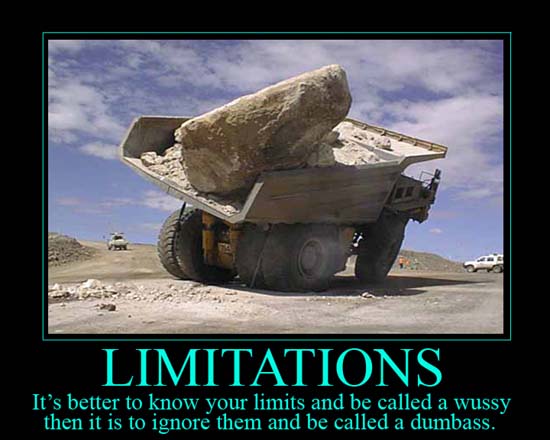
Limitations

I really doubt that geology is unique in the way that its students confront "fail" on such a regular basis, but there does seem to be an unusual acceptance among its practitioners that we are, at the very least, occasionally not going to find an answer that stands up to testing, or even that satisfies us in the short term.  If this category seems derogatory, you probably haven't spent much time doing geology.
(Found here, with the comment "Truer words were never spoken..." Except in geology, a better caption might be "It's better to know and accept your limitations than to be eulogized.")

CB Dawson of Point Source gets at a perennial problem in many disciplines: techniques and technologies have been developed to simplify doing whatever it is you want to do, but the devil is in the details.  If you don't know what's happening in the process of simplification, can you say you know what's happening at all?
After the initial glow of “wow, that was easy!” I realized I was far from done. I had so many questions:
  • How did the model correspond with other geophysical data and local stratigraphy?
  • Was the model meaningful?
  • Was the model equally valid and reliable in all areas?
  • How does the software get from the initial data I provide to the inverse model?
I had so many questions, but not enough answers! I dug into the software. I learned more about the modeling algorithm. I learned about the variety of settings you could use when running the model. I learned about sensitivity analyses and maximum/minimum versions of the model values.
Jessica (AKA Tuff Cookie) at Magma Cum Laude offers a personal, poignant, and very wise bit of insight for anyone practicing a complex technical skill... especially for the first time:
As a freshman, I may have been bright enough that my advisor invited me to come on a trip that was normally restricted to upperclassmen, but I should also have been bright enough to realize my own limitations. That was one of the best things I learned on that trip, and one that's helped me immensely since. If I can take a step back from whatever frustrating problem I'm dealing with at the moment, I can figure out what I tools and knowledge I need to acquire to solve it. That process may be slow and frustrating itself, but it's much better than thinking I know everything (and then finding out, usually in embarrassing ways, that I'm wrong). Come to think of it, this is a great way to look at life in general, not just geology.
Julia at Stages of Succession reminds me of a very similar experience I had- though for better or for worse (the outcome was fine in both cases), no one would have had any idea how far afield I was. I'll recount my own story another time, but for now, here's Julia's "Great Cock-up on Great Cockup."
About an hour before our rendezvous point, I was on the saddle between Knott and Great Calva, with Hause Gill and Wiley Gill either side of me. I had intended to go down Wiley Gill, meet up with the track along the Caldew, and stroll back to the car. To this day, I have no idea why I did this, as I was perfectly capable of reading a compass.

I went the wrong way.
BTW, I suspect anyone who doesn't have a story similar to Julia's simply hasn't been at it long enough.  Yet.

Field Camp

The final category for this month's wedge is "Field Camp." As I said at the outset, there is a lot of overlap in the themes I picked out to organize these posts, and a number of others already written up might fit here as well.  These are ones that struck me as really getting at the essence of the field camp experience.
John Wesley Powell's first camp at Green River, Wyoming, from the US National Archives (entry #11, here).

Silver Fox of Looking For Detachment describes the events that fortuitously allowed her to return to her beloved west, instead of "a sentence term in an overgrown, kudzu-infested, hot and humid field camp."
Yes! Bright, brilliant geology everywhere, just the way I had always — after growing up near the Sierra Nevada — thought it should be. And rocks besides limestones! And volcanic rocks that weren't old and decrepit greenstones of nearly unimaginable age!
In addition to being a classic field camp story, Brian Romans at Clastic Detritus again captures that deer-in-the-headlights, dichotomous feeling of "is that really all there is to it?" combined with "I have no clue what I'm doing; do you really expect me to believe I got this right?"
Using my mechanical pencil to point on the topographic map, I said: “We think the contact runs right through here”.

He looked at me with a grin, saying “Well, you should go ahead and draw the contact there”. I remember looking at the map, looking out at the landscape again, looking back down at the map with my head cocked to the side. I simply wasn’t sure if what I was seeing was correct. My professor must have seen the lack of confidence in my body language. He took my hand with the pencil in it and, with his hand over mine, drew a small line on the map where I said the contact was. I looked up at him saying “That’s it?” and he smiled saying “Yep … now keep going”.
Last, but most certainly not least, Geotripper Garry Hayes' story isn't of the typical undergrad field camp, which generally comes near the end of a four-year degree, but an intensive and grueling field experience nonetheless: hiking to the bottom, and back out, of the Grand Canyon.
We were going in, spending 4 or 5 days below the rim, checking out each and every one of the layers from top to bottom (and back to the top again).

The trip involved a hike along some of the semi-maintained trails that are not usually a part of the tourist experience. The route down was along the New Hance Trail to the Colorado River, then along the Tonto Platform to Horseshoe Mesa, and then up the steep trail to Grandview Point. The entire journey was a revelation, as we saw the Paleozoic and Proterozoic sedimentary formations up close and personal (miles are meaningless in the canyon; when climbing out, you note what layer you've reached, not a mileage post), explored a copper mine, climbed through two limestone caverns (with ropes and helmets, no less), and even of all things, saw the aurora borealis from our camp on Horseshoe Mesa. I walked out of the canyon a geology major.
So that winds up this edition of the Accretionary Wedge.  It's been both more work and more rewarding than I expected. More work in the sense that I hadn't really thought about how difficult it would be to both organize and give fair play to the tremendously wide set of experiences- a great many shared by most of us, and some almost unique- and the overlapping nature of those experiences.  More rewarding than I expected in the sense that working through these recollections has triggered memories of a large number of other geological stories I should tell at some point, picking up on the themes so wonderfully expressed in these entries: sometimes a little self-deprecatingly humorous, sometimes reeking of frustration- or spitting in the face of frustration- but always, always, always anticipating that next moment of awe and wonder, the feelings that drew us to this sublime discipline in the first place.

I just realized a bit ago that I haven't actually put up a notification of the next Accretionary Wedge at the AW Blog (Now remedied), though I have here at OTI and on Twitter.  But just as a reminder, Matt has kindly offered to host October's AW, with the theme of "Deskcrops."  See the link for full details, and leave comments and links to your submissions at Matt's call for posts.