Showing posts with label Science News. Show all posts

Monday, August 12, 2013

25 Minutes of Agonizing Helplessness

A recently found and released video of the 2011 Japanese tsunami has got to be seen to be believed. I generally don't watch clips longer than a few minutes, but what this one illustrates is just how unbelievably long the tsunami advances. I can think of no other way to show this than actually seeing that duration. And there are some cuts, so it's not clear if we're actually seeing the whole thing.

The first arrival is about 3 minutes in, and at first it doesn't look all that bad, though the boats being swept up and along are dramatic. Obviously, the onlookers are unimpressed at first, as well; they're remarkably nonchalant. Then it gets worse.

Then it gets much worse.

And by the end, it's catastrophic.

I white-knuckled my way through it, and any geo-inclined readers are advised to do the same. The educational value of this clip is incredible.

Tuesday, June 21, 2011

Science by Press Release

I've been spending more and more time on Twitter, with a result of less time here. Partly that's because I've been having a slew of aging computer, connectivity and software problems (Seriously Adobe, your plug-ins couldn't cause more issues?), and partly it's because sharing a quick comment and link on Twitter is just so much faster and easier... especially when aforementioned problems are causing my computer to go into lockdown every 3 to 5 minutes.

The downside is that Twitter, like Facebook, is very much ephemeral. It is next to impossible to find a particular tweet unless it's pretty recent.

I got onto another Twitter rip today, with the theme of "If Science by press release existed in [...]'s day," satirizing the kind of sensationalistic, overly dramatic, factually challenged, and premature types of reports that pass for science journalism these days. So for the sake of a permanent record- for my own satisfaction, at least- here are my tweets (and one from another) on that topic:
If Science by Press Release existed in...
  • Newton's Day: "New Discovery May Lead to Space Flight: Report."
  • Stone Age: "Control of Fire May Resolve Transportation Problems Says Eminent Witch Doctor."
  • Pasteur's Day: "Animicule Theory Could Lead to New treatments for Bad Air."
  • Archimedes' Day: "Application of Density to Astronomy Suggests New Class of Exotic Space Objects."
  • Becher's day: "Phlogiston Theory Supports Existence of Human Soul, Angels, Demons, Study Says."
  • Eratosthenes' day: "Shape, Size of the world: Controversy and Conflict Among the Experts"
  • Agricola's day: "New Study to Examine differences between Dwarf and Kobold Mining Techniques."
  • Socrates' day: "Announcement: New Element Discovered, Named 'Aether.'"
  • Pliny's day: "The Next Supervolcano Eruption and You: Is YOUR Family Safe?"
  • Mendel's day: "Peagate 'Proves Inheritance is Hoax:' Scientific Report" (with followup comment from @, "Gene Skeptics Scoff at New Wrinkle in Mendelist Theory")
  • Hutton's day: "Claim: Earth May Be One Million Years Old. Theologists Express Skepticism, Outrage."
  • Mendelev's day: "New Periodic Organization Dismissed: Chemists Prefer Traditional, Alphabetic Order.
Also, from , If science by press release existed in Darwin's day: "It All Comes Down to Sex: New Study by Fossil Sleuth"

I'll add any others that I come up with, and, with appropriate credit, other folks post. How would your favorite scientist(s) have been misquoted, misrepresented or misinterpreted by today's so-called "journalism?"

Tuesday, June 14, 2011

Preventing A Cave Calamity

The Deschutes National Forest says it's taking safeguards to prevent the spread of a deadly bat disease at Lava River Cave south of Bend.

KTVZ reports that when the cave opens July 1, visitors will be asked not to wear clothing or use gear that has been used in caves or mines outside Oregon and Washington.

(From KGW) I've seen a couple of articles on preventative measures being taken here in the PNW to protect cave-dwelling bats. I mentioned it to an IZ friend earlier today; she is planning to visit Oregon Caves (in the Klamath Mountains of SW Oregon), and said they had warnings on their website asking visitors to not bring clothing, shoes or other gear that had been in eastern caves.

Lava River Cave is a heavily used, semi-developed lava tube, and the longest of its type known in the state. It's quite fun and not too demanding or hazardous. There are others I like better, but I haven't visited any of them in years. Given the environmental services bats provide- especially insect control- please take time to consider and exclude any items that may have been in eastern caves from visits you make to any PNW caves, not just the heavily used ones that are mentioned in articles like the one above. Once this disease (a fungal infection referred to as white nose syndrome) gets established, it appears to spread rapidly with or without human vectors or intervention. But the only way it is likely to be able to spread (at least quickly) from the eastern US to the west coast is through ignorance, thoughtlessness, and indifference.

Wednesday, May 25, 2011

RIP Spirit

There have been numerous reports over the last couple of days on the fact that after many attempts, NASA is giving up on re-establishing contact with the Spirit Rover. Phil Plait at Bad Astronomy provides what strikes me as a very fitting eulogy. Followup: Another concise but satisfying summary of the life and times of Spirit by Ryan Anderson at The Martian Chronicles.

I got quite a bit of flack, early in Spirit's rovings, for pointing out that it was very slow, primitive, and limited. I stick by those comments, though. With a six-hour source of breathable air, a hammer, hand lens and camera, I could accomplish in that time much of what Spirit took six years to do. What my critics failed to grasp was that this was intended as a slam on neither the rover, its engineers, nor the mission scientists who managed the day-to-day logistics, data acquisition and analysis. The fact is, we do not have the means to put me (or others more competent) onto Mars alive. Spirit was state-of-the-art... ten years ago. My point was simply that compared to technologies of the near future, or (drool) human explorers, it's important to understand just how limited Spirit really was. That should take nothing away from the accomplishments of the plucky little rover that could, but rather provide motivation and inspiration for the next steps in our exploration of Mars and other solid-surfaced planets and moons.

To Paraphrase the X-Files, the truth is out there, and I want to believe we have the determination to find it. I know we have the resources. I know if we choose to, we can figure out how to make it happen. The only thing I'm uncertain about is whether we have the will.

Certainly, taking the next step will help make up for the undignified manner of Spirit's demise:

Saturday, April 16, 2011

Happy Birthday, Packy!

Portland Zoo's Packy was born there 49 years ago today. I have to say, he looks very much the patriarch in this clip. (Source and article) The latter half of the clip sets out some of the research findings that have come from the zoo, Packy, and his family over the course of nearly half a century.

It's pretty amazing to me that this elephant is only two and a half years younger than I am.

Followup: Oregon Live has a nice write-up too, with the additional tidbit that "...Asian elephants typically live well into their late 50s." Glad to hear it; I admit I was wondering.

Tuesday, April 12, 2011

Awash in Anniversaries

As I mentioned yesterday, and as you've most likely seen elsewhere, today is the 50th anniversary of Yuri Gagarin's orbital flight around the earth. (Today's APOD is a beautiful salute to that accomplishment) However, there are a slew of others coming across my radar:
  • It's the 30th anniversary of the first shuttle flight... kind of mind boggling that it was only 20 years from the first manned space flight to the shuttle. And 30 years later, we're still using the shuttle. NASA today also announced the future homes of the soon-to-be retired shuttle fleet.
  • It's the 150th anniversary of the shelling of Fort Sumpter, and the opening ceremonies for the Civil War.
  • Five years ago today, Mitt "Mittens" AKA "Willard" Romney signed ObamaCare RomneyCare The Massachusetts Health Care Bill into law. And hasn't stopped running away from it since.
  • 113 years ago, Marie Curie announced her discoveries relating to radioactivity.
  • 66 years ago, Franklin Roosevelt died, leaving his VP Harry Truman the task of ending WWII.
  • Finally, 200 years ago today, a team from John Jacob Astor's Pacific Fur Company landed on the southern shore of the mouth of the Columbia River to establish a trading post; the community that grew up around the site is now called Astoria, Oregon. No biggie, right? Well, oddly, for me at least, this may be the most important item on the list. Money quote:
    "Without John Jacob Astor sending the party to establish a trade outpost in 1811, Oregon, Washington and Idaho would very likely be part of Canada today. The group he sent beat a group of Canadians by about a month."

Tuesday, April 5, 2011

Unmixed Signals

Couple of articles in today's Oregon Live, here and here. I started to write these up earlier but I did something that turned quite a bit of text into a massive blob of html hamburger, and I'm not going to attempt to reconstruct it now. So, short version: The first article is mainly about Oregon coastal communities' preparedness or lack thereof, for large tsunamis, and some of the work underway to become better prepared. It contains the following quote which despite its sobering content is quite funny in its phrasing:
"The shaking will be so strong, you will most likely fall on the ground," said Nathan Wood, a geographer with the U.S. Geological Survey. "That's a sign you know this is not some little tremor. When you can stand up, that is the indication you should head for high land."
Got that? The shaking is the signal you should fall down, and standing up is the signal that you should run for high ground. Another quote highlights a fact about tsunamis that I didn't really comprehend until I'd seen some of the video clips of the 2004 Boxing Day tsunami:
"It's a wall of water," said Witter. "It is a wave, but its wave length is kilometers long. They are so big they produce a sudden rise in ocean level and continue to flow at that level. If you raise sea level by 20 or 30 feet or even higher, where does it have to go? It flows downhill inland. There will be flooding in every place that is low. Where you have bluffs, the waves will hit the bluffs and go back out to sea. If the tsunami is higher than 50 feet, it will top the bluffs that are lower than 50 feet."
The other article is about a "buddy safehouse" program being developed at Cannon Beach- a community that is mostly at lower elevations. A point that I have mentioned in the past, and developed in much more detail in the earlier post I abandoned, is that many- I would say most- Oregon coastal communities are in large part on elevated terraces. There are a few, like Tillamook, Waldport, and Cannon Beach that are largely on dune, estuarine, and/or beach deposits, and which are vulnerable as a whole. But the heart of nearly all our coastal communities is a harbor and port, and even though most of the population and development might be out of inundation risk, these commercial centers are uniformly vulnerable to the inevitable large tsunami that will accompany a great Cascadia quake. And if it occurs during waking and working hours, these vulnerable area will be full of workers and tourists. In many cases, evacuation routes will be obvious and readily accessible, but in other cases, not so much.

As an example, Newport is the town about an hour west of where I sit. The north shore of Yaquina Bay is a narrow strip of flat developed land that rises quickly to the newer parts of town- a person could get to safety in just two or three minutes of brisk walking. The south shore, on the other hand, is broad and low, and is becoming more and more built up. It is the home to The Oregon Coast Aquarium, Oregon State's Hatfield Marine Science Center, the Rogue Brewery, and NOAA's marine operations headquarters is being built there. Where would those people evacuate to? I'm not really sure.

So the point is, if you live or visit the coast of the spectacular Pacific Northwest- and you should: there's only one really bad day out of about 100,000 or so- take a moment to look at your surroundings and ask yourself, "What would I do?" Having even a sketch of a plan is better than none, and though unlikely, could save your life.

Wednesday, March 30, 2011

The Most Dangerous Illusion

I was just going through my (week) daily newsletter from Spiegel Online, and saw this attention-grabbing headline:

'Our Most Dangerous Illusion Is that We Can Control Nuclear Energy'

Well. I'm not going to argue that there aren't dangers associated with nuclear energy. Having followed the efforts to determine a site for a US nuclear waste repository for about 30 years now, having been frustrated with the process from the outset, and seeing that we still haven't succeeded in finding a satisfactory location, I'm well aware of the many dangers that can arise from nuclear power.

The issue I have with the overly dramatic statement above though is that the person quoted seems to be utterly unaware that other power sources have higher associated risks. Though I linked this chart a week and half ago without reproducing it, I think I'll be more explicit here:
Energy Source              Death Rate (deaths per TWh)

Coal – world average 161 (26% of world energy, 50% of electricity)
Coal – China 278
Coal – USA 15
Oil 36 (36% of world energy)
Natural Gas 4 (21% of world energy)
Biofuel/Biomass 12
Peat 12
Solar (rooftop) 0.44 (less than 0.1% of world energy)
Wind 0.15 (less than 1% of world energy)
Hydro 0.10 (europe death rate, 2.2% of world energy)
Hydro - world including Banqiao) 1.4 (about 2500 TWh/yr and 171,000 Banqiao dead)
Nuclear 0.04 (5.9% of world energy)
The biggest danger of nuclear power is that it and its effects are invisible; without some special devices- which hadn't even been invented a century ago- there is no way to know what your exposure is. The fact that it is imperceptible to an untrained and unequipped person means that the only response possible is panic. Run Away! You can't see it, you can't fight it, you can't protect yourself from it, so the only sensible option is to be somewhere else.

On the other hand, the background knowledge required to deal safely with radiation (in day to day circumstances, not in a reactor) is not that extensive or demanding, the equipment to detect and measure it isn't that expensive, and it's easy to use, so from my perspective, I just don't find radiation or nuclear power all that intimidating. I worked for the better part of a year at Oregon State's research reactor, doing neutron activation analysis on a potential ore body in Africa. I'm no expert, but I know the safety precautions, I know how to keep from being contaminated, and I know what to do if I do find myself contaminated.

On the other hand, I have no idea what the excess mercury load in western Oregon from coal burning is. I suspect it's pretty low compared to what I grew up with in southeast Ohio, but I get the willies wondering what's coming out of the ground water there now, after another half century of intense coal power generation. Not to mention the excess uranium and thorium- two elements that are naturally concentrated by and bound to organic carbon, and which are simply broadcast to the open environment after combustion. Or alternatively, piled up in immense reservoirs of fly ash waste, then ignored until the dam fails. Which amounts to the same thing.

Another note I received this morning from the Union of Concerned Scientists focused on the same issue:

Help Protect the Public from Toxic Air Pollution

Dear Lockwood,

Toxic air pollutants from power plants—mercury, lead, arsenic, and others—are linked to health problems such as cancer, heart disease, neurological damage, birth defects, asthma attacks, and even premature death. Mercury, for example, is a potent neurotoxin that poses a threat to fetal and infant brain development. And coal plants are far and away the greatest source of mercury air emissions in the United States.

Shockingly, there are currently no national limits on the amount of mercury and other toxic pollutants that power plants can spew into the environment. This gap in our public health protections is all the more disturbing since the Clean Air Act required the Environmental Protection Agency (EPA) to start regulating toxic pollutants more than two decades ago. Thankfully, in mid-March, the agency finally proposed a mercury and air toxics rule, which will limit hazardous air pollution from coal- and oil-fired power plants.

Even though the new standards are affordable and would deliver enormous health benefits, some energy companies and their allies in Congress are already working to block or weaken them.

The EPA is now accepting comments on its proposed mercury and air toxics rule. The agency needs to hear from concerned citizens like you, who want a strong rule that protects the public from these dangerous pollutants.

Take Action Today!

Sincerely,

Kate Abend
National Field Organizer
UCS Climate and Energy Program

In short, my response to the Spiegel interview is exasperation. Here we have a person who probably has very little knowledge about, or experience around, radioactive materials, and who has a predictable panic response to them. He is advocating for an end to human use of such materials- again, predictably. But- and once more, predictably- he does not propose realistic alternative sources of energy.

I am not a strong advocate for nuclear power generation; I feel it has many shortcomings. On the other hand, so does every other power source we have developed or have contemplated. To argue that one specifically should be eliminated because it's dangerous, while overlooking the dangers inherent in others, seems ignorant at best and dangerously naive at worst.

The "most dangerous illusion" is not that "we can control nuclear energy." It is that uninformed opinion, generated without consideration of the pros and cons of other options, is a useful springboard for fruitful policy decisions.

Sunday, March 27, 2011

Don't Panic. Waitaminit.... No, Panic

According to this website, which I linked in last Monday's "Cobbles and Gravel" post,
The estimated overall maximum biological effect from the trace amounts of radiation currently detected in Oregon from the events in Japan is about 0.000160 mrem per day. To put this into perspective, a person would need to be exposed to this level all day, everyday for over 100 years to equal the exposure from ONE chest x-ray.
Cue frantic screaming in 3... 2... 1...

If you're really, really concerned, an overdose of potassium iodide will simply kill you outright, so you won't have to worry about radiation poisoning.

Tuesday, March 22, 2011

Cobbles and Gravel

Tohoku (previously referred to as Sendai) Earthquake
  • Via everybody everywhere, XKCD has posted a chart illustrating the magnitude of concern you should have regarding radiation releases from the Japanese reactors. (Spoiler: not so much) ZOMG! Bananas! Domestic Partners! What's my exposure from a cat sleeping in my lap!? Additional fun and enlightening commentary at The Vigorous North.
  • Michael Welland at Through the Sandglass has a piece on tsunamis in the historic and sedimentary records, and implications for human development of vulnerable areas.
  • Power line connections have been completed to the crippled reactors in Japan; water pumps will be tested soon. Hopefully, this is nearly the end of the on-going nuclear crisis there.
  • There have been several good posts on the nature of surface deformation in the neighborhood of the quake. I get exasperated with the breathless statements like "Japan moves eight meters east" and "Earth's day shortens" as a result of the quake. Portions of Japan did move east- some more than others, but not the island nation as a whole- and the earth's rotation did speed up- just as an ice skater who tightens their arms against their body will increase their rate of spin. But what is never mentioned in these kinds of headlines is that over the next centuries, as the area around the fault is stressed and strained, and another earthquake builds, is that the same areas will move west, and as the land surface rises again, the earth's spin rate will slow. It's cyclic. Yes, these happened quickly, but the fact that the motions happen in reverse slowly doesn't mean the counterpart of the sudden motion is unimportant. Hudson Valley Geologist has a good color-coded map of how much different areas moved; Highly Allochthonous puts together an excellent round up of information and links; The Chatterbox: it's not just the tsunamis; subsidence means some areas will stay flooded; a variety of teaching resources from Hudson Valley Geologist. In particular, note the video clip; Jorge at Structural Geology provides a nice explanation, an excellent set of schematics, and lots of links; finally, Callan at Mountain Beltway shows the horizontal and vertical components of overall ground movement from before to after the quake. Keep in mind though, as I said in the introduction to this bullet, this nearly instantaneous movement will be reversed in large part, and "reset" over much longer timescales in the decades and centuries to come. Then it will happen again.
  • Because People Could Die: A culture of nonchalance and our resentment of those who challenge our laziness can kill us, from Swanson Tea.
  • Anne Jefferson at Highly Allochthonous has a great summary piece on the tsunami(s).
  • If I had to pick one image to express how blown away I've been by the last twelve days of news out of Japan, it would be this one, first seen at Steve Gough's Riparian Rap: cars on the roofs of three-story buildings.
Reverberations of the quake in the PNW
  • Tillamook, OR oyster farmer to donate larvae to assist Japanese oyster industry's recovery. (with video)
  • Brookings, OR Harbor reopens; Damage estimate reduced from $10 million to $6.7 million; Federal disaster assistance requested. OregonLive.
  • If you insist on worrying about radiation from Japan in the PNW (please don't), OregonLive has an article about resources you can use. Most important, there's a link to radiation monitors' recent daily data in Oregon. (link for Washington at the OL article) First sentence at the site: "Radiation from the damaged nuclear reactors in Japan is not a health risk in Oregon."
  • Portland Hospitals claim to be prepared for "The Big One." This is some of the best preparedness news I've read in a long time, and I think it sounds well-founded, not just PR.
  • On the other hand, older Portland homes (pre-80's) not so much. The good news, though, is that retrofitting the typical private home is not likely to be as expensive as I might have guessed.
  • And on yet still another hand, Portland schools have been retrofitted with an eye to allow survivability, but not continued usability. In other words, occupants will most likely be able to escape safely, but buildings will not be salvageable afterwards. I have mixed feelings about this strategy, and I'm hoping it's a temporary first step, with schools able to withstand a major quake and be usable afterwards replacing older, weaker structures as funds become available. Schools and other public properties can be critically important shelters and organizational centers after disasters... as long as they're safe to use.
  • I first read about this months ago, and I've been meaning to comment, but in the meantime, Cannon Beach, OR planning to build nation's first tsunami-resistant building. My quick response: I'm dubious, and I'm afraid that if the conditions are exactly wrong, this could be a terrible liability magnet.
  • Oregon Expat posts a video I haven't yet taken time to watch, examining the OR coast and its tsunami risks. Another topic I've been hoping to get to, but haven't set aside time. Short version: much of the coast is situated on elevated terraces, and at-risk sites are limited in area. However, most coastal communities are situated near harbors with adjacent estuarine-tidal flat lands moderately to heavily developed. So a majority of communities have some of their most economically important land in vulnerable areas. Here's the OregonLive article Oregon Expat is working from.
  • OregonLive: Don't turn your back on tsunami warnings. An excellent, startling video of the late tsunami at Depoe Bay (most famous as the location for the fishing excursion in the film One Flew Over the Cuckoo's Nest) The reason I say startling is that it really doesn't look like it's all that big a deal... until all of the sudden it obviously is a big deal. Also, if you missed it above, Chris embedded a time lapse video of the tsunami at Crescent City, CA so I didn't have to. For both these clips, you'll probably be happier with the sound way down or off, though I have to say with the Crescent City clip, the time lapse sound of the tsunami tsiren kind of made me giggle.
World Water Day
Et Cetera
  • Incredible description and photo of pseudotacylite and megabreccia from Vredefort crater, South Africa at Erratics. Erratics is a blog created specifically for those who would like to dip their toes into geoblogging without the trouble and commitment of actually starting a new blog of ones own. Curious? Check it out!
  • Via Iceland Volcano and Earthquake Blog and Eruptions, yesterday was the one-year anniversary of the beginning of the Eyjafjallajökull eruption. It started off beautiful, became a royal pain in the butt by disrupting European air travel, but it never killed anyone. My kind of disaster.
  • This could fit in several different categories, but there has been some twitter discussion of a piece by Simon Winchester at Newsweek. Chris at Highly Allochthonous has posted the first blog commentary I've seen so far, but I expect this item will be under discussion for a while: watch for more. For the record, I'm not a big fan of Winchester. As an example, the first book of his I read was The Map That Changed the World. Let's just ignore his predilection for hyperbolic titles and statements, and my general distaste for phrases in the form of "The X that Y'd the Z," where X is a noun, Y is a catastrophic verb, and Z is a general noun carrying implications of "everything important." A person who didn't know who William Smith was would come away from that book with the idea that the great accomplishment of his life- emphasized and re-emphasized at least once or twice a chapter- was spending a few weeks in debtor's prison. Likewise with Krakatoa: The Day the World Exploded, I think the author makes a good case for the importance of that eruption. He admits very quickly and in passing near the beginning that it was not the largest eruption in recorded history- let alone geologic history. Yet an innocent and geologically naive reader might very well come away with the idea that it was the biggest explosion since the Earth was created; Winchester falls all over himself trying to find ways to supersize this eruption, just like a McDonalds clerk. And like McDonalds, there are way too many empty calories for my taste. As I commented at Chris' post, Winchester too often strikes me as more interested in marketing than informing.
  • Ah Ha! Here's another bit of Winchester debunking at Life's Little Mysteries.
  • "The battle to prevent dangerous climate change is over; the race to survive it has begun." Via Hot Topic. If only we could get the US House to legislate recalibrating the Fahrenheit, Celsius and Kelvin temperature scales, this wouldn't be a problem.
  • I found this a baffling mixture of fact and fake, sense and nonsense; it's not totally wrong, but there's enough wrong that my BS detector was ringing at three-alarm levels. Calcite, for example, is much more plastic under high T&P than quartz; halite and gypsum even more so. However, the latter two aren't major components of rock on a global scale. Quartz could hold key to explaining earthquakes.
  • Deaths per terawatt-hour from various electrical generation energy sources, via Swanson Tea.
  • Sunday was the Vernal Equinox; Steven Schimmrich at Hudson Valley Geologist lays out the details.
  • Garry Hayes at Geotripper takes his analytical skills to the next level, and predicts an earthquake today. And tomorrow. And the next day. And the day after that. Useful? You decide.
  • If only idiots will vote for certain politicians and listen to certain shock-jocks, you can rest assured those pols and jocks will do everything they can to make sure everyone is an idiot.

Saturday, March 12, 2011

Earthquake and Tsunamis in Japan, Part II

After spending pretty much the whole day yesterday, and making what felt like very little progress through all the information flying through teh innertubz, I promised myself I wouldn't do the same thing today. Yeah, well... promises are made to be broken, right? I'm just finding too many frightening and amazing things this morning to ignore them. For example:

Mary at Geographile found this amazing video of liquifaction and mud volcanoes on reclaimed ground after the quake. I don't think I've ever seen footage of this phenomenon active before; many photos of the aftermath, but it's pretty interesting to see the actual process.

This clip has been all over the place this morning: the nuclear emergency that was widely reported yesterday has culminated (hopefully) in an explosion at the Fukushima power plant:

Many of the usual suspects are treating this as apocalyptic, Chernobyl-level or worse news, and I'm still trying to unravel exactly what happened. My current understanding, which to be clear may be incomplete or incorrect, is that this is a steam explosion. It clearly is not a core explosion. Some radiation has been leaked, but officials are claiming it is not intense. Still, I find the lack of details in official reports troubling. I'll add on additional information as I find it.

So as I did yesterday, I'll add items as I continue reading. The times I post with each represent the time I found it, not the time it was originally posted... there's still an enormous backlog from yesterday, some of which may be dated at this point, but some of which will undoubtedly provide some important background.

12:27 PM, PDT (UTC minus 8 hours)- Oregon Live lists seven reputable organizations that are accepting donations to aid the victims of the quake. In another article, the same source notes that the FBI is warning the public to be wary of scam artists posing as aid organizations.
The Federal Bureau of Investigation warned Friday that con artists often prey on donors responding to charity calls in the wake of natural disasters. The warning comes as charities begin reaching out for contributions to help deal with the damage caused by Friday's tsunami.
12:37- Commenter CJR points out an interview by Evelyn at Georneys with her father, a nuclear engineer, on the unfolding Fukushima reactor crisis. Due to noise here inside the Interzone, I haven't been able to listen to it yet, and I'm hoping Evelyn finds time to transcribe it. However, I've been reading so many positive comments on how her father explains the situation that I'm just going to pass it on to readers, even though I haven't listened to it yet.

12:46- OregonLive catches an AP story that reiterates some of what I've read elsewhere, and clarifies some points on the Fukushima story:
The blast destroyed the building housing the reactor, but not the reactor itself, which is enveloped by stainless steel 6 inches thick.

Inside that superheated steel vessel, water being poured over the fuel rods to cool them formed hydrogen. When officials released some of the hydrogen gas to relieve pressure inside the reactor, the hydrogen apparently reacted with oxygen, either in the air or the cooling water, and caused the explosion.
So it was hydrogen exploding (chemically, not fusion) that caused the blast, and the inner steel containment vessel was not breached. The article also confirms my unease with the lack of information and transparency: "But authorities did not say why, and the precise cause of the explosion and the extent of the ongoing danger were not clear."

1:01- Susan at Geology in Motion works toward an order of magnitude estimate for the amount of energy the tsunami imparted on the Japanese coast, concluding that the value is somewhere in the range of 1 to 100 times that of (sum total of) the bombs dropped on Hiroshima and Nagasaki. She concludes with the comment, "My 'gut feeling' from looking at the number of completely devastated cities is that these higher numbers are very likely."

1:09- In Focus has a gallery of 48 large-format photos. There is some overlap with images from yesterday's Big Picture post, but a number I haven't seen before, as well.

1:17- SciAm:
GENEVA, March 12 (Reuters) - The World Health Organisation (WHO) said on Saturday that the public health risk from Japan's radiation leak appeared to be "quite low" but the WHO network of medical experts was ready to assist if requested.
So is WHO making this judgment based on their own observations and data, or upon evasive statements by public relations officers? 'Cause, you know, that kind of matters.
1:38- Callan has a good piece on so-called "secondary effects," or follow-on consequences of earthquakes, which often kill many more people than the quake itself. As he points out, few people die directly from the quake. Have you ever heard of quake-induced whiplash?

1:43- Elli Goeke at Life in Plane Light extends her post from yesterday of links for her students with today's links.

1:46- Yesterday we saw aerial footage of the tsunami sweeping through the Sendai Airport. Today Bits and Pieces finds footage shot from inside the terminal:

2:08-OregonLive: $10 million in damages to Port of Brookings alone. I've read of serious damage to harbors and ports in Coos Bay, Port Orford, Depoe Bay and Gold Beach in Oregon, and Crescent City and Santa Barbara in California. I'll keep an eye out for sources and links as I go- those are just from memory, which is most certainly not flawless. 3:18- here's the article I read last night discussing the some of the tsunamis' impacts on the OR coast.
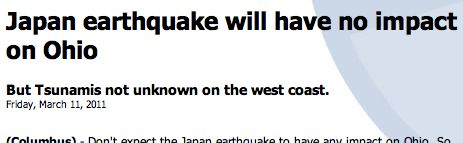
2:15- Whew! That's a relief! (What Would Jack Do?) In a non-ironic vein, it's too early to make any serious observations or predictions, but this may have negative consequences for the nascent economic recovery. So to say "no impact on Ohio" may be a bit premature... at least in terms of "secondary effects."

2:20- Oregon Expat:
My email inbox has continued to flood with earthquake notifications, more than doubling yesterday’s tally. As of right now (15:00 GMT), Japan has experienced a total of 171 earthquakes greater than M 5.0.

Of those, 26 were stronger than M 6.0, including a 6.8 that occurred at 1:47 this morning and a 6.4 less than two hours ago. Incredible.
I'm having a really hard time getting my head around 171 M 5+ quakes, with 26 equal or greater than M 6, in less than 48 hours. Criminy.

2:36- A very helpful post from Swans on Tea discussing the issues with the Fukushima reactor (with the amusing title, which at first I didn't get, "I stayed at a Holiday Inn Express last night"):
The reactor is shut down, so what’s the danger? The products of a fission reaction are typically radioactive, and subsequent decays also release energy. Shutting down the reactor reduces the fission rate by many orders of magnitude, so it’s effectively zero in terms of heat output, but the radioactive fission products still release up to 6-7% of the plant’s power output. The actual value depends on the operating history; the fission products with long half-lives take longer to build up to steady-state values. This value will drop fairly quickly as the short-lived isotopes decay, but it’s still significant — a reactor rated at 1000 MW will still be producing tens of MW of decay heat. The reactors in question at Fukushima Daiichi are rated at 460 or 784 MW.
2:41- RT @: "Personnel have flooded Fukushima reactor 1 w/ seawater & boric acid: 'throw in the towel' strategy that perm. damages reactor." So hopefully, that's that.

2:47- Chris Rowan at Highly Allochthonous put up some background information in a post from yesterday. For me, the most helpful bit was on some of the reasons that modern moment magnitudes (estimates of total energy released, as opposed to Richter magnitudes, based on ground motion) frequently get revised upwards in the hours and days following very large quakes. I haven't seen any resolution to this yet, but while the MSM news sources are still reporting this as an 8.9, the geoblogosphere was reporting fairly early yesterday that USGS had upgraded it to a 9, and some other agency (which one?) to a 9.1. Again, Chris titled his piece with an eye to humorous tongue-in-cheek recognition of this.

3:26- I, Cringely gives a good rundown on "How Flea Powder May Be Saving Lives in Japan," highlighting a use of boron (in the form of borates, or more likely, sodium polyborate) that I mentioned just ten days ago. As I noted at 2:41, there are now reports that the borate coolant has been injected into the reactor, which is apparently a permanent killer.

3:40- If you've spent any time reading this blog at all, you know I don't have much use for religion or prayer. That doesn't mean I don't entertain benevolent thoughts and wishes for those suffering and endangered, just that I don't have any belief that there's a great sky wizard waiting around pensively to find out what I'm going to blow out the candles and wish for today. I like hope, and I like this (Sober in a Nightclub):3:49- Ben Travato, The Wulfshead: "We are all Springfielders now."

3:52- I sometimes forget why I subscribe to The Telegraph (UK). Then they remind me. They print some of the stupidest, overblown, sensationalistic headlines this side of the Weekly World News: "Earthquake like 'dropping boulder the size of the Isle of Wight into the ocean.'" All of it from sea level up, or from the ocean floor up? Maybe including the whole of the crust, or the mantle as well? And, uh, dropping it from how high? Sigh... nitwits.

4:12- NASA provides side-by-side before and after images (2/26/11 & 3/12/11) of the flooding near Sendai, Japan:4:37- Jessica Ball at Magma Cum Laude has a post that does a good job of getting at the complexities inherent in establishing a causal relationship between an earthquake and a subsequent volcanic eruption. I'd add that both subduction quakes and volcanic arcs result from (are caused by) subduction zones, so they are related, but as Jessica points out, only rarely will a quake actually trigger an eruption. The details of how a quake might trigger an eruption, though, are interesting.

4:41- Silver Fox at Looking For Detachment has added many, many more links to her post from yesterday, so if you're wondering how the geoblogosphere is responding to the news, this remains the most comprehensive list of Japanese quake/tsunami posts that I'm aware of.

4:50- More on the Fukushima reactor crisis: NYT:
A radiation leak and explosion at the Fukushima Daiichi Nuclear Power Station on Saturday prompted the government to expand an evacuation order to affect 170,000 people in the plant’s vicinity. And the plant’s operator issued an emergency notice early Sunday morning that a second reactor at the same aging plant was also experiencing critical failures of its cooling system, and that a way to inject water into the reactor to cool it was urgently being sought.
Al Jazeera's liveblog:
6:29am [local time, UTC plus 9 hours]

Fukushima nuclear plant - where a huge explosion yesterday blew the outer walls and roof off the No.1 reactor building - faces a new problem.

The emergency cooling system of No.3 reactor has now also stopped working, the Japan Nuclear and Industrial Safety Agency has announced.

Sea water is being pumped into the No.1 reactor chamber to cool its fuel rods - and officials are scrambling to secure a means of of supplying water to the No.3 reactor.
Also from the Al Jazeera liveblog, this eerie photo:5:06- great discussion at Boing Boing of what's happening in Fukushima's "black box," and what we can expect going forward. (spoiler: if it doesn't get worse, it'll get better.)
Also, a friend of mine left some data on the energy released in the comments... too big to comprehend.

Friday, March 11, 2011

Earthquake and Tsunamis in Japan

The Big Picture, #6
The Big Picture, #7

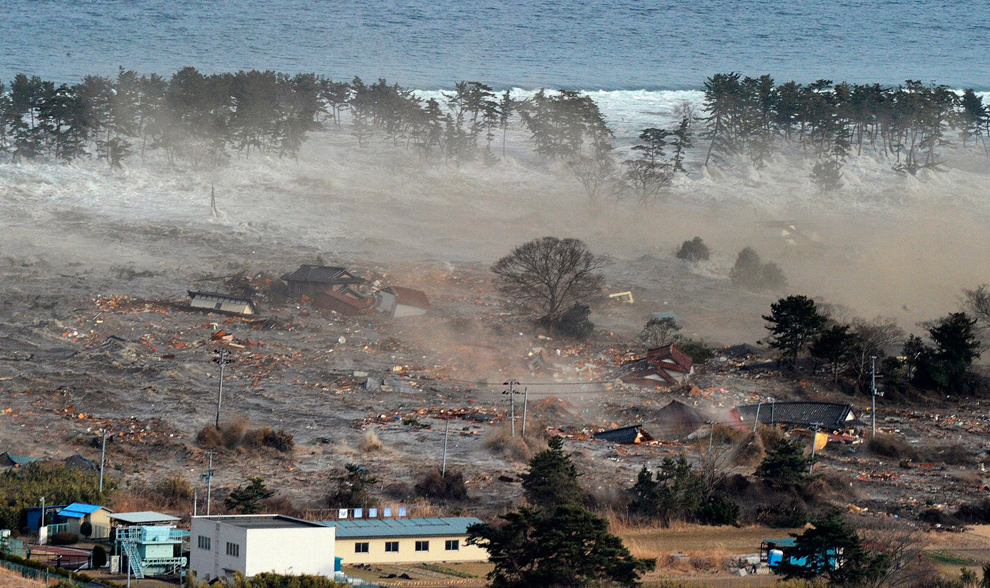
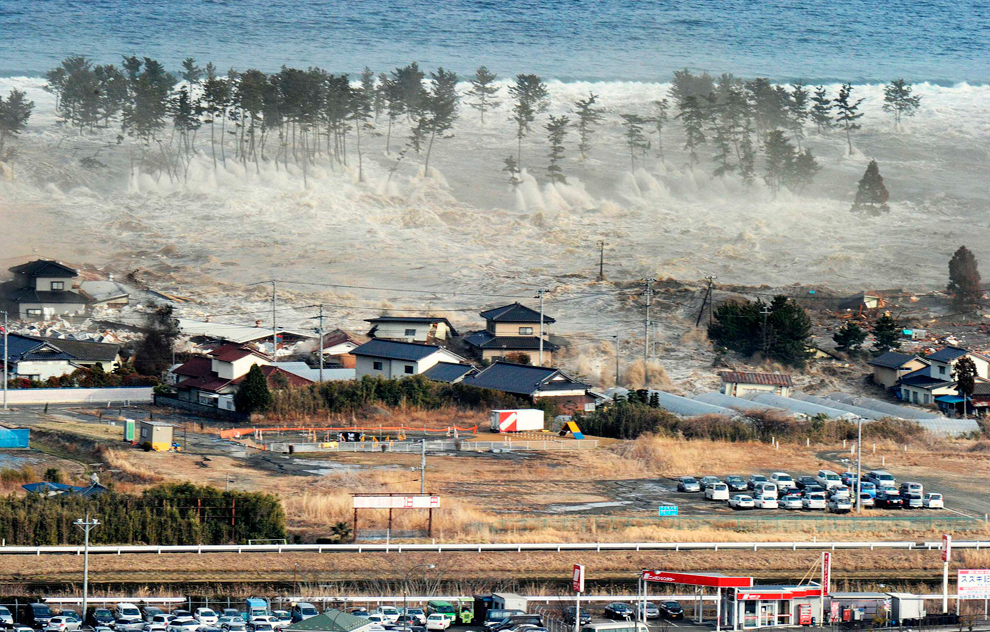
Above, two stunning photos from The Big Picture show a Tsunami sweeping into Natori, Miyagi Prefecture, Japan. This set of (currently) 43 pictures is mind boggling.

I caught word of this just before I went to bed last night. I'm really just getting started today, but I've already received a couple of e-mail requests from readers and relatives to chime in. Looking at the enormous amount of stuff that's rolling in today, I think the way I'll approach it is simply to link and comment briefly on items that strike me as particularly worthwhile. Various news agencies are going to have better resources for reporting, and other geobloggers are going to offer better interpretations. I think I can best serve by picking out what I think is most informative. I'm just going to post updates as I find useful links, rather than try to get all the cats in a row before posting. I think it may be months before this gets straightened out.

(All times PST, UTC minus 8 hours) 11:41- Dave Bressan at History of Geology provides some historical background on earthquakes in Japan.

11:46- Via NYT's Dot Earth blog and @callanbently, the first video I've seen so far, and some commentary on the risk to Oregon's schools. To be clear, Oregon is moving to retrofit or replace schools with high seismic risk- two have been closed and replaced in Corvallis alone over the last 20 years. This issues are that it isn't happening quickly enough, and anti-government, anti-tax interests make funding very difficult for these expensive undertakings. Furthermore, the risk awareness in the general population is low. Many of us fear that what it's going to take is an enormous disaster, with thousands or tens of thousands of casualties, before voters take it seriously. And then, of course, it's too late.
11:55- Awesome RT @: Tsunami surge arriving in San Francisco Bay /via @. Awesome photo at the "http" link. Also, News10 - California KDRV, ABC Oregon affiliate, has confirmed that 4 people in Crescent City have been swept out to sea. One of the victims is a fatality. RT by GeoSocietyOR. OregonLive reports on the Tsunami reaching SW Oregon; it hit at low tide, and troopers had been out since the wee hours evacuating low-lying areas, so it wouldn't be a problem if not for people who can't read or follow instructions. Hint: If there are tsunami warnings, stay the hell off the beach. Natural selection doesn't care about your excuses... or your literacy.

12:06 PM- A report on the damage in N. California.

12:14- From Wil Wheaton's Tumblr, skyscrapers in Shinjuku. Yay! Science, technology and engineering work! Or maybe everyone was just praying really hard.

12:21- Oregon Expat:
In the seven years I’ve been subscribing to the U.S. Geological Survey’s email alert system, I have never seen anything like what happened today. Between 5:46 GMT and the moment I’m writing this (twelve hours later), there have been 86 earthquakes stronger than M 5.0 off the northeast coast of Japan.
Holy moley!

12:23- OregonLive reports tsunami tsiren tsounds again in Curry County at 11:15. Four people rescued south of Gold Beach, one nearly drowns. Fer chrissakes, stay the hell away from the water until an official all-clear is given. It's not just your life at risk.

1:09- NYT on how Japan's shaky history has created a culture of seismic awareness and preparedness.

1:13- KATU: "PORTLAND, Ore. (AP) — Gov. John Kitzhaber said Oregon coast residents should be able to return to their homes by noon Friday after an evacuation prompted by a tsunami warning that resulted from an 8.9 magnitude earthquake just off the coast of Japan." But stay off the beach, dammit. 1:28- Also, OregonLive is reporting much the same, with some more detail. Lucky it was low tide

1:20- Via Pharyngula, a video clip from The Guardian. I'm overwhelmed.

1:40- OregonLive is reporting major damage in Brookings, the southernmost town on the OR coast. Brookings is where I taught, and the house I lived in looked directly across the Chetco River at the port. Most of the fleet moved out to sea to avoid damage, but many in port have been damaged or destroyed. One body found, but not clear the victim died during the tsunami. More on damage to US west coast and Hawaii from OregonLive here. 1:59- Aerial photo of Port of Brookings.

1:48- NYT: Cooling crisis at Japanese nuclear power plant, nearby residents evacuated. Plant engineers "planning to release slightly radioactive vapor to reduce pressure inside a reactor." Define "slightly," please.

1:55- Silver Fox has posted an exhaustive list of other geobloggers' posts on the events. I haven't worked back to most of them in my RSS feed yet, and I may very well link some of those posts later. But in the meantime, If you want geologists' perspectives, this is the go-to post.

2:05- I always feel a little futile and repetitive when I start banging this drum yet again, but perhaps in the aftermath of such a disaster, people may be more receptive to the message. Or not. I don't know. The PNW and Oregon in particular are not ready for an event like this, and we will have one at some time in the future. Preparing is cheaper, in terms of money, pain, and lives, than repairing.

2:15- Der Spiegel has a gallery of photos as well. They look to be largely screen captures from Japanese television, so they're not as high resolution as the leading set from the big picture. Still, jaw dropping.

2:21- In the "not-all-press-releases-are-awful" department, OSU has a couple of quick responses: West Coast tsunami warnings shouldn’t lull Oregonians to sleep. Money quote:
Robert Yeats, a professor emeritus of geology at OSU, agrees that Oregon is in better shape now than in 2005, when one of the last major tsunami warnings took place. “Then you had a bunch of people running down to the beach to take pictures, acting like idiots,” Yeats said. “It was sort of a fiasco. Oregon coastal communities seem to be better prepared now, even though there’s still work to do. Our building codes for new structures are much better than they used to be.
I had Yeats for a number of classes... good guy. Speaking of which, he also leads the second piece, Pacific Northwest faces nearly identical risks to Japanese quake:
Yeats, a professor emeritus of geology at Oregon State University, said that if people didn’t already get the message from recent disasters in Sumatra and Chile, they should pay attention now. “This is an earthquake of the same type, with about the same magnitude and proximity that we face here in the Pacific Northwest from the Cascadia Subduction Zone,” Yeats said. “What you are seeing in Japan today is what you will also see in our future. Except they are better prepared than we are.”
3:22- A gallery of coastal damage in southern Oregon and northern California at OregonLive.

3:49- Breaking news! The moon caused the earthquake! Umm... no, it didn't. (Erik Klemetti, Eruptions)

3:53- OregonLive. Hmm... I'm not sure I like the way this is being reported: geophysicist Robert Gellar says "I don't think those hazard assessments are meaningful" with respect to predicted 7.5 EQ, which turned out to be a (now revised) 9-9.1. I guess my thinking is "this is the minimum we need to be prepared for" should not necessarily be taken to mean "this is the maximum we can expect."

4:06- In yet more "News for Nitwits," in addition to beachcombing, surfing is another activity best avoided during tsunami warnings.

4:10- Wasting gazillions on something called tsunami monitoring. You just know the Republicans aren't going to tolerate that kind of waste.

4:17- Callan at Mountain Beltway has a post that offers not only a good summary (and lots of links), but illustrates one of the real strengths of blogging. After making a major error, and getting a correction in the comments, he strikes out the erroneous material and writes a corrected version. The error (and correction) are thus highlighted, not printed on different days, on page 1 one day and and page 37 two days later. The ability of bloggers to do this increases my trust in their good faith, due diligence, and credibility. It's a technique I've used from time to time, and I really appreciate it. Also, check out his Art Imitates Art post- if this isn't purposeful, it's almost certainly a subconcious imitation.

4:28- Clouds and Tsunamis: what do they have in common? Von Karmen vortices! (Steve Gough, Riparian Rap)

4:37- Evelyn at Georneys posts some more mind boggling footage of the disaster, and links to organizations that will channel donations to aid the victims.

4:53- From GeoCosas (Spanish), an animation I saw earlier as a QuickTime clip. This computer and QT don' t play well together, so I'm pleased to see a YouTube version.

5:13- OregonLive: Oregon Coast tsunami: Warning downgraded to tsunami advisory; state parks reopen.
"Basically, (the downgrade) means that we're still seeing wave energy from the tsunami, it's still affecting our coast, but it has less impact from before and there is not considered to be a major threat of damage," said Meteorologist Jeremiah Pyle.
5:16- I'm getting mixed messages from this report on the ongoing emergency at the endangered nuclear reactor five (!) nuclear reactors.

5:41- OregonLive has more coverage on damage to Oregon ports, and this video clip from Brookings. I've been out on that jetty a number of times- my house was about a block from there. The people who filmed this were very lucky nothing bigger hit. One of the things I've internalized about the coast is that you always need to be aware of your path for retreat in an uphill direction. I can't tell how far out on the jetty they were, but it's very rough and bouldery- you can't exactly run on it.

5:58- Despite some problems in some areas, OR coastal residents seem to feel the tsunami alert system worked pretty well. However, as Yeats pointed out in one of the OSU press releases, when our megathrust quake hits, warning windows are going to be on the order of minutes, not ten hours. On the other hand, a distant quake like this provides an opportunity to shake bugs out of the system.

6:02- My brain is full. Headin' home. Later all.

(Part II is here)

Wednesday, March 2, 2011

Running on Empty

Cracked has a list of "6 Important Things You Didn't Know We're Running Out Of." I generally don't look to that website for substantive news- more specifically science news- but they often have things of interest. As long as you take the information there as primarily anecdotal, and don't simply accept their claims at face value, there's plenty of articles that can lead down thought-provoking paths.

Of the three earth material resources they mention (helium, phosphorus and water) only phosphorus is one that wouldn't have come immediately to mind. I think I would have come to it eventually, but there are a number of others that might have come up faster for me. The key qualifier is "things most people wouldn't know we're running out of." So oil, for example, is not on the list. Neither are rare earth elements (REE's). The latter may not be included because they've received a fair amount of publicity over the last year or so (but then, so has fresh water in recent years), or because the issue is not running out, but competitive supplies to counterbalance China's economic lock on these strategic materials.

Likewise in opposition to REE's, we're not going to "run out" of phosphorus- there's an enormous amount of it both in the solid earth and in the hydrosphere (not to mention the biosphere). The issue is that the relatively cheap and easy to extract sources we've become dependent upon are being depleted. There are other sources, but they are more expensive to utilize. The same holds true, albeit with perhaps greater urgency and proportionally less public awareness, with fresh water.

So the issue, such as it is, is not that the earth is going to "run out" of these materials, but that between prices being kept artificially low, a lack of broad awareness of the limited nature of these resources, or at least the cheapest to use sources of them, and what strikes me as a particularly American outlook, that resources have no value unless someone is directly making money off of them, we are facing bottlenecks in a number of materials that have become indispensably important to a modern quality of life. Continuing to use these materials at our present rate is sustainable only by increasing the amount of energy and effort- that is, cost- to concentrate them into usable form.

My main concern is not so much that we will "run out" of these substances, but the profligate and irreversible ecologic damage that is likely to accompany efforts to minimize cost increases. For example, it would be comparatively cheap to augment our electricity generating capacity with coal power; coal is one resource the US is not going to run out of soon. However, even overlooking climate change- likely the most dangerous consequence of over-reliance on coal- the devastation caused by fly ash containment ponds, mercury contamination, particulate pollution, mountain-top mining, and so on and so on, should raise concerns with anyone who likes the idea of a livable environment.

So to geobloggers: What other resource(s) can you think of whose main sources are not going to last too much longer? I nominate boron, which is not an abundant element to begin with, and whose main source is evaporite deposits. It is used in glasses, ceramics, semiconductors, chemical processing, and has a very broad neutron capture cross section, which means it's good at capturing neutrons. Those of you who are old enough may remember that in the aftermath of the Chernobyl disaster, the news reports talked quite a bit about helicopters dumping sand and borax on the exposed ruin of the core. I didn't understand at the time, but the idea was to block thermal neutrons from reaching more uranium fragments, thus suppressing runaway fission. I don't know what estimates are for how long known boron resources will last at current rates of consumption, but since learning how restricted its economic occurrence is, and learning how many uses it has, it's been an element of concern for me.

Saturday, February 26, 2011

Christchurch Earthquake

I haven't said anything about this yet. There are so many geobloggers that know much more about the details of this event than I, and more about seismology generally, and who have been doing an excellent job of informing me and others of what happened and continues to unfold in the aftermath, that I haven't felt I had anything to add. However, while I have seen The Big Picture's photo spread linked in a number of places, I don't think I've seen anyone else link to Alan Taylor's new project, In Focus. There are two sets of photos from the quake there, Monday's Earthquake in New Zealand, and yesterday's New Zealand Earthquake: Search, Rescue and Repair.

Taylor created and edited the Boston Globe's Big Picture feature for about two years before leaving for this new project for The Atlantic about the end of last year. The Globe has decided to continue the Big Picture with its own photo editors, and I have been quite pleased to see no noticeable loss of quality without Taylor's leadership. However, I don't have the feeling that others have realized that In Focus has arrived as another regular source of extraordinarily fine photography- and Taylor has a track record of following breaking news in the earth sciences very well, and of recognizing the beauty of photos of the natural world when there is no other pressing news to cover. So if you're a fan of The Big Picture, consider this an alert for another site that you will almost certainly enjoy.

As I mentioned, there have been many, many posts in the geoblogosphere on this topic; not only would it be pretty dull for me to list all of them (both for me and for readers), but futile as well: more posts have been going up daily. I think the single best piece I've read- for me at least- was Dave Petley's "On the causes of the high levels of loss in the Christchurch earthquake." Last September's quake was significantly stronger than the recent one. Why, then, was the destruction and death toll so much higher for the weaker of the two quakes?

Finally, while I have no interest in trivializing this terrible disaster, I have seen this picture in a number of places. Yes, in a way, it's pretty funny. But in a deeper sense, I think it's a wonderful illustration of human resilience. It's an ill wind indeed that blows nobody some good. (Bits and Pieces)Best wishes to our Kiwi friends.

Saturday, February 12, 2011

Happy Darwin Day!

The Tree Lobsters contribution to the #chuckdarwin Twitter hashtag; there is also a blank if you're inclined to create your own Chuck Darwin LOL.

Dave Bressan at History of Geology has a dandy post on Darwin the Geologist.

Godless Liberal Homo gives a shout out to The Humanist Society and a video clip with reasons to celebrate Darwin Day.

Wooster Geologist Mark Wilson has also created a Darwin graphic, and elucidated some of his background in geology.

Deep Sea News has a post on the role of how his studies of barnacles helped shape Darwin's formulation of The Origin of Species.

Dr Monkerstein shows a better understanding of evolution than many primates I could name.

And Dana at En Tequila Es Verdad winds it up with a rather glum-looking Darwin "celebrating" his 202nd birthday.

Monday, February 7, 2011

Gravel and Cobbles

There are days when it feels like there is an unusual amount of geology and earth science related stuff in my reader. Today was one one of those days. Calamities of Nature
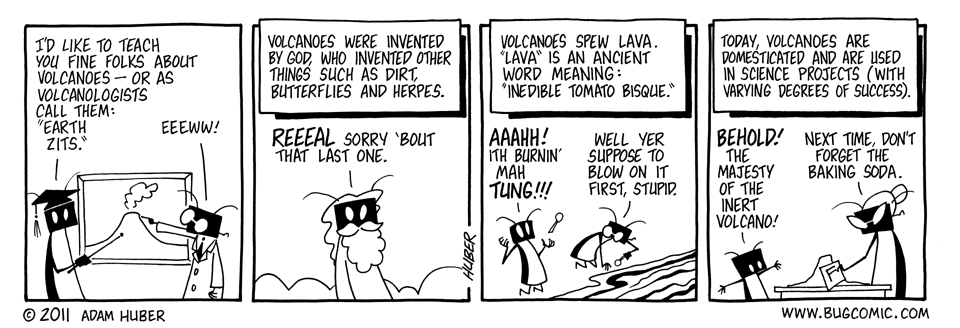
Introduction to Volcanolgy, G411, from Bug. (Click to enlarge)
So CSM, could you, say, qualify that a little more carefully? For example,"Apophis asteroid will likely probably almost certainly not smash into Earth, unless it does, but that's doubtful, say most scientists, at least those we talked to."
funny pictures history - Yes, but how do we  get it on a ring?
see more Historic LOL. I really enjoy seeing people wearing rocks as decorations- that is, jewelry. I can't really wear it myself because I tend to smash things- not so much clumsy as forgetting that bumping into that wall may not hurt me, but it'll play havoc with the bracelet/watch/ring. And oversize jewelry can be a fun and attractive tongue-in-cheek joke. But this is a bit much.
demotivational posters - ROCK SMASH
We've seen this flick before: in rock Vs. car, rock wins. see more Very Demotivational

And there's some serious news, too!

Oobleck could've made all the difference. Why didn't the pin-heads in their ivory towers figure this out? Oh, that's right! They did! Saving BP all the tedious hassle of figuring out how to deal with deep water spills, and making sure the profits went to the right people.

The Earth... for Physicists. The BIG events in earth history, via Kottke.org.

Krugman is shrill again... crop failures and climate change? Followup- forgot I set this aside a couple of days ago: The Guardian paints an even gloomier and scarier picture than Krugman.

A bit behind the curve on this one, but it's mostly because I assumed those who might be interested had already seen it elsewhere; some conversations today and yesterday indicate I'm mistaken in that assumption. The Kepler orbital telescope has identified over 1200 candidate exoplanets- that is, each will need to be confirmed by further observations, but it's believed that most will be confirmed. This effectively triples the number of known exoplanets!

The sex life of anchovies. Isabella Rosselini was, half my life ago, what is known in the male biz as "hawt." (see, for example) And here's the thing: in my experience, once you've decided someone is beautiful, they always will be. Over the last few years, she has been getting quite a bit of acclaim for her work describing and popularizing the sex lives of various creatures. And this is relevant to earth science how? Sex and evolution are inextricable, and biological evolution is one of the major narratives (to some, the major narrative) in our planet's history. Plus, I have to applaud an iconic sex symbol using her fame to promote science education.

Thursday, February 3, 2011

Not Telling.

I need to just stop reading press releases. Seriously. They either piss me off or disappoint me. This one does both:
New model for how Nevada gold deposits formed may help in gold exploration
So silly ol' me, I kind of assumed this might tell me something about a new model for Nevada (Carlin-type) gold deposits, and how this might help in exploration for such deposits. HA! Here's the closest it gets:
The team relates formation of the gold deposits to a change in plate tectonics and a major magma event about 40 million years ago. It is the most complete explanation for Carlin-type gold deposits to date.
So after reading what is, to be fair, not a bad summary of what Carlin-type deposits are- though redundant for me- the press release ends with that. Five minutes wasted. Sigh. This is my theory, which is mine, and it is, as follows, mine: Brontosauruses were narrow at the end, much, much thicker in the middle, and then thinner again at the other end.

Thanks, perfesser.

Monday, January 31, 2011

No Biggie

There have been a few reports today, in OregonLive, KGW and KATU, about a series of small quakes at Mt. St Helens over the weekend.
There were 15 quakes, mostly in the magnitude 1 range, with a couple around magnitude 2.5 recorded by the Pacific Northwest Seismic Network. They were about two miles deep just northwest of the volcano.
Small swarms like this are not uncommon under any of the major Cascade peaks and the surrounding area. All three reports appear to be based on the same AP source, and all agree that this shouldn't be taken as a warning of any incipient St Helens activity. On the other hand, if you're in the vicinity of Yellowstone, you might want to hightail it out of there. In fact, I'd like to recommend that any geological activity, anywhere on the planet, should be taken to indicate that the terror threat at Yellowstone has risen from red to at least crimson, and very likely ultraviolet.

Wednesday, January 26, 2011

I Slept Through the Big One

311 years ago today, a so-called "great earthquake" struck the coastal region of the United States Pacific Northwest. Here's my post from last year explaining some of the details of why we think we know this; I'm not going to rewrite it here. However, this year's anniversary is somewhat special for another reason: Oregon conducted its first "shakeout" to encourage preparedness for the inevitable next great quake at 10:15 this morning.

I slept through it.

Unfortunately, metaphorically speaking, so did public awareness. @GlacialTill pointed out earlier that many members of his geology department weren't even aware of it. I was aware of it, and its coincidence with the anniversary, but it was sort of a peripheral awareness, something to which I wasn't paying attention. As I mentioned to him, this is our first such event, so expectations shouldn't be too high. On the other hand, I see my own complacent attitude toward the exercise as cautionary and a little shaming: if a person who is pretty well informed and concerned about this issue is essentially ignoring the shakeout, how can he expect that the general public will catch on? As it turns out, slightly more than 1% of Oregonians are reporting their participation.

So in the spirit of trying to do better next time, here are some links, resources and commentary. The official homepage is here, and the graphic at the bottom claims "Over 37,000 participants." Of particular interest to me are the instructions for how to react at the onset and for the duration of a quake (and the page upon which these instructions are apparently based, with more detail and explanation).

Unfortunately, I think the biggest failure during this first attempt was the lack of media coverage. As I commented to GlacialTill, I remember quite a few cursory articles last fall when the drill was announced. I thought about writing up a post then, but decided to wait until it was closer with the assumption I would be reminded by news releases. I know I've seen at least one article on the event during the last week, but I can't find it now. An article from KVAL (which I do skim over) shows up in Google- though not my RSS- but the link goes to a generic search page with no results. There have been a few articles and press releases, but not in places where I might have seen them without an intentional search. For example, despite my general contempt for press releases, this one at Newswire is very well done, in my opinion. (Oregon State University source is apparently here, with some links I haven't followed yet.) This one, from Portland's Fox affiliate, is shallow and cursory, but at least it's something. A brief at Medford's News Tribune notes the event... in this morning's edition. This seems like a day late to me, at least, but again, it's something.

I don't want to point fingers here- I think it would be wrong-headed and counterproductive. Further, as I implied above, I do not hold myself unaccountable. Between one route and another, I estimate I get somewhat fewer than a thousand readers a day. This is certainly a situation where a trivial amount of effort on my own part could have- likely would have- made a significant and substantive difference. The Medford article claims that 24,000 participants were anticpated, so the actual number tallied thus far- which may increase- is better than 50% higher than expected.

Still.

I don't think Oregonians, Washingtonians and British Columbians have fully grasped the disruption we're talking about here. Roads, water, power, airports, hospitals, food distribution and all sorts of other physical and social infrastructure that we take for granted are likely to be knocked out for weeks, or, at the very best, functioning at very low levels of efficiency. Are you ready for that? Have you really thought about what that means?

It could strike in the next few minutes. It might not strike within the lifetimes of children born today. We don't know. To say it becomes more likely as time goes on, I think, would be misleading: seismologists and structural geologists are constantly reassessing their understandings of how stress and strain are relieved and distributed at any given moment and through time. For example, the recently discovered "slow quakes" of the PNW (that article is also a pretty good back-grounder) are still mostly mysterious. Do they concentrate strain and make a great quake more likely, or relieve strain and make one less likely? We don't know.

Given the unknowns, the potential consequences, and relatively low hassle and cost of being prepared, it seems obvious to me that being prepared is clearly preferable. As I said in last year's post, there is some good news here. I don't feel bleak about the situation. But I do feel we could be doing better.

As I looked back over the above to proofread for obvious errors, one sentence jumped out at me: "This is certainly a situation where a trivial amount of effort on my own part could have- likely would have- made a significant and substantive difference." I earnestly hope and pray you don't recall that sentence as you huddle in the rubble with your family, wondering when help will arrive.

Followup: Glacial Till, a geology student in Portland, and About.com Geology (Andrew Alden) have posted on The Shakeout as well. Both mention, as I forgot to, that British Columbia also conducted a shakeout. Glacial Till notes that the reported participation in BC is 460,000. Wikipedia says the population of that province is about 4.5 million, so that's a 10% participation rate, even though this is their first such event as well. C'mon, Oregon. We can do better. And Washington? You might want to come along next year.

Followup 2: I was half expecting this would get some after-the-fact coverage, despite there being effectively no coverage ahead of time. The Portland Tribune chimes in with the first such article I've seen, and I'll post any similar reports here as I come across them.