Showing posts with label Art. Show all posts

Friday, January 2, 2015

Geo 1095: January 2, Day 732: Farewell, Timberline!

Heading back to the car after our sojourn at Timberline Lodge and the surrounding mountainside, this is the view back toward the lodge. Once again, you can see the chimney over the main guest lounge, and the use of the native andesite/dacite as the foundation stone. It's a gorgeous piece of architecture; the only  jarring note is the somewhat futuristic-looking tunnel over the entryway stairs. I don't know if that's present during the entire warm season. It looks as if it might be sectional for relatively easy removal and replacement. However, having been here a few times in mid-winter, I can confidently say it would be a nightmare to keep those stairs snow and ice free at that time of year, and a liability disaster if they weren't. I can put up with a bit of an esthetic "ouch" as the price of preventing a potentially crippling physical "ouch."

Followup: From the FlashEarth imagery, it looks as if that tunnel does indeed get removed for some portion of the summer. Keep in mind, this visit was in mid-October; winter storms could arrive at any time, and within two weeks, they had.

Photo unmodified. October 10, 2012. FlashEarth Location.

Thursday, January 1, 2015

Geo 1095: January 1, Day 731: Dear Deer

What better way to usher in 2015 than with a carved newborn fawn, at the base of the stairs between the lower entryway and the upper floor with the registration desk, at Timberline Lodge. It's a little worn, but adorable nonetheless. Also, don't miss the rough wrought iron reinforcements around that post and along the bannister, as well as the gorgeous little pine cone adorning the end of the hand rail. The funny thing about this and yesterday's posts is they strike me as utterly perfect. I don't think I could've found better selections for the days, no matter how much time I spent searching through my photos. And they just happened to be the next ones in line from our visit to Timberline!

This is being written December 31; Interzone will close at 2 PM, and remain closed until January 2. I'll try to put together a retrospective of / reflection on 2014 over the coming weekend. However, I still have too much unread stuff, and too little time (it's 1:12 as I write this) to consider that right now. In short, it was a year of  incredible highs in science, incredible lows in news, and incredible satisfactory contentment in blogging.

Photo unmodified. October 10, 2012. FlashEarth Location (approximate).

Wednesday, December 31, 2014

Geo 730: December 31, Day 730: Spring Mosaic

This seems like a highly appropriate, cheerful, and punny photo with which to end the year: a mosaic of wildlife around a Cascade spring to create a setting for a water fountain, in the lower entryway of Timberline Lodge. It doesn't hurt that everything here is made of geological materials. There's the raw andesite/dacite blocks in the walls, fired clay in the tiles of the floor and mosaic, glass in the enamel of the mosaic tiles, with various metallic salts for pigment, and copper and zinc alloyed to make the brass of the drinking fountain fixture itself. (It's possible this is bronze; I've never really been confident in telling the two apart. If that is the case, it's an alloy of copper and tin.)  And, of course, once tonight's festivities have concluded, what's the next major annual event we're all looking forward to? Why, spring, of course!

Update, 1:30 PM, 12/31/14: The animals, clockwise from upper left, are deer, bear, wild turkey, dragonfly, salmon, and skunk. The plants, in same order, are maybe huckleberry, but not sure, rhododendron, Douglas fir (probably), trillium, and skunk cabbage.

Happy New Year, all! See you on the flip side.

Photo unmodified. October 10, 2012. FlashEarth Location (approximate).

Tuesday, December 30, 2014

Geo 730: December 30, Day 729: Seen Lurking in Timberline Lodge

This reclining cougar panel can be found over one of the doors in Timberline Lodge. There's a similar panel of coyotes that I photographed a couple times, but they're too blurry to include in the Geo series. I love the craftwork up here; it's rough-hewn, but so evocative of this landscape. Speaking of which, how is this geology? Only two or three centuries ago, wild lands such as this were a source of fear, or at least unease, avoided by anyone who could, aside from the most intrepid explorers. It's only been in the last couple centuries that western civilization has come to romanticize and seek out alpine areas, deep forests, or "barren" deserts. When this lodge was started in the 1930s, that shift was well underway, and people were excited to get away from the hubbub of city living, and up into the clear mountain air. Later, in the 1950s and 60s, when alpine skiing became popular in the US, this lodge became one of the first skiing meccas in Oregon.

In short, if it wasn't for the geology here, this lodge would never have existed.

Photo unmodified. October 10, 2012. FlashEarth Location (approximate).

Thursday, April 10, 2014

Geo 730: April 10, Day 466: Abstract II

A different angle on yesterday's shot. I've said before that what drew me to geology was the beauty of it. What rooted me in it was the awe I feel toward it, and the wonder I feel at being able to interpret the stories it's telling.

Photo unmodified. July 10, 2012. FlashEarth location (approximate).

Wednesday, April 9, 2014

Geo 730: April 9, Day 465: Abstract

As I mentioned in the March 27th post, erosion of cross beds in wind-blown sand can create some beautiful patterns. Here we're looking down the axis of a trough. It appears that in both the older, eroded cross beds, and in the more recent transverse ripples to either side of the eroded area, the direction of the transporting winds were roughly similar.

Photo unmodified. July 10, 2012. FlashEarth location (approximate).

Saturday, April 13, 2013

AW #56: Photos From a Geologist's Perspective

This is a tough one, but important.
What makes a landscape beautiful, or a rock beautiful or a fossil beautiful, is more than just its superficial attractiveness. These things also have geological information. In documenting them, the geologist's task is like that of the portrait photographer: to show the beauty in the true.
Why tough? I got my first SLR camera in the early 1980's, after I'd already started on my geology degree. So, basically, I've been taking photos from a geological perspective from the outset of really trying to do serious photography (as opposed to random snapshots of friends). Thus it's difficult to contrast what's different in my perspective; it's the only one I know.

What I can say is this: I definitely think about the esthetic aspect when I'm framing a shot. I'm not really sure exactly what it is I think about, but I often try several different frames and zooms to get a shot that I like. The advent of DSLR's has made that much easier: with film, each shot was a bit less than a dollar taking into account film and developing costs, so a roll of 36 slides was not a cheap proposition. These days, I can fire merrily away, then pick the one or few shots I like. But I definitely want the photos to look appealing.

I tend to focus mostly on outdoor photos, at the scale of a cobble or boulder, to outcrop, to landscape scale. My photos of hand samples tend to be uninteresting, to me, at least.

But it's the comment "These things also have geological information," that resonates with me. There are two broad "topics" that I tend to focus on: things I know and understand, and want to share, and things I don't know or understand, and want to look at more carefully, or perhaps ask others what they think. Time is a huge limit on field trips, but not such a limit in looking carefully at photographs. As an example of the former, here's a recent one from "Islands of Seals:"
Now the fun thing about that one was that it was in that post I came up with a plausible explanation for a photo I'd taken moments earlier of a feature I thought, at the time, I understood, Elephant Rock:
I, like Silver Fox, am definitely thinking about what features are visible in the viewfinder before I press the shutter button. And one nice thing about digital photo technology is that it's easy to mark up and highlight the features I was looking at when I shot the image, as In the Neighborhood of the Splort:
And of course "The Splort" itself is likely my favorite photo I've taken on my new camera. I certainly did not understand WTF I was looking at with this one at the time, mostly because I was focused mainly on what had gone where, rather than looking at and thinking carefully about the faults that accommodated those motions. What I "saw" was a plug intruding down into the surrounding rock, and that just didn't make sense. So, get a picture of it.
A couple of other nice options with digital photography are the options to easily create panoramas, such the not-quite normal normal faults...
(this version has also been annotated) ...and animated gifs: Heeere's Water!
Snow Melt
My feeling about gifs is that they offer an ability to photographically illustrate another dimension beyond the two of traditional photography. Rotating the view can offer a visceral sense of the depth in a view, or as here, the third dimension illustrated is change through time.

So in the end, I think what influences my perspective as a photographer of geology is an imperative to communicate the nature of the planet we live on. The esthetic, emotional aspects are important to me, too, but I guess even if a shot is gorgeous, if it's not telling a story, or part of a story, it's not one I'll be likely to take.

Friday, January 21, 2011

Life on Palette Earth

Dark Roasted Blend has a gorgeous gallery of art on a planetary scale. At one level, I find this disturbing and silly- a similar act to the one above in Oregon's Alvord desert a decade or so ago was treated like environmental vandalism. At another level, though, I have to say it's kind of impressive.

Sunday, August 15, 2010

Arid Lands

The NYT has an article and video clip promo for photographer Murray Fredericks' trekking about on Australia's Lake Eyre:
The Lake Eyre basin stretches across 750,000 square miles of inland Australia, draining nearly a quarter of the continent’s land mass. During the rare rainy season, Lake Eyre fills with water; the rest of the time, its lake bed forms a vast salt flat the size of Holland.
Fredricks has an online gallery here; the photos are quite lovely.
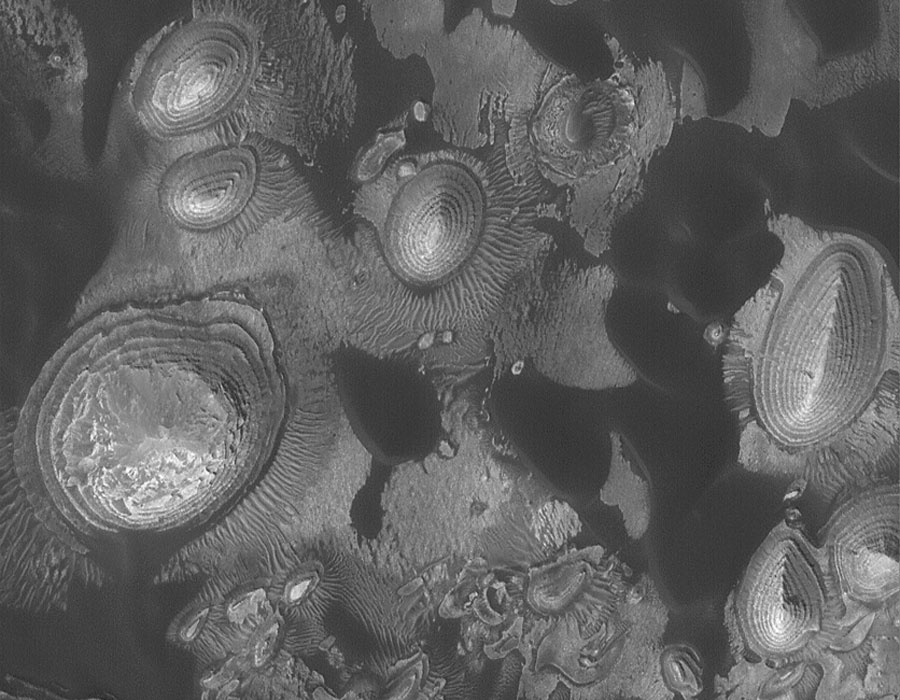
And continuing to promote astronomy with excellent geology, APOD today shows hills eroded from layered deposits on Mars

Saturday, June 5, 2010

I Am Sitting in a Room, Different From The One You Are in Now

I am sitting in a room different from the one you are in now. I am recording the sound of my speaking voice and I am going to play it back into the room again and again until the resonant frequencies of the room reinforce themselves so that any semblance of my speech, with perhaps the exception of rhythm, is destroyed. What you will hear, then, are the natural resonant frequencies of the room articulated by speech. I regard this activity not so much as a demonstration of a physical fact, but, more as a way to smooth out any irregularities my speech might have.
This performance piece, by Alvin Lucier, was regularly played on KBVR, Oregon State's student radio station, when I was an undergraduate. The text above was read, then replayed and recorded, then that recording replayed and recorded, and so on, over and over, ultimately becoming a series of squeals and hoots. You can hear an mp3 of the original recording here, though I don't think that was the one I was accustomed to. Here's a YouTube clip that sounds more like the version I recall, but I do remember the original as being something like 15-20 minutes; this one is 8:21.

It's odd, and you may not want to sit through the whole thing. It's not intended to be aesthetically pleasing, but I did, and do, find it fascinating and thought-provoking.

So what? If an admittedly unpleasing demonstration of resonant frequencies isn't your cup of tea, so what? Well, as with so many things in this age of lightning-speed data, there's a remake...

That's the original.
I am sitting in a room different from the one you are in now. I am recording the sound of my speaking voice as well as the image of myself, and I am going to upload it to YouTube, rip it from YouTube, and upload it again and again, until the original characteristics of both my voice and my image are destroyed. What you will see and hear, then, are the artifacts inherent in the video codec of both YouTube and the mp4 format I convert it to on my computer. I regard this activity not so much as a demonstration of a digital fact, but more as a way to eliminate all human qualities my speech and image might have.
Here's number 56:

Number 168:

Turn down the sound... number 1000 is really ugly.

As I said, this isn't intended to be "pretty," but it is fascinating to me. If you're curious, it looks as if all 1000 iterations have been posted.

Friday, May 14, 2010

Okay, Pretty Much Every Single "Fact" Is a Mistake

but the pictures at Dark Roasted Blend today are very nice, nevertheless.First, I wouldn't call those striations; the bedding is being clarified as the result of differential weathering and erosion. Second, striations (meaning scratches) are not necessarily caused by glaciers, wind or waves. Third, these canyons are not "fed by the Colorado River." They're tributaries of that river, meaning they flow into it, not vice-versa.

Still, the photos are awfully pretty.

Sunday, April 25, 2010

503 Years Ago Today

Via The Bend Bulletin:
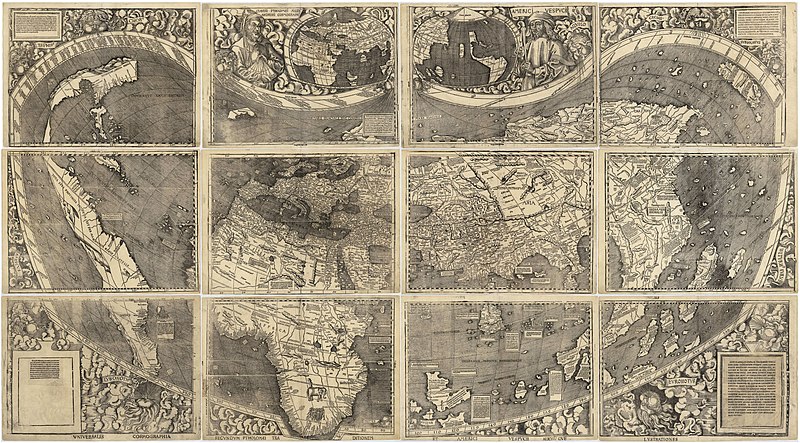
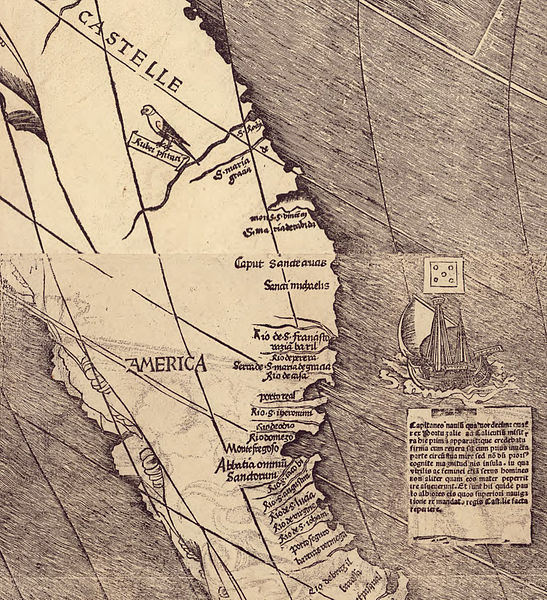
In 1507, German cartographer Martin Waldseemueller named a huge land mass in the Western Hemisphere “America,” in honor of Italian navigator Amerigo Vespucci.
Apparently, this is a big day in the history of navigation. From the same link,
In 1859, ground was broken for the Suez Canal.

In 1959, the St. Lawrence Seaway opened to shipping.
From Wikipedia,
In 1513 Waldseemüller appears to have had second thoughts about the name, probably due to contemporary protests about Vespucci’s role in the discovery and naming of America, or just carefully waiting for the official discovery of the whole northwestern coast of what is now called North America, as separated from East Asia. In his reworking of the Ptolemy atlas, the continent is labelled simply Terra Incognita (unknown land). Despite the revision, 1,000 copies of the world maps had since been distributed, and the original suggestion took hold. While North America was still called Indies in documents for some time, it was eventually called America as well.
I've always been a little curious about how these two continents came to be known as America, rather than Columbia. I mean, I knew where the name came from, but why didn't he choose the actual discoverer as the eponym, rather than a second explorer and writer? According to the excerpt below, the decision was made because it was Vespucci's observations, not those of Columbus, that made it clear this was an entirely new land:
Apparently among most map-makers until that time, it was still erroneously believed that the lands discovered by Christopher Columbus, Vespucci, and others formed part of the Indies of Asia. Thus some believe that it is impossible that Waldseemüller could have known about the Pacific, which is depicted on his map. The historian Peter Whitfield has theorized that Waldseemüller incorporated the ocean into his map because Vespucci's accounts of the Americas, with their so-called "savage" peoples, could not be reconciled with contemporary knowledge of India, China, and the islands of Indies. Thus, Waldseemüller reasoned, the newly discovered lands could not be part of Asia, but must be separate from it, a leap of intuition that was later proved uncannily precise.
Also from Wikipedia, the above is apparently the chart under discussion. I love old maps, but the full size image is ginormous, 13,708 × 7,590 pixels, file size: 19.65 MB, and my computer basically choked on it. Below is a crop (from the same page as above) showing our part of the world getting named.

Wednesday, March 17, 2010

The Chicks of Rock

I don't recall whether I got around to posting this video when I first saw it. I meant to, but there are far more blog-worthy things I come across than I actually get to. At any rate, if this is a repeat, apologies; if not, it's a fun clip of zebra finches playing guitars.

I'm curious if the birds learn to make an association between the instruments and the noise that's produced, but the reason I bring this up is that there was a fun story at The Guardian yesterday on the unfolding events at this exhibit: one of the finches laid an egg on a guitar. "The day an egg stopped the rock-chick show. The Barbican's new exhibition features birds playing musical instruments – which leads to the occasional unexpected drama." I read it, then marked it as unread, half thinking I might write a bit about it, but not really wanting to bother seeing if I'd posted the clip before. Then this morning one of the bloggers I follow, Bing McGhandi at Happy Jihad's House of Pancakes, stuck it up, making it easy, and really, unavoidable.

And you thought this post was going to be about the upcoming film, "The Runaways," didn't you? No. I would never refer to Joan Jett as a "chick."

Saturday, March 13, 2010

Friday, January 8, 2010

The Apocalypse Will Be Greeted With Candy And Flowers

Krista Huot: "Four Unicorns of the Apocalypse" 2009, via Phantasmaphile. This is one of quite a few paintings in a show that will open at Gallery 1988 in San Francisco tomorrow (January 9), and be on display until January 30. Unlike about half the others, this one hasn't been bought yet. Out of my price range, but I like the simplicity and humor of this. Ms. Huot's website is here; I haven't looked through it thoroughly yet, but there are lots of paintings there.

Wednesday, December 2, 2009

A Few Recent Science Image Collections

Dark Roasted Blend has a gallery of terrific renderings of recently discovered crocodiles via National Geographic. I have been less than impressed with NatGeo's science reporting over the last few years; they seem too eager to jump on sensationalist reporting, and sometimes don't vet their research and sources well. Nevertheless, their imagery is, as always, very impressive. Just take the veracity with a grain of salt.Another recent post at Dark Roasted Blend features some photos of magnificent science glass work created by a couple from 1887 to 1936 for a Harvard botany professor who wanted to show what plants actually looked like, rather than dead, faded, dried, and flat specimens. Yes, you read that right: the above are glass!Later in the same post as the glass plants is this photo of street art from Russia. I can't help but think of Night of the Lepus... (If unfamiliar, you can see some clips from this enjoyably awful movie here.)Finally, today's Big Picture features a selection of 24 shots from 100 photos on 100 consecutive days from Glacier National Park, compiled to commemorate the park's upcoming centennial anniversary. There is also a link there to the full gallery, but I haven't looked at that yet.

Friday, November 20, 2009

So What We Do Is Go and Get Us an Asteroid

And blow it to pieces. It would be messy for a while, and random poofs would appear on Earth as pieces hit the ground. Yeah, some people would die, and it would basically put an end to the space program. But it would so totally be worth it, don't you think?

From here, via The Daily What

Thursday, November 19, 2009

Mad as Hell

I haven't picked up a copy of Mad magazine in many years. I loved it when I was young, but sort of lost interest during college. That said, their "20 Stupidest People" issue, which was supposed to hit the stands Tuesday, looks terrific. Coming in at 18th place (18th? srsly?) is Sarah Palin. Hot on the heels of the Newsweek scandal, rampant sexism raises its ugly head again. Comics Alliance posted this picture more than a week ago: (click for fool size)
Michael Jackson is ranked first. Now I think he was crazy, and the style of music for which is famous isn't my cup of tea, but in the stupid department, Palin so outclasses him that I have to wonder about Mad's ranking system. But I do love the picture, again via Comics Alliance. I'm betting you can figure out how to see this in glorious full-size.

Tuesday, November 10, 2009

Yep. That's About Right.

From Regretsy. The last frame is an actual product for sale (only $50.00). What? You don't recognize The Artist formerly known still known as Prince? (He is still called Prince isn't he?) The whole series is Helen Killer's mathematical summary of how one gets to that last frame.

Monday, November 2, 2009

I Hate it When That Happens

The Telegraph has a mind-blowing gallery of Lego sculptures. The artist, Nathan Sawaya, quit a job with a "six-figure salary" (keep in mind this is a London Paper; in Pounds Sterling, that's a minimum of 150 K USD), and sells these for thousands of dollars apiece. Looking through the photos, I personally wouldn't buy them- I can't afford that kind of money, and I have no place to put them that would do them justice- but they're totally worth it.