This is a submission for "The Accretionary Wedge #13," Geologeeeeee in Spaaaaaaaace! Hosted at Good Schist.
Followup: "The Accretionary Wedge #13," Geologeeeeee in Spaaaaaaaace! has now been posted
here. Go and gaze in wonder at his cover illustration. Take a look at the Geology, too. If you find youself fascinated, you can find links to many of the past editions of "Accretionary Wedge"
here, along with topics to be covered in coming months. The complete set of links to the previous 12 editions can be found
here.
We had our second home game yesterday, and apparently the OSU Beavers kicked some butt. I'm not a fan of football, but it pleases me to see people pleased- I wish they weren't so noisy about it, but let the kids party and be crazy on the last days before school starts. The nights are getting longer and cooler, and while my color perception is pretty bad, even I can tell the leaves are starting to turn. We had some showery weather Wednesday and Thursday; I always like the return of the rain. We normally have some really nice warm weather around the end of September; this year is no exception and the weather people are predicting upper 80's for Sunday and Monday. However, there is no doubt that winter is on the way.
For obvious and unavoidable reasons, we humans all think of hot, cold, and average in very narrow terms. Growing up in Ohio, hot was 90 degrees with abominable humidity. Here in Corvallis, hot is 95-100, but dry as a bone. Cold in high school was 0-10; in Western Oregon cold is 35 or less- yeah, I'm spoiled. Others regularly have more extreme temperatures, but that range of 100 degrees Fahrenheit (55-60 C) probably encompasses the vast bulk of human experience.
As geologists, we learn to think about more extreme temperature situations on the upper end of the scale; metamorphic processes start around 200 C, a granitic melt may be around 700 or 800 C, A Hawaiian flow around 1100 to 1200 C. Yesterday a fellow coffee drinker asked me what my favorite rock is, and without hesitation I answered "komatiite." Then I had to explain about Earth's thermal evolution, the role of MgO and SiO2 in melting temperature and how crazy a melt temperature of 1600 C or more seemed to me. And finally winding up with a discussion of how I just found it amazing that a rock common in Earth's early history could no longer be formed in the conditions now present. How odd it was to consider a rock "extinct."
I don't know how much Ben understood, but he's pretty sharp.
But the point is, as people, we have a very limited perspective on what a reasonable temperature range is. As geologists, our window is open somewhat wider on the high end.
We rarely consider the low end. What goes on in that 273 degrees between freezing and ultimate cold? As both geologists and as people, that whole range is dormant: dead and cold. What could possibly happen? Water doesn't run, rocks don't deform. There's glaciers (for the time being, at least), but they're actually quite close to freezing, not that cold at all. From our earthbound perspective, it's difficult- nearly impossible for me at least- to think of anything
happening at 100 or 200 below zero.
Which is why this was probably the most stunning space image I've ever seen and ever expect to see:
 This was one of the first images
 posted by ESA when the Huygens probe descended to Titan on January 14, 2005. My friend Matt, a doctoral student in physics, with a focus on stuff astronomical, and I had been hovering over the computer breathlessly, waiting for news on the descent. When this came up, I remember my jaw dropping, and blurting at him, "But that's goddamn dendritic drainage."
As if, somehow, that was prohibited.
We knew there was a chance a chance of methane/ethane preciptation, we knew there was a chance of liquids on Titan. But the idea that dendritic drainage might form at 178 below zero Celsius never crossed my mind. The idea of valleys being carved into
water is just plain alien.
This was another picture released the day my universe changed

I immediately pointed out that these cobbles showed the distinct rounding I associate with river processes; there's even a little scour moat around the center clast. These are made of water ice.
It was a little ironic; I had mentioned to Matt on several occasions that the "geology" of the solar system's outer icy bodies would be difficult to comprehend until we learned to think of ice as a lithic material. Yet here was a classic earthly landform confronting me, challenging my expectation of the unexpected. When I settled on this topic, I reread Chris' call for "Geologeeeeee in Spaaaaaaaace," and noted this quote with amusement: "Geology doesn’t just happen here on Earth, it’s happening everywhere there’s a small amount of silicates being drawn together by gravity." Nah, us geotypes are flexible. We don't need no stinkin' silicates. We like silicates just fine, but if you want to count in terms of numbers, or even in terms of surface area, ice geology is more abundant in our solar system. Three of the four Galilean satellites of Jupiter are icy; most of Saturn's moons are icy; the "plutoids" (I'm still going to call Pluto a planet, dammit) are icy. But the parallels between ice and silicate geology are amazing to me.
In addition to fluvial features, we can get
geysers as in the south polar regions of Enceladus:

(I do love this picture; where do you suppose the moon is trying to go?)
We can get
rifting, as on Europa:

We can get
folded terrain, as on Miranda:

(Check out the
full-size picture here) In fairness, Miranda appears to be a half-and-half body: half silicate, half ice.
So it's clear that geology is not just about silicates, though it's perfectly understandable and reasonable that us earthly geologists are predisposed to think in those terms. Does cryogeology have the equvalent of Bowen's reaction series? Are there chemical reactions that occur within ice as a lithic material? We always throw around the phrase "life as we know it," to quietly skirt the possibility of "life as we don't (yet) know it." Possible? Impossible? Who knows. But in a universe where an
earthly scene like this
shows up on Titan, at nearly 200 below zero C, far be it from me to suppose what can't happen.
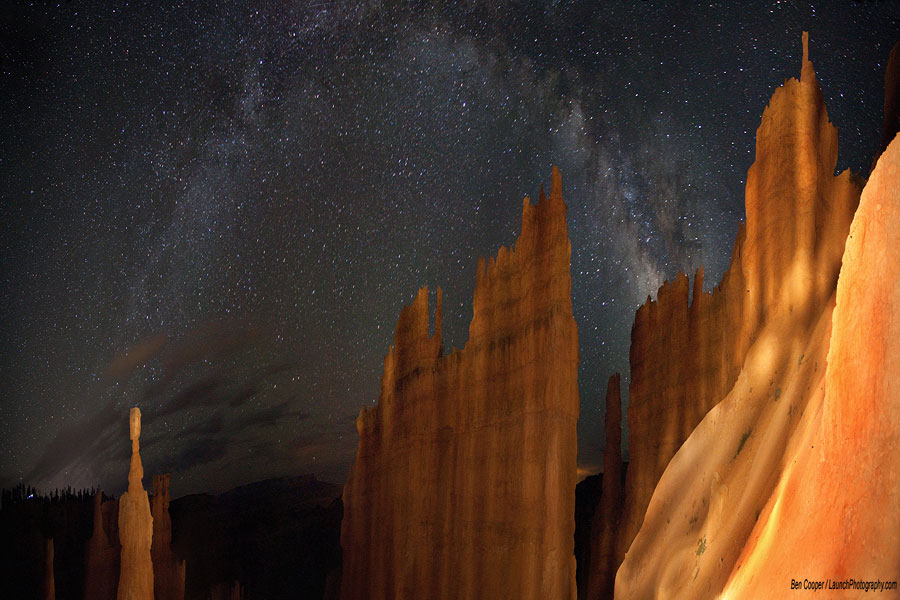 APOD 7/27: The Milky Way over Bryce Canyon National Park.
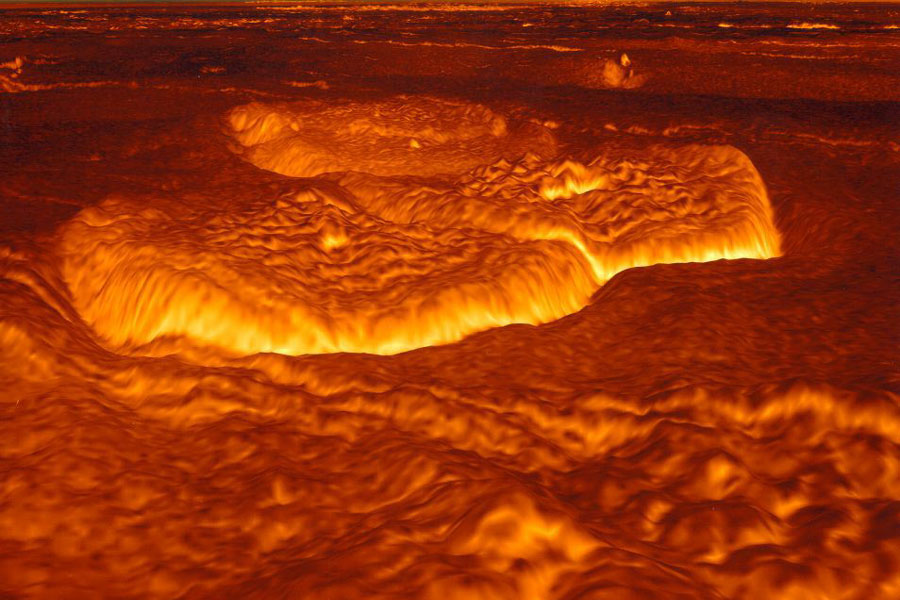 APOD 8/01: Thought to be volcanic domes on Venus, reconstructed from radar data (color not natural).
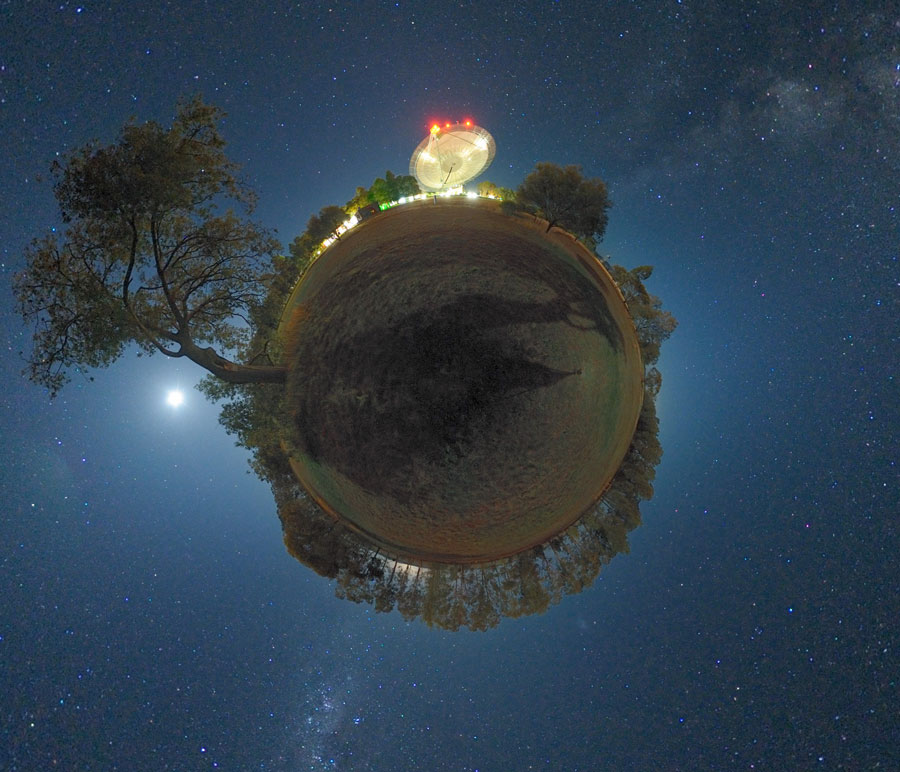 APOD 8/03: Fish eye view of the ground, stitched together with three panoramic views of the horizon and sky recreates the planet of The Little Prince. Click over and move your cursor over the photo for labels on various astronomical features.
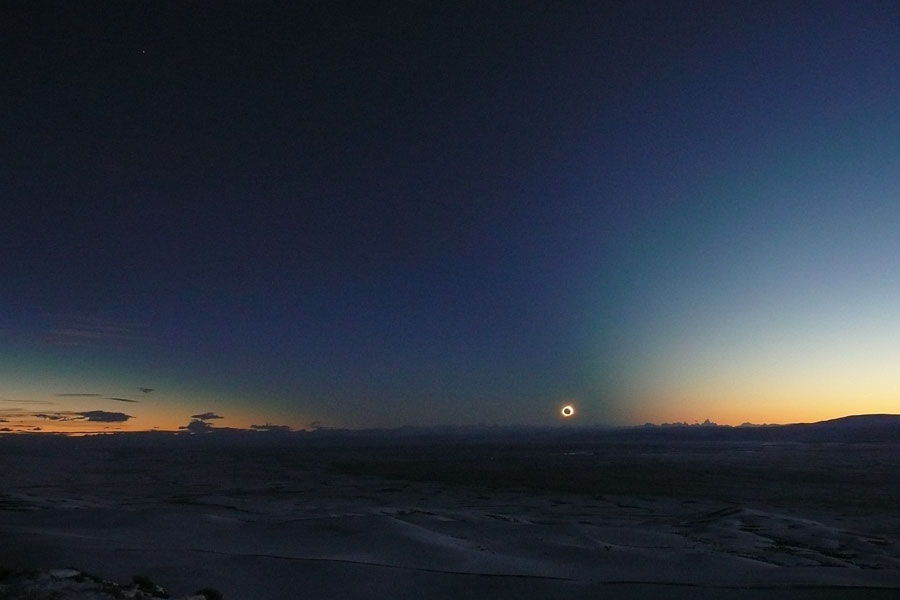 APOD 8/04: Eclipse shadow cone over Patagonia, Andes Mountains in the distance.
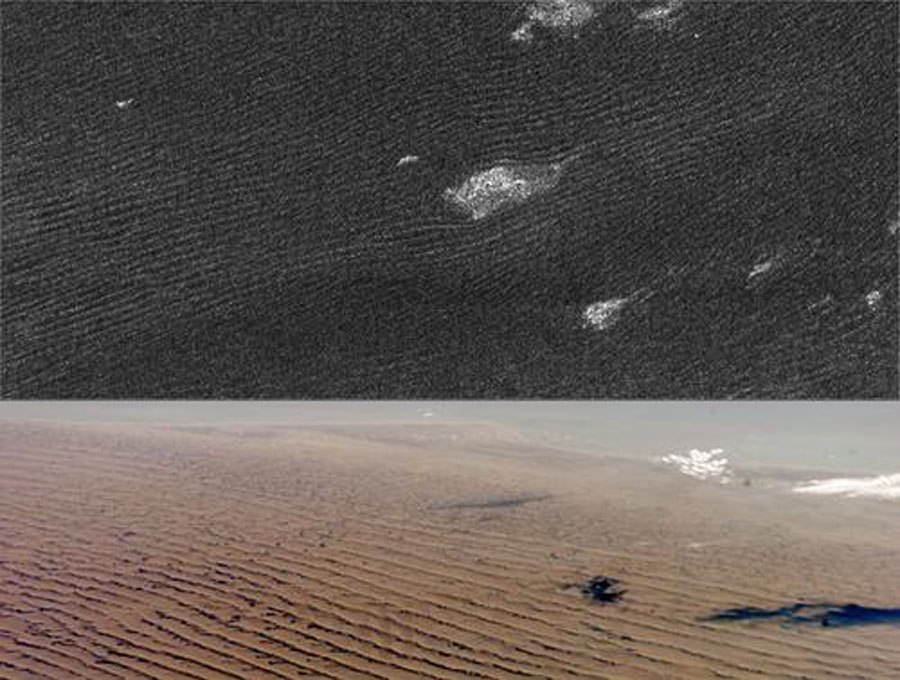 APOD 8/10 Below, dune field in Namibia. Above, dune fields on- get this: Titan, Saturn's largest moon. Some of the similarities of Titan's geomorphology to Earth's are, well, unearthly. The description doesn't say what the composition of the sand is ("sand" specifies a grain size, not a composition); I suspect it's water ice. Ice appears to make up an important lithological component of Titan's surface. What we think of as "water" here would be considered lava to a Titan native, and "groundwater" would be the equivalent of magma.





 Posts
Posts


