Showing posts with label Astronomy. Show all posts

Monday, May 29, 2017

Advice to an Eclipse Chaser

Saturday, I received an email from a stranger who reads this blog, and occasionally reads my tweets, asking for advice on where to watch the eclipse in Oregon. As I explain below, the issue at this point is not so much where to watch, but where to stay. I'm posting my response in hopes this might help others with their planning.

Dear -----,

Glad to hear you've been enjoying my geology stuff, and I think you'll find Oregon does not disappoint in that regard. However, my immediate reaction to your letter is that if you haven't got accommodations locked down, you're going to have a very difficult time finding an allowed camping spot (without spending a fortune) at this point. There have been stories since last fall about reservations already being full. I can't really make a recommendation, as I have no idea where there might be openings. Probably your best bet is to hunt around outside the path of totality, wake up early, and drive to a decent viewing site.

Other things to be aware of:
  • This will be peak fire season, and many areas will likely be closed due to extreme fire risk. [addendum: Keep an eye on fire reports, and avoid those areas. Keep in mind that downwind smoke will not enhance the experience. Also, keep an eye on weather forecasts.]
  • Eastern and most of Central Oregon is sparsely populated, and smaller towns are going to have a very difficult time meeting the needs of the thousands of people expected to descend on them- so carry as much of whatever supplies you may want/need as you can. My suspicion is that lines will be horrendous, especially the morning and afternoon of the event.
  • Marys Peak would be ideal, which is why I never entertained it as a viewing location. I was relieved to learn, a few weeks ago, that access would be heavily restricted, and all permits for driving there are long gone. (Imagine a health emergency when 10 miles of road is gridlocked. Imagine the road rage from people furious they can't see, and the inevitable legal issues that would follow. These are just a few of the reasons I eliminated the site from my choices when I first learned of the eclipse 9 years ago.)
  • I expect much if not all of the path in OR will be blistering hot, with clear skies and intense sunshine. Plan water and sunscreen accordingly. On the other hand, nights can be surprisingly chilly, so bring some warm clothes as well.
  • Expect traffic to be a nightmare.
  • In case you don't know, it's safe to look at the disk during totality, but NOT during any portion of the partial, unless you have optics that are explicitly sun-rated.
My bottom line is this: I expect that if you're doggedly persistent, and plan your travel times to be longer than you'd expect otherwise, you'll be able to get in on the fun. You should check in with the BLM and Forest Service offices to ask for advice, but I'm gonna guess they'll tell you much the same. On the other hand, I know that John Day NPS will offer free camping to volunteers, if that possibility is still open. It might not offer the very best location for viewing, but it might save a lot of work and disappointment. I feel pretty confident in saying that everything will come to a halt as the time approaches, so any volunteer duties will basically end for at least a few minutes.

Also, I have found this site, hosted on Google Maps, to be very helpful.

Other than the eclipse, though, I can certainly give you scads of pointers of what to see and do around and near OR, and specifically in the Steens/Malheur area and nearby areas in northern Nevada. Please let me know how you're coming into SE OR, and I'll bet we can work out a sweet itinerary.
Wishing you the best of luck in your travels!

Lockwood DeWitt

Sunday, August 21, 2016

One Year From Today

The blue line across the middle represents the mid-line of the August 21, 2017 total solar eclipse. The shaded area around that line represents the area of totality, where the sun's disk will be completely obscured for a period of time as the moon passes in front of it. The closer an observer is to the mid-line, the longer the sun will be obscured.

I've been excited about this for years; I've never seen a total solar eclipse. I've seen partials that were total or annular elsewhere, but I've never been in the path of totality. For viewing, all I really need to do is be awake and standing in view of the sun, but I'd like to get to a decent elevation. I understand that if you're in a spot with a good east-west vista, you can see the shadow of the moon approaching and receding before and after totality. In Corvallis, the umbral speed will be 1.310 km/sec, or 2929 miles per hour-- which is to say, the fastest predictable thing I will ever see. This interactive map (from which the above screen shot was taken) is the best resource I've found for planning, with extensive details about the event. Simply click the crosshairs on a point of interest, and a table of data will pop up, telling you everything you could want to know about the eclipse at that position.

I have some ideas about where to watch it, but I hope to have opportunities to do some scouting between now and then. It may be that I can get up to the Santiam Pass area and do geology for much of the remainder of the day. In the end, I suspect I'll play it by ear. This time of year, fires and smoke can muddle an otherwise glorious view. However, the chance of rain- or even heavy clouds- in mid-late August is next to nil.

Wednesday, November 12, 2014

Philae: "Hey Folks, I Got You a Comet"

At some point, I'll copy over some tweets and retweets from the past couple of hours, but for the time being, science people on Twitter are being like this. And I'm one of them. I'm not sure that anything else will be happening today. Thanks, ESA!


Sunday, July 20, 2014

45 Years Ago Today

The Onion, July 21 1969. There will never be a better commemoration. (Source; open the image there for full readable size)

Thursday, January 24, 2013

Funny 3-D in 2-D

Yesterday, tweeted, "I can't believe I'm not finding any search results for "ternary diagram funny." Can any geologists out there help me out?" I did a search, and found this one, which is fun, but not too pertinent to the Hallowed discipline that is Geology. I also found one from Georneys, which I thought was pretty clever, but which Emily apparently thought was not up-to-par in the humor department. I sent those links along, but followed that tweet with "But you're right... most are seriously intended. This is indeed a void in the geologic literature, crying to be filled."

So, in the interest of opening up a new area of investigation in geology, here is my (first) suggestion for a funny ternary diagram:
Okay, it's not going to make anyone die laughing, but it's my first shot...

Here are a couple of blanks if anyone else wants to chime in.
(From Wikipedia) A more formal (and larger) blank ternary diagram:
Anyone else have any ideas? I'm giving this a "Memes" label, not because I expect that it will take off, but because I'd really love for it to do so.

Followup, 12:55 PST: Here's another...

Thursday, September 6, 2012

The Little Robot That Could... Visits Miranda!

Note: This wedge has now been accreted at En Tequila Es Verdad.

This month's Accretionary Wedge (#49) theme is "Out of this World," hosted by Dana Hunter at En Tequila Es Verdad. A similar theme was done four years ago in September of 2008. We've tried to avoid repeating themes that are similar, but this one troubles me not at all, for several reasons. First, it's a little startling to realize just how much has been done and accomplished in four years- that's four extra years of Spirit and Opportunity tooling around in the Martian desert, Curiosity is getting geared up, calibrated, and checked out for its own Martian odyssey, Dawn exploring one asteroid and preparing a voyage to a second, four more years of Cassini exploring the Saturnian neighborhood and moons, and Messenger arriving, doing initial higher orbit observations of Mercury, then descending and starting higher resolution observations in a lower orbit. And THOSE are just the big name probes. Second, the geoblogosphere has seen quite a few new members (including Dana herself), so at this point, I have no problem with repeating or doing similar AW editions to earlier ones. New members, new perspectives. Third, the earth is plenty big, but the solar system is inconceivably huger. There are quite a number of bloggers out there who post almost exclusively on planetary geology (as I grew up calling it) or exogeology (as it seems to be most commonly called now). (Emily Lakdawalla at the Planetary Society Blogs is my favorite.) So it's not as if one AW post on Out of This World Geology was going to put more than a scratch on the countless subjects that could be addressed.

In my post four years ago, my first participation with the AW, I addressed the broad topic of cryogeology, and the idea of how alien it is to us to think of ices as lithic material. While it is quite literally alien from our perspective to think of water and other ices as making up a large or even dominant portion of a large solid body, that is in fact exactly the composition of many bodies in the mid- to outer portion of the Solar System. I mentioned Miranda in that post, and I featured that Uranian moon in my first Moonday post (and the APOD upon which that post was based), but it's my favorite known moon, so forgive me for returning to it yet again.

35 years ago yesterday (September 5, 1977), Voyager 1 was launched into space. Oddly, Voyager 2 had been launched on August 20- if I recall correctly, the reason they were numbered "backwards" was that Voyager 1's path would quickly put it ahead of Voyager 2, even though the latter had a 16-day head start. Voyager 1 was thus able to scout the way at Jupiter and Saturn, and give scientists a better idea of how to target their observations when Voyager 2 passed through those systems later. At launch, Voyager 2 was expected to visit Jupiter and Saturn; extending its planetary mission was contingent on further money being budgeted by Congress, always iffy. However, the budget was extended, and Voyager 2 was pushed deep into Uranus's gravity well, to give a final gravity assist "kick" to also intercept Neptune.

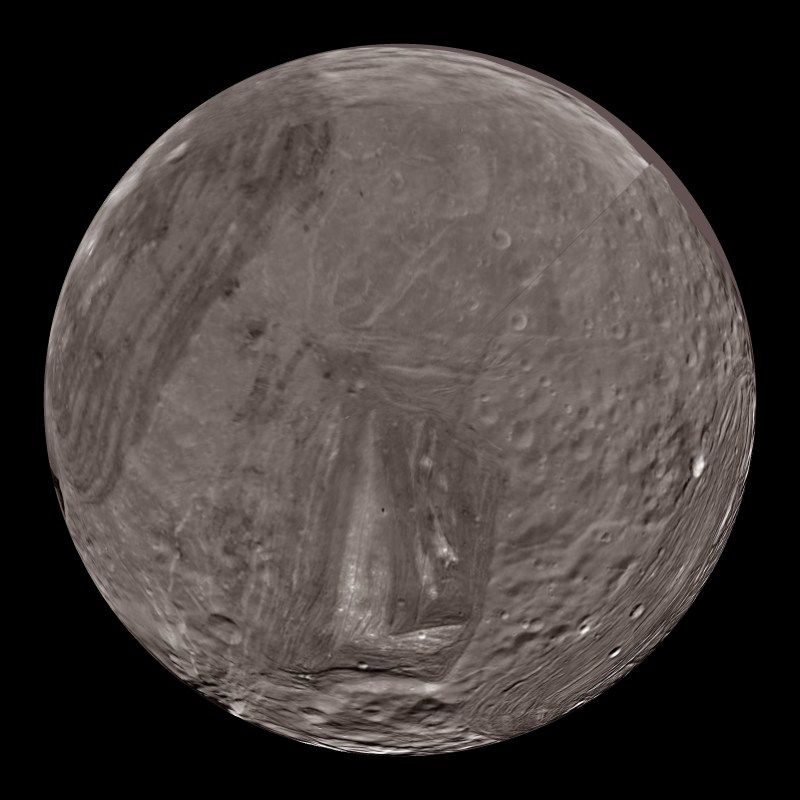
The dive in to Uranus meant that some of the outer moons, which initially were more interesting to planetary scientists, would not be as well observable as had been hoped. And since there was no "scouting trip" by Voyager 1, there would be one chance and one chance only to see what that planetary system had offer. Miranda was not expected to be as interesting as other targets might be, but the path of the probe, and sun/moon illumination aspects would give ample opportunity to study that object. Good thing. Here's a whole-disc image:
At some point in its past, Miranda must have been one of the most geologically active bodies in the solar system. Early speculation was that the moon had been severely impacted, perhaps a number of times, with enough force to disaggregate it, but not enough to cause the pieces to fly apart. That was the story I repeated for roughly 15 years. Then I saw somewhere a new theory that it was impacts and melting, which didn't make as much sense- complete melting would allow segregation of lithics/silicates from ices- and at a density of ~1.2 grams per cubic centimeter, Miranda looks to be a mixture of both. In reading up for this post, I find a much more appealing explanation, which is that Miranda went through a period of orbital resonance with Umbriel, which could have warmed its interior enough to trigger diapirs to develop in the equivalent of its mantle. This would involve solid ice deforming plastically, not melting to liquid. But whatever the explanation, the sense I've always had is that we're seeing enormous depth, compared to the radius of this body, turned over on its side. That fascinates me.

Central in the image above is the feature referred to as the "chevron," and on the right, structures that, as far as is known, are unique to Miranda and Venus, coronae. Looking at the heavily cratered terrain in the upper portion of the image, and down the lower left middle, one can infer you are seeing an ancient, mostly undisturbed surface- much at odds with the dynamism apparent on so much of this small moon. At less than 500 km (300 mi), Miranda would fit easily within the borders of a number of US states.
Above, from a NASA image gallery, shows three different terrain types, from left to right, ancient cratered terrain, linearly grooved terrain- an example of a corona- and complex terrain, in which grooves and folds abruptly terminate into each other. Speaking of abrupt, the transition from one terrain type to another is strikingly sudden. Another striking feature pointed out in the Moonday and APOD posts linked in the second paragraph above is the tallest known cliff in the solar system: Verona Rupes, a 20 km fault scarp. At more than 8% of Miranda's radius, an equivalent cliff on Earth would be over 300 miles tall: bigger than Miranda itself! I think the APOD is a zoom and crop of this image, which shows how completely disrupted the terrain is in the neighborhood of that enormous cliff.
I commented to Dana in a recent note, that in each page I had found worthwhile reading while brushing up on this topic, I was amused to see some variation of the comment, "...but, really, no one knows for sure." When I was young, in middle school, I was under the impression that essentially all the questions in science had been answered. And while I loved science, I didn't really grasp what scientists *did,* beyond just "knowing things." Without that context, I don't suppose you'd be able to grasp the childlike glee that the phrase "...but, really, no one knows for sure," gives rise to in my heart. Knowing is wonderful, but coming to know is even more wonderful. And recognizing what one does not know is the first step in that process.

New Horizons is on its way to Pluto, with passage through that system expected in 2015. Based on the Voyager missions, as well as innumerable other planetary science missions over the last few decades, I have no doubt whatsoever that there will be things there that will blow me out of the water. But I will always have a special fondness for Miranda, a tormented child of the the solar system. There are no further missions planned to Uranus, and it's unlikely any great strides in understanding exactly what caused that chaos will occur during my lifetime. I'm okay with that. I wouldn't want to live in a universe where's there's nothing to point at, and with a note of wonder and awe, say, "...but, really, no one knows for sure."

Saturday, June 9, 2012

Twice in a Lifetime

...And as best as I can recall, I missed the first opportunity because it was too early in the morning and the weather was expected to be cloudy. But on Tuesday, we had decent weather- mostly clear skies, with some broken clouds- and a great chance to watch the last transit of Venus for 105 years. And thanks to discussions by other bloggers following the annular eclipse (partial, here) two weeks ago, I learned how to project an image with one side of my binoculars. And the quality of the projection far exceeded my wildest expectations.
Interzone people gathered around the projected image, and below, what we saw:
Our high-tech equipment...
The paper is 8 1/2 by 11 inches, so not only was the image sharp and bright, it was a good size, too.
 Below, a crop from the above photo, with labels.
And another view of folks gathered around enjoying the show:
The best part? I've since had three people come up and tell me they went home, got out their own binoculars, and gathered little crowds of their own. In the words of Douglas Adams, "Last chance to see!" There will be a transit of Mercury on May 9, 2016, and with that planet both smaller and more distant from us, it will be more challenging to view. But I'm very impressed with this projection technique- it's far superior to a pinhole viewer- and I'm guardedly optimistic we can pull it off.

Addendum: Today's APOD shows the image quality you can get with good equipment. In this case the Hinode satellite.

Monday, June 27, 2011

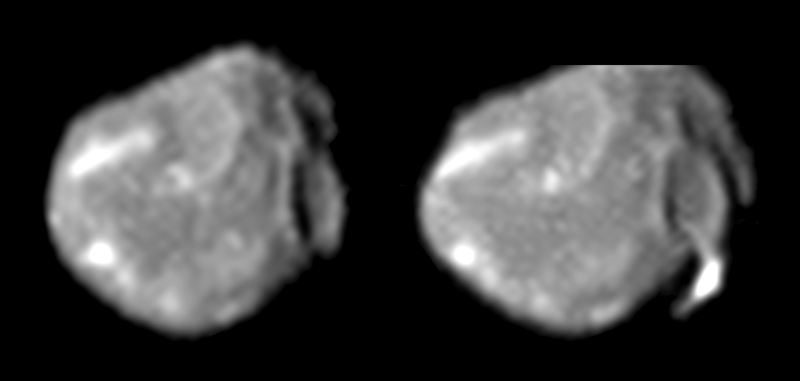
Moonday: Amalthea

(Image from Wikipedia; full article here) At 83 km in diameter (~50 mi), Amalthea was the fifth discovered moon of Jupiter (the first four were the large Galilean satellites), and the last planetary satellite to be discovered by direct visual observation, as opposed to photographically. Given that the above Galileo images are among the highest quality available, it should be unsurprising not too much is known about this object. A couple of seemingly unrelated facts do constrain its history, though. First, Jupiter would loom in the sky, covering more than 45 degrees of arc; in other words, if you drew a horizon-to-horizon line, Jupiter would cover more than quarter of that. Second, recent observations strongly indicate that Amalthea is icy. Since the young planet was very hot, we can conclude Amalthea did not form where it is today. It either migrated from a more distant orbit, or was captured by Jupiter later in its history.

Monday, June 20, 2011

Moonday: Helene (Again)

I won't make a habit of using the same moon twice in a row, but this is too cool to pass up. NASA's image of the day is a high-resolution shot of Helene, captured by Cassini just two days ago. I'm struck by the evident streamers on the surface... I have some ideas what they might be, but I'll keep them to myself. Poorly informed guesses can cause more problems than they're worth. (Full size image here; definitely worthwhile)

Monday, June 6, 2011

Moonday: Helene

From The Planetary Society comes this image of Saturn and its moon, Helene. (Several other magnificent color pictures of Saturnian moons at the link.) You can tell at glance it's a fairly small moon; it's irregularly shaped and has enormous relief compared to its size. Larger bodies with more mass are more strongly effected by gravity and pull themselves into more spherical shapes. A quick check of Wikipedia gives its mean diameter as 17.6 km (11 miles). Though this moon was only discovered in 1980, it was not from a Voyager flyby, but from ground-based observations.

Saturday, May 28, 2011

Weird Geology: Name That Rock Type!

Note: AW #34, Weird Geology, has now been accreted at En Tequila Es Verdad.

This month's Accretionary Wedge topic, hosted by Dana at En Tequila es Verdad, is one near and dear to my heart: weird geology. To step back a bit, one might define weird as something decidedly outside or beyond typical human experience. Taking that as a working definition, nearly all geology is weird: the environmental conditions, rates of change, chemical reactions, as well as starting materials and end products are too hot, too high pressure, too slow, too extreme, too unusual, or too obscure to make sense without quite a bit of background. Conversely and paradoxically, the materials and processes are often so mundane that we simply don't notice them or pay attention to them. Just as the structures and behaviors of a spider or flowering plant are so day-to-day that few really look hard and try to understand these odd (from a human perspective) organisms, so too the never-ending passage of sand, silt, mud and dissolved material through a neighborhood stream goes unnoticed and unremarked. Yet millennia and eons of such mundane activity will result in breath-taking changes in the nearby landscape. From this perspective, I think it's fair to say that nearly all geology would be considered weird to most, and certainly to those with no training or background in the subject.

I think of myself impossibly lucky in that even with a considerable background, I can still look upon geologic processes and materials with such fresh eyes, and see the wondrous weirdness of such things with one part of my mind, even as I observe, analyze and hypothesize with another. Perhaps it's schizophrenic, but it pleases me to be amazed by things that generally make pretty good sense to me.

All that said, there is a matter of degree... there are definitely some rocks and processes that are more difficult to come to grips with. For example, I'm fascinated by komatiitite, a type of volcanic rock characterized by its extremely high magnesium content. It can be considered the volcanic equivalent of peridotite, just as basalt is the volcanic equivalent of gabbro. It was quite abundant in the earth's early history, but as the planet has aged and cooled, as its original dole of radioactive nuclides has decayed and decreased, the geothermal gradient has become too gentle to allow melts of this composition to reach the earth's surface. One can think of komatiite as an "extinct" rock type. It is preserved as lithic "fossils" in various places (I have had the opportunity to see some first hand in the Hill Lake quad between Temagami and Cobalt, in central Ontario), but not only is it no longer created, it no longer can be created.

But the weirdness I really want to address gets at the way we name things. Often, the way we do science can get in the way of better understanding- a characteristic shared with language generally. Words allow us to symbolize ideas we can share with others, and allow us to perform abstract operations on the symbols that we could not perform with the actual thing. But the utility and availability of those symbols also confines us. We tend not to think too much or too hard about things for which we do not have words.

Anyone who has had even a grade school lesson or few on geology knows the three rock types: igneous, metamorphic and sedimentary. A little more background, and one begins to grasp just how arbitrary the boundaries between those rocks types are, and how difficult it is to simply draw lines between them. Exactly how hot, and under how much pressure, must sedimentary rocks be, before miniscule changes in textures and mineralogy force us to conclude that the rocks must be considered metamorphic? In fact there isn't, nor can there be, any such precise definition. We learn to hedge; we create a new facies ("zeolite grade metamorphism") to delineate this intermediate stage. Never mind that the vast majority of zeolites and zeolite-cemented rocks I have dealt with are clearly the result of diagenesis, not metamorphism.

But at least we can assign all known rocks to those three classes, or their intermediaries, right? Well... maybe not so much. The term "metasomatic rocks" came up in only one of my classes, and only in passing. The term was not used at all in my economic geology class, where most of the rocks we discussed could be considered to be members of that group. The roots (meta=change, soma=body) imply a change in mass composition, differing from a common assumption in metamorphism, that the bulk composition of the rock is mostly fixed, but mineral phases and textures change in response to changing T & P. With metasomatic rocks (AKA hydrothermal rocks), certain elements/ions may be preferentially removed or deposited as their solubilities change due to changing temperature of transporting water/water vapor/hydrothermal fluid. Even the concept of liquid and gas become fuzzy at high enough temperatures and pressures. For example, above a temperature of about 375 C, water behaves as a gas; at or slightly below that so-called critical temperature, it requires a pressure of 218 atmospheres to maintain a liquid state. So what happens if both T and P exceed those values? You have what is called a supercritical fluid, one which has a density nearly that of liquid water, but a behavior more like that of a gas. And one that is very, very reactive with many minerals. A graph of SiO2 solubility (both quartz and amorphous silica) can be seen here (~500 kB PDF). Note that under the conditions we are accustomed to, SiO2's solubility is essentially zero; somewhere around 325-350 C, it hits a maximum of about 600 PPM for quartz to 1600 PPM for amorphous silica.

I do not currently have any photos of vein quartz, so I snagged this one from Callan's class notes for Geol 135; follow the link for a full description, about halfway down the post.
So should this quartz vein be considered igneous, metamorphic or sedimentary? It crystallized from a hot, silica saturated fluid, like an igneous rock, and the textures are most similar to igneous textures. But that fluid was water, so perhaps it should be considered a chemical sedimentary rock. On the other hand, the conditions of high T & P are suggestive of metamorphism, and the mineralogy is more like metamorphic rocks than most we would consider igneous or chemical sedimentary. How do we resolve this conundrum?

This is not a trivial question. While metasomatic/hydrothermal rocks are fairly uncommon, I would not really consider them rare. And while (taking an educated guesstimate) I suppose they probably make up a fairly small fraction of a percent of rocks exposed on the planet's surface, they are extremely important economically. The same processes that dissolved quartz from one region and redeposited it in concentrated form in the vein above can do exactly the same thing with a variety of other materials and elements. Think gold, copper, silver, zinc, lead, barium, and many, many others- our sources of these materials are largely places where moving hot water has concentrated them to a degree and in a location where they can be extracted profitably.

I don't have a sense that there is widespread acceptance of "metasomatic rocks" as a valid class at the same level as the big three, but at least one person (I think it was @stressrelated, but I'm not positive) has said the text they use considers that class as a fourth rock type.

So that gets all the unrecognized rock types, right? Well, maybe not so much. Again, as always, I cannot speak for the geologic community; I can only say I've spent some time thinking about this and toss my ideas out there. If anyone finds them useful, super! If they need to be criticized or shot down outright, I'm open to hear/read the reasons. But I would suggest there are at least two more rock types that we may need to consider. The first is vanishingly rare, the second fairly common but short-lived, in the earth environment. And since there are not widely accepted words for these rock types, I have to give them my own names: let's call them sublimate and cryologic rocks.

Sublimate rocks would be those that crystallize directly from a gas to a solid. On earth, sulfur is probably the most important sublimate rock (though most of it is mined from and resides in other rock types). The Big Picture had a striking gallery a couple of years ago of sulfur mining in Indonesia; I'm pretty confident that most of the sulfur condenses from fumerolic gases- though some may have remelted, and would thus be considered igneous. But thinking about the still bigger picture, if my understanding is correct, nearly all the solid matter in our solar system was originally gaseous effusions from an earlier generation of stars. Those gases crystallized to form dust and chondrules, the primordial building blocks of the terrestrial planets. So while sublimate rocks and minerals may be of miniscule importance on earth today, understanding them may be of fundmental importance in comprehending the history of our solar system and our home.

Cryologic rocks would be those that are made of frozen material that would be gas or liquid under the conditions with which we're most familiar. The biggest deposits of these on our modern world are in Greenland and Antartica: ice. But again, many moons from Jupiter outward have a large component of frozen water, ammonia, and hydrocarbons. Recognizing and understanding this rock type and the kinds of processes, chemical reactions and depositional patterns that can occur in it will be of critical importance to understanding what has happened and is happening today in the cooler parts of our solar system.

I'd like to develop this more, but it's already late: it was due yesterday. I'm tired and exasperated with Firefox, my computer and the Interzone Wifi. I'm going home, where I haven't had a wifi connection for a few weeks. But I hope this tweaked your imagination a little, and made you think about the idea that I mentioned near the beginning: that naming things is very useful and very powerful, but it can become limiting when you feel as if you've named everything important. You probably haven't, and if you don't have a word for it, you will tend to be blind to it.

How many rock types have yet to be named?

Wednesday, May 25, 2011

RIP Spirit

There have been numerous reports over the last couple of days on the fact that after many attempts, NASA is giving up on re-establishing contact with the Spirit Rover. Phil Plait at Bad Astronomy provides what strikes me as a very fitting eulogy. Followup: Another concise but satisfying summary of the life and times of Spirit by Ryan Anderson at The Martian Chronicles.

I got quite a bit of flack, early in Spirit's rovings, for pointing out that it was very slow, primitive, and limited. I stick by those comments, though. With a six-hour source of breathable air, a hammer, hand lens and camera, I could accomplish in that time much of what Spirit took six years to do. What my critics failed to grasp was that this was intended as a slam on neither the rover, its engineers, nor the mission scientists who managed the day-to-day logistics, data acquisition and analysis. The fact is, we do not have the means to put me (or others more competent) onto Mars alive. Spirit was state-of-the-art... ten years ago. My point was simply that compared to technologies of the near future, or (drool) human explorers, it's important to understand just how limited Spirit really was. That should take nothing away from the accomplishments of the plucky little rover that could, but rather provide motivation and inspiration for the next steps in our exploration of Mars and other solid-surfaced planets and moons.

To Paraphrase the X-Files, the truth is out there, and I want to believe we have the determination to find it. I know we have the resources. I know if we choose to, we can figure out how to make it happen. The only thing I'm uncertain about is whether we have the will.

Certainly, taking the next step will help make up for the undignified manner of Spirit's demise:

Monday, May 23, 2011

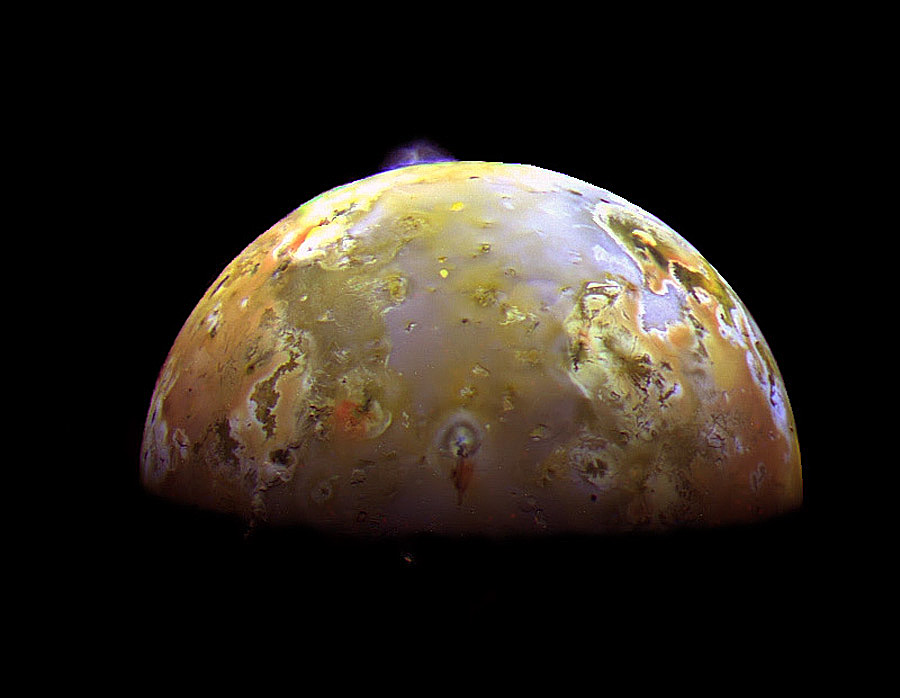
Moonday: Io

It has been my intention to draw attention primarily to moons that aren't as well known or "popular" in this series, but this image from yesterday's APOD takes the cake:(follow the link to the site and click the pic there for full-size awesomeness and detailed insets) Quoth APOD:
What's happening on Jupiter's moon Io? Two sulfurous eruptions are visible on Jupiter's volcanic moon Io in this color composite image from the robotic Galileo spacecraft that orbited Jupiter from 1995 to 2003. At the image top, over Io's limb, a bluish plume rises about 140 kilometers above the surface of a volcanic caldera known as Pillan Patera. In the image middle, near the night/day shadow line, the ring shaped Prometheus plume is seen rising about 75 kilometers above Io while casting a shadow below the volcanic vent. Named for the Greek god who gave mortals fire, the Prometheus plume is visible in every image ever made of the region dating back to the Voyager flybys of 1979 - presenting the possibility that this plume has been continuously active for at least 18 years. The above digitally sharpened image of Io was originally recorded in 1997 from a distance of about 600,000 kilometers. Recent analyses of Galileo data has uncovered evidence of a magma ocean beneath Io's surface.
Regarding that magma ocean, which I also mentioned last Moonday, Erik Klemetti had a good clarification last Wednesday on why "ocean" is probably not the best word to use to clearly communicate the nature of magma in Io's subsurface.

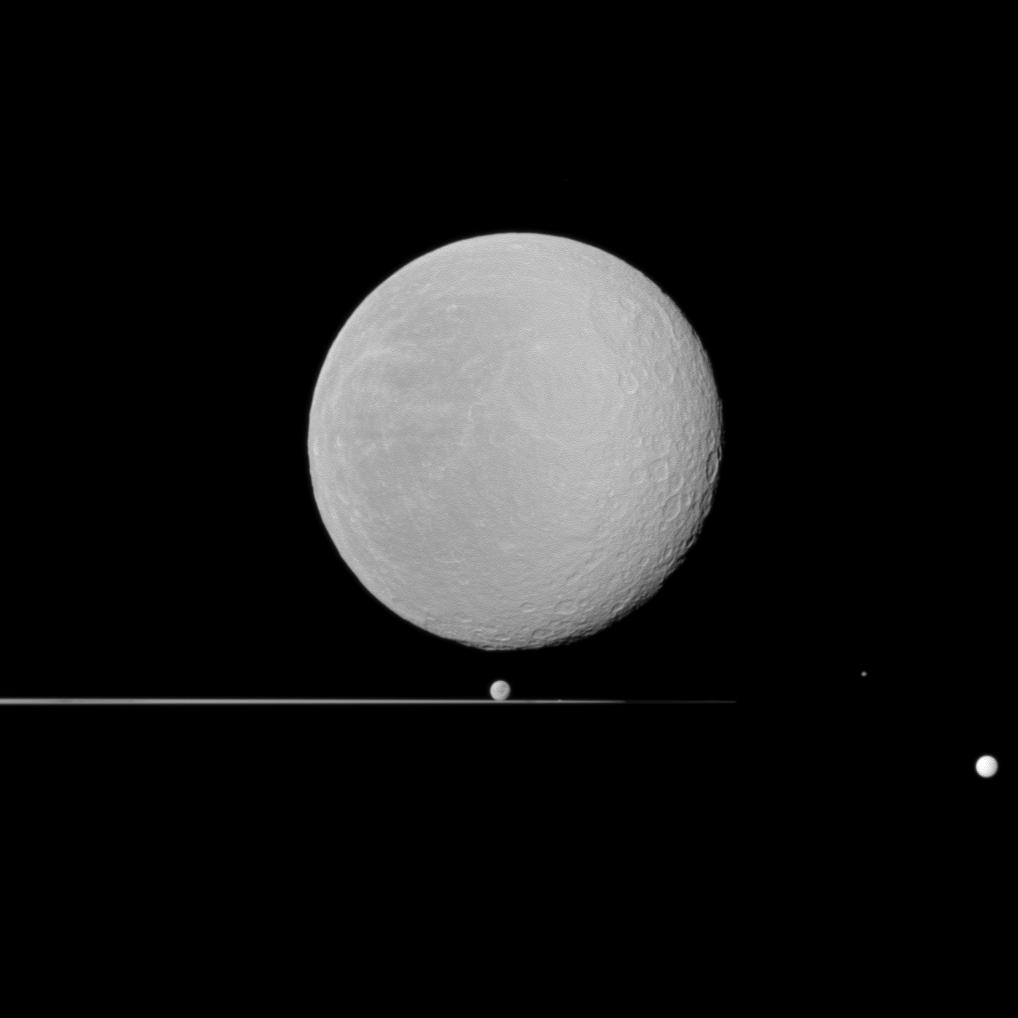
A couple of other loony images have come across the innertubz recently: the first is another APOD from May 12 of Enceladus and its cryovolcanism, which I had actually been intending to use for last week, until I got distracted by the Callisto/Callista differentiation. The second came from The Cassini Solstice Mission webpage this morning, and captures five of Saturn's moons in one frame!
Rhea (1,528 kilometers, or 949 miles across) is largest here and is closest to Cassini. Dione (1,123 kilometers, or 698 miles across) can be seen just above the rings near the center of the image. Tiny Prometheus (86 kilometers, or 53 miles across) is just barely visible in the rings to the right of Dione. Epimetheus (113 kilometers, or 70 miles across) is to the right of the rings, and Tethys (1,062 kilometers, or 660 miles across) is on the extreme right of the image.
I've linked the full-size image here; the only one that might be difficult to spot is Prometheus, which looks more like a tiny bump on the ring plane, rather that a moon, just to the right of Dione.

Monday, May 16, 2011

Moonday: Callisto

Callisto is the outermost of the four Galilean moons of Jupiter (identified as such because they were discovered by Galileo Galilei, and important because they were the first objects discovered that clearly could not be orbiting the earth), and the only one not currently thought to possess a subsurface ocean. Io has been much in the news the last few days with new results supporting the hypothesis of a subsurface magma ocean, while Europa and Ganymede are thought to have water oceans under crusts of water ice. One reason to believe that Callisto does not possess such an ocean is its heavily-cratered and obviously very old surface, unmodified by tectonic processes, such as can be seen on Europa and Ganymede, or volcanism, such as can be seen on Io. A second reason is that Callisto is not subject to tidal forces as strongly as the inner three, so tidal kneading and heating are much weaker.

According to Wikipedia (which is also the source of the image), "It is the third-largest moon in the Solar System and the second largest in the Jovian system, after Ganymede. Callisto has about 99% the diameter of the planet Mercury but only about a third of its mass." Another way of putting this is that Callisto's density is about a third of Mercury's, a difference due to the latter's suspected massive iron core, and the former's large component of low-density water and ice.

Monday, May 9, 2011

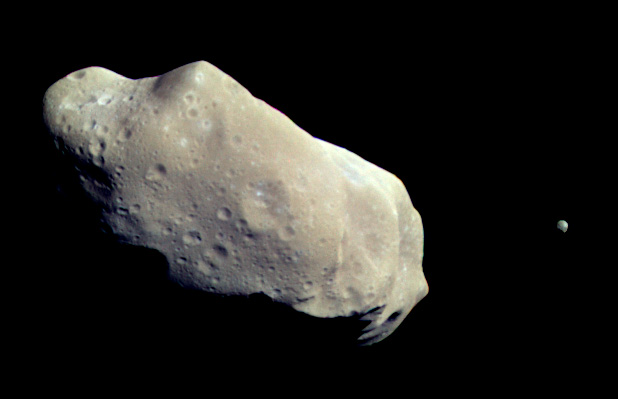
Moonday: Dactyl

Dactyl is that itty-bitty dot to the right, the first known satellite orbiting an asteroid, 243 Ida, which is the larger body to the left. According to Wikipedia,
Ida's moon, Dactyl, was discovered by mission member Ann Harch in images returned from Galileo. It was named after the Dactyls, creatures which inhabited Mount Ida in Greek mythology. Dactyl, being only 1.4 kilometres (4,600 ft) in diameter, is about one-twentieth the size of Ida. Its orbit around Ida could not be determined with much accuracy. However, the constraints of possible orbits allowed a rough determination of Ida's density, which revealed that it is depleted of metallic minerals. Dactyl and Ida share many characteristics, suggesting a common origin.

Monday, April 18, 2011

Moonday: Mimas

Phil Plait at Bad Astronomy posted this image last Wednesday, and I feel compelled to pass it along (full size here). That flat ding on the right of this moon is not an image artifact; it's the side view of an enormous crater.

Voyager 1 passed through the Saturn region in November of 1980, just three years after the first Star Wars film was released. Though Mimas had been discovered in 1789, the views sent back from that flyby immediately gave the moon it's nickname, the "Death Star moon." According to Wikipedia (which is also where the image below comes from), "The impact that made this crater must have nearly shattered Mimas: fractures can be seen on the opposite side of Mimas that may have been created by shock waves from the impact travelling through the moon's body." More information at the Wikipedia link and at the Bad Astronomy post.

Tuesday, April 12, 2011

Awash in Anniversaries

As I mentioned yesterday, and as you've most likely seen elsewhere, today is the 50th anniversary of Yuri Gagarin's orbital flight around the earth. (Today's APOD is a beautiful salute to that accomplishment) However, there are a slew of others coming across my radar:
  • It's the 30th anniversary of the first shuttle flight... kind of mind boggling that it was only 20 years from the first manned space flight to the shuttle. And 30 years later, we're still using the shuttle. NASA today also announced the future homes of the soon-to-be retired shuttle fleet.
  • It's the 150th anniversary of the shelling of Fort Sumpter, and the opening ceremonies for the Civil War.
  • Five years ago today, Mitt "Mittens" AKA "Willard" Romney signed ObamaCare RomneyCare The Massachusetts Health Care Bill into law. And hasn't stopped running away from it since.
  • 113 years ago, Marie Curie announced her discoveries relating to radioactivity.
  • 66 years ago, Franklin Roosevelt died, leaving his VP Harry Truman the task of ending WWII.
  • Finally, 200 years ago today, a team from John Jacob Astor's Pacific Fur Company landed on the southern shore of the mouth of the Columbia River to establish a trading post; the community that grew up around the site is now called Astoria, Oregon. No biggie, right? Well, oddly, for me at least, this may be the most important item on the list. Money quote:
    "Without John Jacob Astor sending the party to establish a trade outpost in 1811, Oregon, Washington and Idaho would very likely be part of Canada today. The group he sent beat a group of Canadians by about a month."

Monday, April 11, 2011

Moonday: Miranda

I meant to kick this off last week, then got distracted by other shiny things. My intent is to post a weekly image from that under-represented group of solar system citizens, the moons. And I vow to keep doing this right up to the point that I don't anymore. This happens to be an auspicious day to start the series: tomorrow (which is already today in the Eurasian borderlands) is the 50th anniversary of Yuri Gagarin's orbital flight around the planet, and the dawn of manned spaceflight.

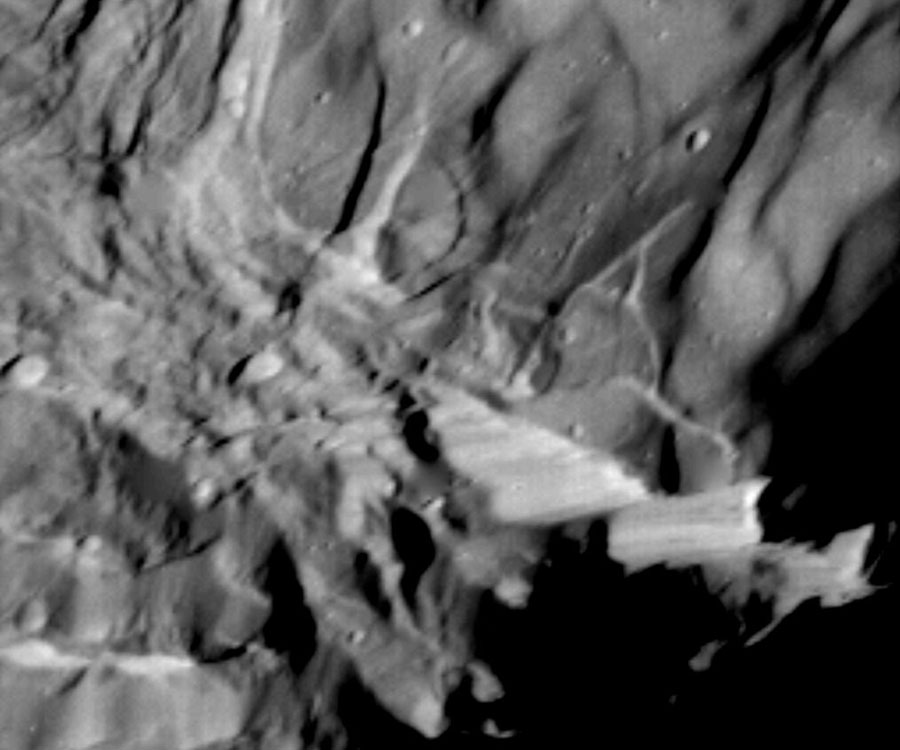
Here's my first selection: my favorite known moon, Miranda, which orbits Uranus. This was posted last week at The Astronomy Picture of the Day (a site which regularly features some out-of-this world geology- see today's pic, for example), with the title, "Verona Rupes: Tallest Known Cliff in the Solar System." The lighting angle and orientation are odd, but the cliff face is toward the lower right, and faces toward the bottom of the image. See that flat, bright surface? That is an estimated 20 kilometers of vertical. Miranda's gravity is much lower than earth's and it is thought that the 12-minute fall from the crest to the bottom might be survivable with the appropriate air bag at the bottom... presuming you could hit it. Click that last link to read more, and click the pic there for a larger field of view. Or click here to see a full-disk mosaic of Miranda. Or both, if you like.

Thursday, March 17, 2011

Fingers Crossed

I've been meaning to mention this for a while, but all sorts of news has been all sorts of crazy for the past week and more. On top of that, Interzone has (finally) switched ISP's, but the wifi is still buggy for long stretches at a time. To describe browsing as glacially slow would malign the celerity of glaciers. But in about two hours, the MESSENGER probe will fire its main engines for 15 minutes, allowing itself to be gravitationally captured, and become the first man-made object to orbit Mercury. The Planetary Society Blog has the time line and web resources (as well as the image above at a larger size) to follow it live, if that's your thing.

Even though Mercury is one of the closest planets, it's poorly known and studied. It's too close to the sun, from the earth's point of view, to get detailed telescopic images, and it's so deep in the sun's gravity well that spacecraft from earth have gained enormous speed after "falling" toward it from earth. That speed has to be nearly matched to Mercury's for the probe to orbit the planet. The MESSENGER probe has used a series of planetary flybys, over fifteen orbits of the sun, to bleed off some of its excess speed. Tonight's burn will be the conclusion of one voyage and the beginning of another, if all goes well.

Mercury is an important key to understanding the early evolution of the solar system, and I have little doubt there will be images and discoveries that flabbergast me. I'm pretty excited about this, and I'm keeping my fingers crossed.

Followup, 6:50 PM PDT: Reports coming from NASA say the orbital insertion maneuver has been successful; expect first imagery in a couple of weeks. Congratulations, NASA and MESSENGER!

Followup 2, 7:28 PM PDT: The MESSENGER news service I subscribe to just sent me this report, titled "MESSENGER Begins Historic Orbit around Mercury" Full text of report:
At 9:10 p.m. EDT, engineers in the MESSENGER Mission Operations Center at the Johns Hopkins University Applied Physics Laboratory (APL) in Laurel, Md., received the anticipated radiometric signals confirming nominal burn shutdown and successful insertion of the MESSENGER probe into orbit around the planet Mercury.

The spacecraft rotated back to the Earth by 9:45 p.m. EDT, and started transmitting data. Upon review of these data, the engineering and operations teams confirmed that the burn executed nominally with all subsystems reporting a clean burn and no logged errors.

MESSENGER’s main thruster fired for approximately 15 minutes at 8:45 p.m., slowing the spacecraft by 1,929 miles per hour (862 meters per second) and easing it into the planned eccentric orbit about Mercury. The rendezvous took place about 96 million miles (155 million kilometers) from Earth.

“Achieving Mercury orbit was by far the biggest milestone since MESSENGER was launched more than six and a half years ago,” says MESSENGER Project Manager Peter Bedini, of APL. “This accomplishment is the fruit of a tremendous amount of labor on the part of the navigation, guidance-and-control, and mission operations teams, who shepherded the spacecraft through its 4.9-billion-mile [7.9-billion-kilometer] journey.”

For the next several weeks, APL engineers will be focused on ensuring that MESSENGER’s systems are all working well in Mercury’s harsh thermal environment. Starting on March 23, the instruments will be turned on and checked out, and on April 4 the primary science phase of the mission will begin.

“Despite its proximity to Earth, the planet Mercury has for decades been comparatively unexplored,” adds MESSENGER Principal Investigator Sean Solomon, of the Carnegie Institution of Washington. “For the first time in history, a scientific observatory is in orbit about our solar system’s innermost planet. Mercury’s secrets, and the implications they hold for the formation and evolution of Earth-like planets, are about to be revealed.”