 Coming up tomorrow, "Given choice between Trump, Palin, most registered voters choose suicide."




Is This Your Hat?
12 years ago
Coming up tomorrow, "Given choice between Trump, Palin, most registered voters choose suicide."
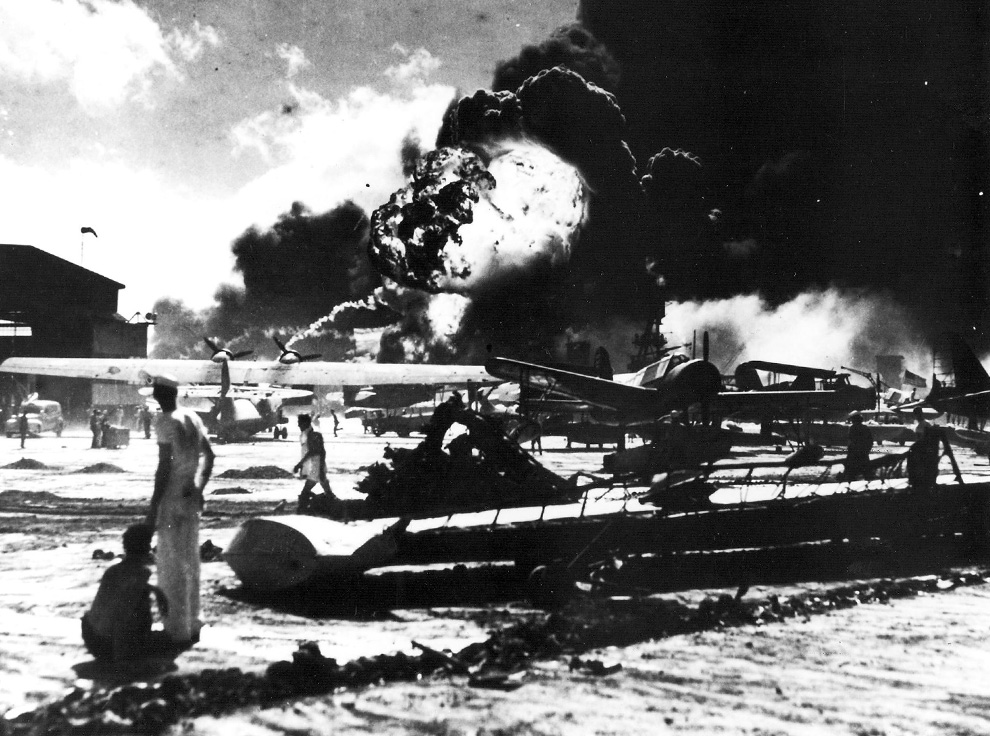 69 years ago today, Japan's forces attacked Americans at Pearl Harbor. The Big Picture has a collection of 34 photos from that day and its aftermath; some of them, like the above, seem very familiar to me, so I'm giving it the "Iconic Photos" label.
 The Big Picture has the definitive collection of photographs from the oodles I've seen so far today. As you might imagine, there are lots and lots of articles and blog posts on St. Helens today and over the last few days. I'll probably post several pieces myself today. The above photo (or a very similar one, or perhaps a crop of the above) covered 2/3 of the whole front page of The Oregonian on Monday. I bought two copies, and one was a wall poster for years. The other got filed.
 these four young people died. For no particular reason that I've ever heard.
 However disgusted I may be with politics in this country, my faded memories have put things in a different perspective today. Hard as it is to believe, things could be worse.
 with this atrocity, but I'd like to give a special shout out to James Rhodes, Ohio's governor at the time, as a pigfucker of note.
 Sorry ma'am. Your kid won't be coming home. Ever. Governor Rhodes felt that carrying signs was too threatening to the stability of his government. So he had'em shot from a football field away. Have a nice day.
SPIEGEL: Would it have been possible to give the order to open fire?
Jäger: No, we had the order not to open fire even if the border was breached, unless our own lives were in danger.
SPIEGEL: So shooting at people in front of the barriers was not an option at any point on November 9?
Jäger: No, but people could have been injured or killed even without shots being fired. In scuffles, or if there had been panic among the thousands gathered at the border crossing. That's why I gave my people the order: Open the barrier!
 Also, a few photos here, including the above.
"We didn't realize how the world was changing because part of that change was held back by the cold war," Mr. Scowcroft says.Chuck at Lounge of the Lab Lemming offers a wise geological perspective... I feel like I'm swiping a bit much here, but I really wanted to get his smackdowns of both the right and left. Obviously, I'm biased toward the left, but I appreciate on-target criticism of my own biases as much as I do criticism of others.
It was like a dam breaking, powerful ideas and technologies sweeping the globe.
"One of the important aspects of globalization was information technology," Scowcroft says. "What the radio and television was doing was politicizing the world's people. [For much of history] the population of the planet did not know what was going on past their own neighborhood, didn't much care; life went on. All of a sudden they saw what was going on in the world and they were energized."
Some took that energy and immigrated to the West in search of better lives, Scowcroft says. Others, though, were outraged by what they saw in the West, triggering a rise in religious fundamentalism.
It took Al Qaeda's strike on the US on Sept. 11, 2001, for the world to turn its attention to the currents that roiled the Middle East. Now, the US finds itself in two wars, in Iraq and Afghanistan, battling terrorism – shadowy, stateless foes.
Indirectly then, the Berlin Wall's fall ushered in a new, more complicated era, one unimaginable to those who built the bedrock post-World War II institutions like the United Nations and NATO.
Today is the twentieth anniversary of the fall of the Berlin wall. In the 20 years since then, it has become easy to take freedom for granted. The idea that people would be imprisoned for pursuing their dreams and aspirations seems barbaric, and the idea that they would be shot for trying to see the rest of the world seems absurd. But 20 years is just an instant- one 200 millionth of the history of the Earth. For most of that time there were no people at all, of course. But the idea that our lives are ours to live as we please is a very recent development even when you only consider the 200,000 years that we have walked this Earth.Followup Tuesday, November 10: A very good summary of the history prior and subsequent to the fall at Just an Earth-Bound Misfit:
Sadly, communism does not appear to be as dead as it seemed to be headed in the early 1990’s. While military parades and red flags have fallen out of favor in most places, many of the fundamental ideas that made the Eastern Bloc so vile have become entrenched in Western culture. The left’s political correctness and the Right’s truthiness are both examples of communist style diktats demanding that the universe conform to a group’s bland paradigm.
The preparation on both sides was deadly serious, as both sides regarded each other as the future enemy. The Western Berlin Garrison had a wartime mission that could be boiled down to two words: Die bravely. The NATO forces in Germany had a mission of to hang on until reinforcements could arrive (or things went nuclear). Both sides had enough chemical nerve agents to turn most of Europe into a dead zone. Life during the Cold War was to live with the knowledge, however much [one] wanted to bury it, that if things went horribly wrong, we all had less than an hour before civilization basically ended.The Big Picture has a wonderful gallery of photos from the days around November 9, 1989, and celebrations and memorials from the last couple of days. Again, I'm struck by the expressions of various people- citizens and soldiers- of joy, confusion and dismay. For those who lived through it on site, it was truly a day the Universe changed. As I mentioned in a comment at EB Misfit's blog a little while ago, the event seems much more important and profound to me now than it did at the time.
 Another in the "Iconic Photos" series, this was supposedly shot during the Spanish Civil war. A soldier coming across a hilltop was captured at the moment of his death. This was one I was planning on posting eventually, but it is particularly timely today: an article in the NYT claims that recent research suggests the photograph was staged.
 People tend to think first of the momentous achievement involved with putting a living person on the moon, and forget the equally daunting task of returning that person to earth alive. 40 years ago, human beings accomplished that second task. I seem to vaguely remember being woken for the landing itself, but not being able to stay awake to watch the first step. I'm honestly not sure. But I do remember being riveted by the event, and I was much more emotionally involved with the astronauts' fate afterwards. The days it took for them to return to earth were nail-biters, and the splash-down and recovery of the crew was a much more exciting moment for me than the actual walking on the moon. Picture from NASA's Image of the Day Gallery; front page here.
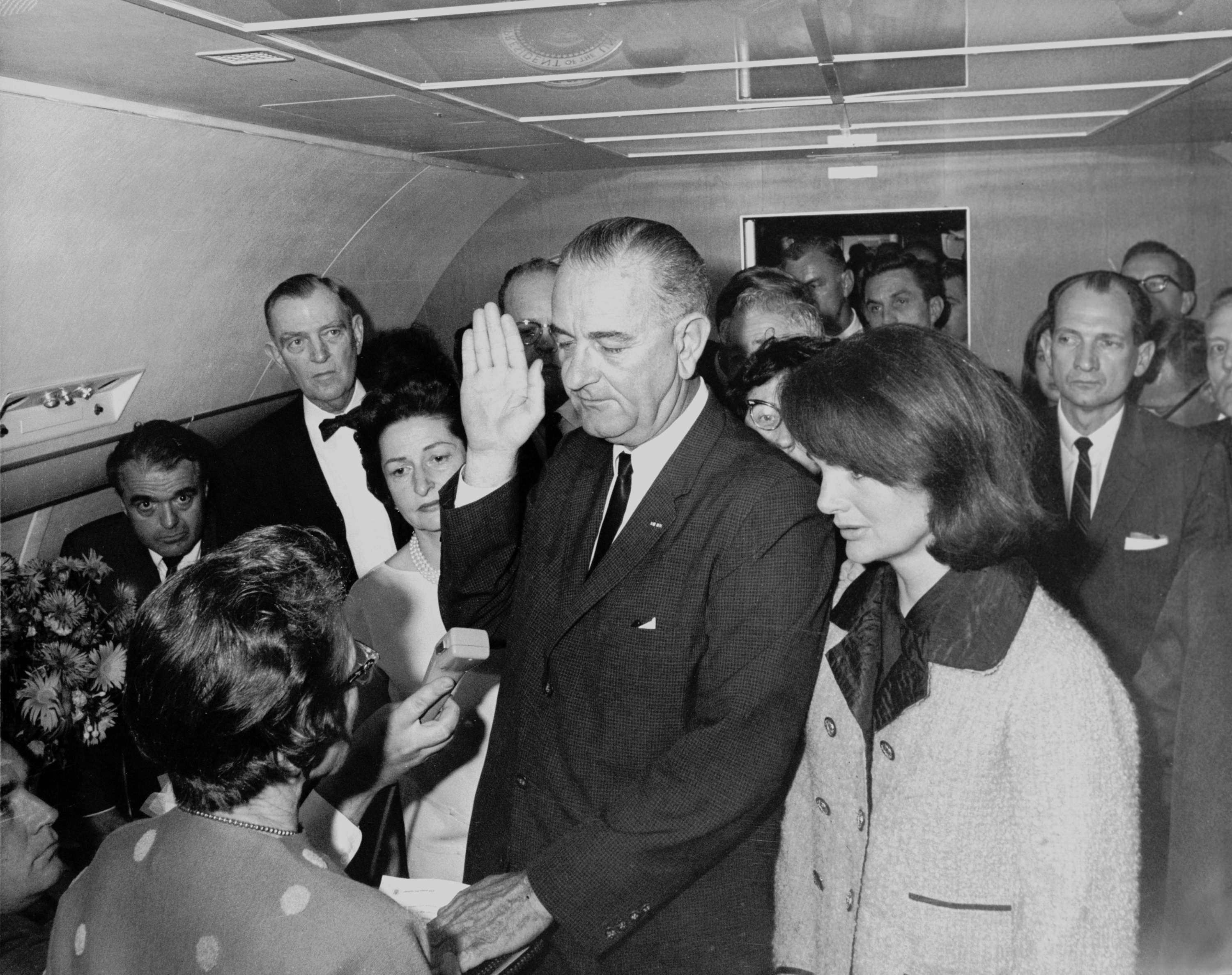
Lyndon Johnson was the only president to take the oath of office from a woman, Federal District Court Judge Sarah Hughes, after the assasination of JFK. He took the oath aboard Air Force One on November 22, 1963. (From Here)

Though I was too young to really comprehend the impact it had, somehow I recall the assassination of JFK nearly as well as that of his younger brother, Robert F. Kennedy, less than five years later, as he was campaigning (and winning) during the presidential primaries. It's only as I became older that I began to fully understand the ramifications of this event, and I've never felt the same emotional impact as with the JFK shooting. But people just a little older than me still find this harrowing to recall.This is an image of RFK immediately after he was shot on June 5, 1968Photo taken by Boris Yaro for the Los Angeles Times (From here)

Gulf War/Dead Iraqi Soldier, 1991, chromogenic color print, by Kenneth Jarecke. Courtesy Kenneth Jarecke/Contact Press Images. (From Here)We were led to believe that the first Gulf War, Desert Storm, was being conducted as humanely as possible. Trouble is, "humane" isn't possible in a shooting war. I'd argue that "Rules of War" is an oxymoron. This image showed that war was, is, and always will be, hell. No matter how smart your weapons are.


 Posts
All Comments
Posts
All Comments


