Wednesday, July 15, 2009

Gone Hikin'

Sanford skips out again, but this time I guess he let everyone know ahead of time.

Maybe if he's real good, Jenny'll let him go hike the Appalachian Trail.

Monster of the Week

Mysterious blobs discovered in the Arctic Ocean near Alaska. I'm not going to blame this on global warming. Yet.

Followup, 6PM: photo and video here, neither very high quality, but still intriguing. Here's how I think Climate change is implicated: from Wikipedia on The Blob (movie), "The film closes with a scene of a military plane dropping the Blob into an Arctic landscape. The film ends with the words "The End", which then morph into a question mark..." I always suspected that dumping the blob onto the icecap was a bad idea. Now, with the ice melting down, and Steve McQueen no longer around to help, it's on the rampage again, and we're in a world of hurt.

Followup, Fri. July 17: It's algae.

Noctilucent Clouds

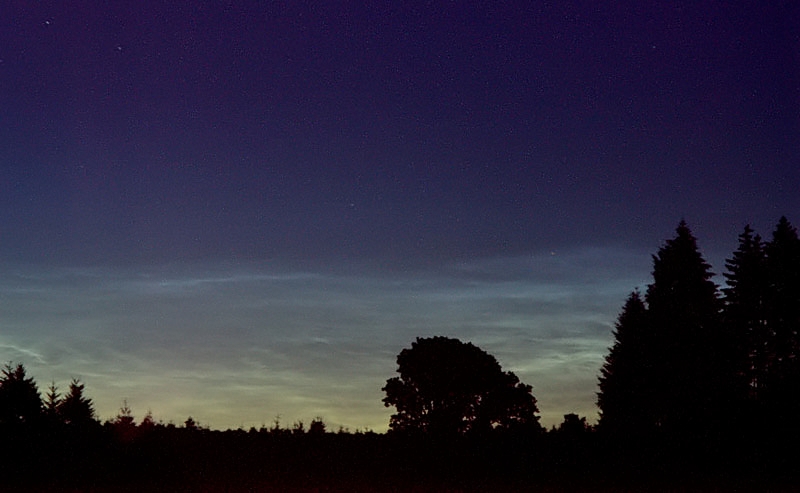
I've never seen noctilucent clouds before, but it's been a phenomenon I've watched for for many years. Guess I should have spent some time outside last night; the above was taken by an old friend just a few miles to the west of my current position. Below is the email from SpaceWeather that alerted me to the outbreak, and the gallery where I found the picture.
Space Weather News for July 15, 2009
http://spaceweather.com

NOCTILUCENT CLOUDS GO WILD: An intense display of noctilucent clouds (NLCs) lit up the skies of Europe and North America last night. Bright electric-blue tendrils were visible through fireworks during Bastille Day celebrations in France, while the clouds descended as far south as Nebraska in the USA. Sky watchers should be alert for a repeat performance tonight. Observing tips and photos of the July 14th-15th display may be found at these URLs:

Europe: http://spaceweather.com/nlcs/gallery2009_page12.htm

USA: http://spaceweather.com/nlcs/gallery2009_page13.htm

Please visit http://spaceweather.com for updates.

You are subscribed to the Space Weather mailing list, a free service of Spaceweather.com.

New subscribers: To sign up for free space weather alerts, click here: http://spaceweather.com/services/.
(Followup, July 16: The archived issue for July 15 is here; there were indeed more sightings last night, including the area where I live.Today's issue and gallery is here. [permanent address])

Noctilucent (night light) clouds are very high elevation clouds. According to this source, "Although NLCs look like they're in space," continues Thomas, "they're really inside Earth's atmosphere, in a layer called the mesosphere ranging from 50 to 85 km high." The lower atmosphere is called the troposphere. The next layer is the stratosphere; jet liners typically fly near the bottom of that layer. The mesosphere is the next layer up. Generally speaking, "weather" (which would include clouds) is thought to be a phenomenon pretty much restricted to the troposphere. See the link for more info, but be forewarned: we really don't know much about them and how they form. At any rate, I'll be spending some time outside after dark tonight.

Carter's Crisis

Interesting Op-Ed piece in today's NYT, on the 30th Anniversary of Jimmy Carter's "Malaise Speech." I remember watching this speech all those years ago, and as the op-ed points out, my reaction was very favorable. It was, in fact, a formative event in my life: " the very act of energy conservation like this is more than just common sense—I tell you it is an act of patriotism." I took that to heart, and ever since, I have actively looked for ways to cut my consumption, to seek contentment rather than satiation. My total home use of energy- my total energy use outside of what I use here at the coffee shop- amounts to a monthly electricity bill of $16 to $20, depending on the season.

Yet 30 years later, we as a society have not forgotten Carter's speech; we've twisted, ignored and ridiculed the very points he was trying to make. Here's a few more excerpts:
In a nation that was proud of hard work, strong families, close-knit communities, and our faith in God, too many of us now tend to worship self-indulgence and consumption. Human identity is no longer defined by what one does, but by what one owns. But we've discovered that owning things and consuming things does not satisfy our longing for meaning. We've learned that piling up material goods cannot fill the emptiness of lives which have no confidence or purpose.
(...)
As you know, there is a growing disrespect for government and for churches and for schools, the news media, and other institutions. This is not a message of happiness or reassurance, but it is the truth and it is a warning.
(...)
Looking for a way out of this crisis, our people have turned to the Federal Government and found it isolated from the mainstream of our Nation's life. Washington, D.C., has become an island. The gap between our citizens and our Government has never been so wide. The people are looking for honest answers, not easy answers; clear leadership, not false claims and evasiveness and politics as usual.
(...)
We are at a turning point in our history. There are two paths to choose. One is a path I've warned about tonight, the path that leads to fragmentation and self-interest. Down that road lies a mistaken idea of freedom, the right to grasp for ourselves some advantage over others. That path would be one of constant conflict between narrow interests ending in chaos and immobility. It is a certain route to failure.

All the traditions of our past, all the lessons of our heritage, all the promises of our future point to another path, the path of common purpose and the restoration of American values. That path leads to true freedom for our Nation and ourselves. We can take the first steps down that path as we begin to solve our energy problem.
Carter was and is a very religious man, but I have little problem with others' faiths, as long as they don't ask me to live by the dictates of those faiths. So accepting those references as valid from his and many others' point of view, I don't see much here to argue with. Sadly, it turns out, Americans were not "looking for honest answers," but easy answers. A bit more than a year later, we elected Reagan president, because he told us mindless consumption was good, it was "Morning in America" (though "mourning" might be more appropriate in hindsight), and that deregualting everything would guarantee everyone their own little trickle.

And 30 years later, Carter's speech is mocked as the "Malaise Speech," even though he never used that word. The full text is here; it's startling and sad to reread it all these wasted years later.

Because No One Should Be

But in reality, they often are.
The question we have to ask ourselves is, are we going to accept that? As I've noted on numerous occasions (here's one example; you can find others by using the blog search bar at the top with the term "torture"), I'm convinced that actions taken under the previous administration constitute violations of international law- violations of laws they were constitutionally required to enforce. I have watched with growing dismay as the Obama administration, in both word and deed, indicated that they were determined to look forward and ignore the past. There has been increasing pressure from the serfs and peasants of this country to demand an investigation, but given the actual power of serfs and peasants, I have been unsurprised that Obama and crew have kept the forward blinders firmly in place.
However, I have been reading that "Attorney General Eric Holder is now seriously considering appointing a special prosecutor to investigate acts of torture carried out during the Bush Administration according to confirmed reports published over the weekend."

This morning I received an email from IndictBushNow.org with an E-card to send to my mailing list; the above quote is from that letter.

I don't open E-cards, and I see no point in sending them.

But here's a link to the card (picture above), and a petition to ramp up pressure on Holder to appoint a special prosecutor. Can this nation survive with a public record of torture on its conscience, unrepented? Unchallenged? Unquestioned? I don't think so.

Monday, July 13, 2009

Mini-Missoula

I had never heard of this glacier (or I forgot about it). Either way this is a fantastic small scale analogue of the glacier that blocked the Clark Fork River in the latter part of the Pleistocene.
If you're not familiar with the Missoula megafloods, the Geoblogosphere got an excellent summary with some excellent pictures from Anne Jefferson for last month's Accretionary Wedge. (BTW, shameless plug, this month's wedge, "Inspiration," is up over at Volcanista's.)

I was tipped off about this glacial lake and the periodic collapse of the dam by a post on the Google Sightseeing Blog. They have a link to a video of the most recent collapse event (last July), but it's not embeddable, nor does it appear to actually breach the ice dam and release the pent-up lake. However, a search at YouTube for "perito moreno ruptura" yields 39 results; a search for the English version, "perito moreno rupture" yields 14. The above is merely the first I watched that showed a full collapse and release. Wow!

Oh. Wow.

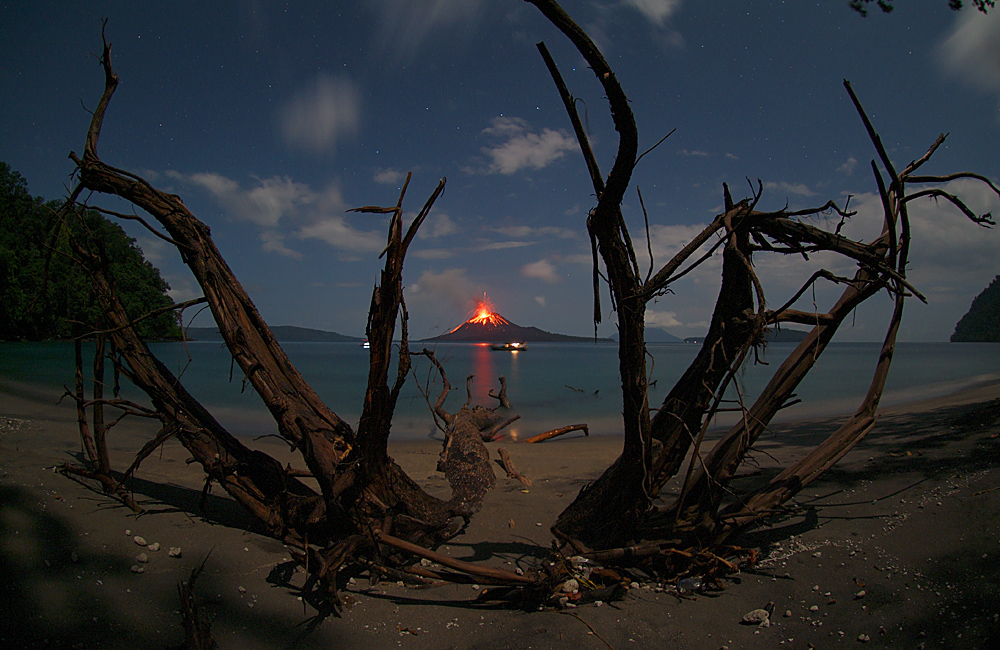
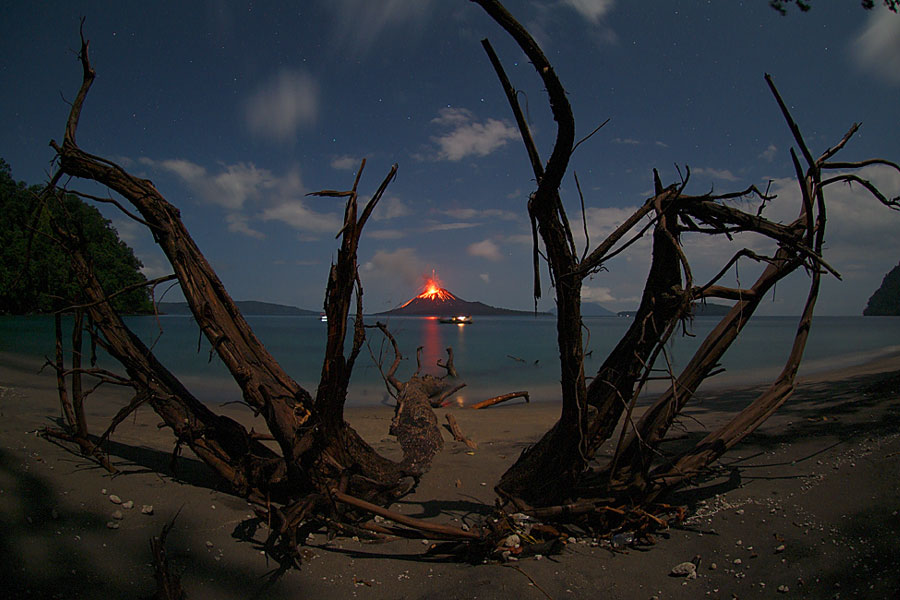
Stunningly beautiful photo from today's APOD... Anak Krakatau erupting beneath a night sky. If you look carefully, you can figure out almost exactly what direction the camera was pointed. Click the pic for bigger, see here for full size, and visit the first link for a full description and a hint on the puzzle.

Rain Today

Well, yesterday actually. As I noted last summer, July and August in western Oregon are stunningly dry most years; according to the data I found for that post, from July 1 to August 13, we had zero measurable precipitation- though I found today that according to another archive we had 0.05 inches. But yesterday, according to the Hyslop Lab weather archive (an OSU ag extension lab just across the river), we had 0.79 inches. According to AccuWeather, we had 0.84 inches. And according to Weather.com, we had 1.10 inches. I'm not sure where the two commercial sources are getting their data; I know the Corvallis airport, about 6 miles south, has a weather station, and I think there's another at Lewisburg, about 6 miles north. (I suspect that all three of those links will have limited to very limited lifespans- I haven't found a decent online permanent archive, but the Hyslop Lab page will update in a predictable way at the end of the month; their permanent archive is here)

Based on the duration and intensity I was watching all yesterday afternoon and early evening, I was estimating an inch or more. I watched the radar loop a couple of times, and the storm just stalled out over Corvallis, sitting and spinning for five or six hours, before it finally moved out. From my perspective it was delightful; I miss the warm weather rain of my childhood. There were even some mid-distance rumbles of thunder. I didn't see any flickers of lightning, but others I talked to did.

Still, my perception is that summer precipitation here, particularly stormy precipitation, has increased markedly over the last ten years. However much I may enjoy it, it's unnerving to perceive such change over such a short period of time. If my perceptions are real, these changes will have a profound effect on agriculture and other aspects of life here. We are quite dependent on snow melt in the Cascades to meet our water needs, and as the winter snowpacks have become smaller over the years, there has been rising concern. More summertime precipitation could help to alleviate some of those issues, but what we're geared for is controlling mountain runoff, not precipitation here on the valley floor. Many crops don't want to get wet, or additional watering, after the dry season starts (wine grapes, a large and growing industry in the Coast Range foothills come to mind, as do our numerous varieties of cane berries).

All this reminded me of a very, very wet spring back in Athens, Ohio... I'm thinking it was my third grade year, but I'm not positive. The Hocking River flooded, and I remember going down to the waters' edge to meet Ohio University students who had been stranded in their dorms. Groups of volunteers had boats and would ferry the students- and enough of their belongings to survive- to shore, and other volunteers, my parents among them, would shuttle them to whatever temporary shelter they were able to find.

As a result of this flood (and earlier, but less severe, floods), the Army Corps of Engineers literally moved the Hocking River, from its old, naturally sinuous, meandering course to a new, straighter course. I moved to Oregon, and haven't followed events there in nearly 30 years, but my understanding is that the rechanneling of the river has been successful in reducing the severity of floods in Athens, but may have made them worse downstream.
My brother Clark and I were among the first to cross the new bridge on Richland Avenue, almost as soon as the concrete deck was set, months before the official opening.

And the title, and the joke I alluded to yesterday? That spring, it just never let up... the rain just kept coming down, hard, day after day after day. The OU student newspaper, the Post, in lieu of regular weather reports in the upper right hand of the front page, just started reporting "Rain Today." And they kept that report at least until the late seventies. I'm curious when (or if) they discontinued the tradition. More than ten years after the rainy spring, and the disasterous flooding, the front page weather report was still "Rain Today," every day. I always took it as a jokey statement that however well things are going, something's probably going to rain on your parade.

The winning move is to find some way to enjoy that rain.

Feeling Il

More on the purported pancreatic cancer of PRNK's Kim Jong Il in today's Christian Science Monitor. They provide a good, easily readable summary, along with a number of interesting links, of what's known and not known, but most importantly, a first-stab analysis of the consequences of a struggle for succession following Kim's death. Of particular interest is a link to a June 18th analysis by The International Crisis Group on the importance of getting back to negotiations. Along with the analysis and recommendations, a couple of points stand out ominously:
A likely succession in North Korea could unleash instability, or it could result in a much more belligerent or isolated military regime. The transfer of power after Kim Jong-il is far less clear than when his father died in 1994.

An isolated North Korea under sanctions will be more, not less, likely to sell weapons or technology for hard currency. Given that its clients have been in the Middle East and South Asia, this is likely to create further problems in highly insecure areas.
I have felt for some time that the existence of a nuclear-armed Pakistan was the single most dangerous fact in today's world. I'm on the verge of deciding that a possible victim of cancer is an even more dangerous fact.

Sunday, July 12, 2009

Sunday Funny

Just one today... I'll try to get a late edition up tomorrow. Stole this one from Dr. Monkerstein; I think it was the funniest thing I saw this week.
It's getting late and it's been a traumatic day. I'm going to go home and back up my entire hard drive. See you in the funnies.

Oh, and P.S., have a good week!

Not Sure How to React to This

North Korean leader Kim Jong-il has pancreatic cancer. The blurb really doesn't say much more than that, and it gives no source or documentation.

Now cancer of any kind is not something I'd wish on anybody... even Karl Rove or Darth Cheney. And Pancreatic Cancer, from what I've heard about it, is particularly nasty. And would Kim's successor (his third son was officially annointed with that position a few weeks ago) be any more sane, or easier to deal with? Based on the article at the last link, I'm not particularly optimistic; if anything, he looks like the kind to take his father's shenanigans to a whole new level, just to establish his bona fides.

So, even if the report is true, this might very well not be a good thing for the relations of the PRNK with the rest of the world.

Followup, a few minutes later: Here's a somewhat more informative report- though still no real idea why this conclusion has been announced- it just notes the same unsourced announcement from a South Korean broadcaster. However, if you read the article about appointing his son as successor, some sort of terminal condition would help fit the pieces together.

Followup, 7:45- Reuters has a more complete report, and it really doesn't look like losing this guy is going to help create any stability at all. I know what I think now: this is not good.

Yeah, I'm Not Going to Get Any Older, Either.

At a historic summit in Italy last week, G8 leaders agreed to limit global warming to 2C above pre-industrial levels and cut their emissions by 80% by 2050.
Many news reports are hailing this as a success, without noting that no measures to meet the stated ends were agreed upon. Given that by 2050, few attendees of the Summit will be alive, let alone in a position of responsibility, this looks like just another form of procrastination. Gordon Brown (yes, the Gordon Brown) makes a good case for a transition to renewable and non-carbon energy souces in the piece I've quoted above, but it's way past time for responsible law-makers and leaders to be relying on feel-good PR. Sorry if it sounds dictatorial or tyrannical, but the time to commit to real measures, real steps forward, real investments in technology R&D- and implementing them- is long past.

To see so many people patting themselves on the back for "committing" to abstract goals, such as 80% lower emissions or a 2C temperature rise (note that many forecasts are now pointing to nearly double that by the end of the century), without actually committing to any pathways that might meet those goals, is pretty discouraging.

Job well done, mates! What shall we tackle next?

Danger! Danger Will Robinson!

When I started up my computer this morning, it told me the "config/sys" file was missing or corrupted. I immediately went into shock.

At any rate, my friend Todd has got the thing up on Linux, connected to the innertubez and we are now in the process of transferring ~ 4 gig of non-replaceable data onto my flash drive so we can proceed with (I guess) some sorts of operations to repair the glitch- which may take out (require reformatting) the C-drive in the process. Hopefully we can get this sorted out; I honestly don't know what I'd do without my faithful internet.

Rain Today (funny story there). Probably no Sunday Funnies this week. Wish me luck.

Followup, 3:48: So we moved some files to make some more room, took the computer off of its Ubuntu life support, then restarted in Windoze to make repairs. It started up just like nothing had ever been wrong. I don't understand Microsoft; I don't think anybody (including Microsoft) does. At any rate, I think I'll call my laptop "Lazarus." At least until the next time it dies.

And I'm adding the "Not Dead Yet" tag to this post.

Saturday, July 11, 2009

A Little Late, Soldier

Rémi Gaillard storms the beaches of Normandy about 65 years too late.

This guy would so be shot dead if he tried to pull this off in the US. Or tried on terrorism charges, if he accidentally lived. Lucky for him the French have a sense of humor, among their other despiccable traits.

Saturd80's

Blogger buddy Tengrain has a feature called "Flashback Friday," wherein he posts a few clips of (mostly) 80's music videos; the below is swiped from his post yesterday. I used to have this on vinyl, an ancient technology that has remained surprisingly intact into the modern era. I haven't heard this song for years, and I'm pleased to report that it stands the test of time well. Based on the fashions and make up, I don't think the video actually dates to the era of the song- more likely the last ten years or so.

As I've mentioned before, I tend to set aside videos for the weekends, when my RSS is less of a torrent. Since I'm just now catching up with them, my last two posts have been prompted by Tengrain's video posts. But never fear, I do try to add extra content to most of my pirated posts, and unless I point out some reason otherwise, you're always welcome to pirate whatever you like from me... although I would appreciate an attribution for stuff I've created myself- photos, writing, graphics and so on (I gotta get that Creative Commons bit figured out). I do try to be clear about what I have created, or where I found stuff.

The below is the English version of a song most have long forgotten, except for an occasional flurry of popularity after a portion of the music is used in a commercial. And I always loved Max Headroom.

There's a German version of the same video here, sans Max Headroom and the gratuitous censorship of cartoon violence, but embedding is disabled. The last clip I'll put up is an oddly funny yet creepy video by Art of Noise. My take on this is that it's trying to get at the spookyness of using destruction as entertainment. I'm very fond of this group, and there's another clip I'll put up some other time with them and Max Head room. Actually, I thought I had already posted it.

First Michael, Then Billy Mays. Who's Next?

Poor Adolph. It's been a tough ten days.

Rawley told me this clip gets trotted out and recaptioned for each major "bad news" story, but I had never seen the meme before the MJ version on July 2. I suppose it'll lose its humor after a while, for for the time being, I still think it's a pretty funny time www.aster. Hat Tip to Tengrain for bringing this to my attention.

Does anybody have recommendations for video-editing software?

Friday, July 10, 2009

An Inspired Accretionary Wedge

Note: This is my submission for this month's Accretionary Wedge, "Inspiration," hosted by Volcanista. The Wedge is expected to go up in the next week or so, and I'll link here when it does. July 13: This Accretionary Wedge is now up at Volcanista's blog.

This month's accretionary wedge question is "what inspired you to become a geologist?" I'm going to go way, way back to (I think approximately) a three-year-old boy listening to "Pagoo" being read aloud, a chapter or two each night before falling asleep.
Pagoo was the name given by the author, Holling Clancy Holling, to a somewhat anthropomorphic biography of a Pagurus: "A two-fisted Hermit Crab." "Now what does this have to do with geology?" I hear you cry. Fair question. This book, more than any other experience I can think of, convinced me beyond any doubt, and even before I could count to ten or recite my ABC's, that science was tres kewl.
Each chapter is four pages long, with three pages of text and line drawings in the margins, and the fourth page a full color painting. Above are the last two pages of Chapter One, and below is a larger view of the bottom of the third page of the same chapter. If you take the time to look over the paragraph and the labels on the line drawings (click for larger), you'll notice that Holling did not spare his young readers some fairly demanding terminology... but that it's written in a simple enough way that the terms become part of a young reader's (or readee's) vocabulary.
As a result of this and other similar experiences, I never found the language of science particularly threatening or difficult. And I associated those science words with beautiful and amazing views and images. (see how this relates to geology?) Below is the picture that was my favorite as a youngster, all those years ago. I found it exciting, mysterious and a little frightening: the octopus is about to catch Pagoo and...? And very beautiful, too. (Now over 50 years old, the book is still in print, and I can't recommend it enough for parents / friends /relatives of kids who have an interest in science)
So like so many pre-scientists, I ended up going through a bug phase, a dinosaur phase, and a more general paleontology phase. The school culture when I started first grade was very different than now: kids were expected to be polite, on task and well-dressed. Not "Sunday best," but slacks and pressed shirts, not tees. Maybe some of my classmates wore jeans, but I don't remember any. Girls wore dresses, never pants or slacks.

Our playground was limestone gravel. One day during recess, I had most of my classmates crawling around in that gravel, looking for fossils. The most common things to find there in SE Ohio were brachiopods, crinoid fragments, coral, and other invertebrates. I was subsequently informed that crawling around in the gravel was not an appropriate activity when dressed in spiffy clothes. Afterwards, I did not encourage my classmates to play amateur paleontologist, and I made sure no monitors were looking when I did.

Elementary school science was non-descript and general, but my grandmother gave me a membership to the Cleveland Museum of Natural History. It came with a subscription to their house magazine, "Explorer." I think it was about fourth grade (when I was living outside Cleveland in Painesville), that I first read an article in that magazine about plate tectonics. I thought it was an amazing and amazingly silly idea. I mean, if I and the land I was living on were charging around the planet like a bump'em car, I'd see stuff going by, right? At the very least, I'd feel the motion, like you can when your eyes are closed in a car.

Silly.

I had a very good pair of science teachers in 7th and 8th grade, Mrs. Vandegrift and Mrs. Barensfeld, respectively. By this point, I wasn't really thinking about anything but science as "what I'm going to do when I grow up," but while I loved learning about it, I was pretty well certain that everything important was already known. As a result, other than teaching or curating, I figured it would actually be a pretty boring job. Sure, I loved puzzing questions like "What's the average distance from the moon to the sun?" and was very good at figuring them out, but anyone older or smarter than me would already know that one. (That particular question led me to the interesting conclusion, in seventh grade, that on average the moon was on earth, and I've never really trusted the idea of "average" since.)

It was also in middle school that I became fascinated with botany, by way of carnivorous plants. I found that the Ohio University Library (I was back in Athens at this point) had an original copy of Darwin's book on flesh-eating plants, and repeatedly submitted holds and requests to check it out. The librarians were unfailingly polite, but somehow the letter never came telling me that they were holding it for me. I did, however, read everything else on the topic I could lay my hands on, even if it was incomprehensible to me. Again, the language of science was not threatening to me, but I often found myself thinking that it sometimes didn't make any sense.

Good science teachers in high school too. Mr. Essex took me under his wing and allowed me to use the greenhouse... no one else had used it in years. Mrs. Barensfeld got married and moved to the high school to teach chemistry (I don't remember her maiden name, so I identified her by the same name in middle school). Mr. Barbour invited me to take the Bio II Ecology class before I had taken all the prerequisites. I was particularly flattered by this. How often does a teacher approach you and say, "I'd really like you to take this class. I think all of us would enjoy having you in there." Mr. Williams, bless his pointy little head, knew less geology than I did, but while he and I disagreed about an awful lot with respect to the content of his earth science class, we got along well. He basically pushed me to prove him wrong, and was OK with it when I did. My math teachers did an excellent job too- I took all four years of math that were offered.

I took a few years off and worked a number of jobs, but most extensively in a machine shop in Eastlake, again east of Cleveland. I spent quite a bit of time driving around and exploring the landscape of NE Ohio: The Sharon Conglomerate, the Chagrin and Cuyahoga Valleys, the lake Erie shore, Stebbins' Gulch. I read an awful lot of books, and spent an awful lot of time partying. In Fall of 79 I signed up for and took my SAT's, and even though I had been out of school for 2 1/2 years, I did very, very well. In March of 1980, I moved to Corvallis to attend Oregon State University.

And I have never since been particularly interested in living anywhere else.

I started as a bio major- there was no separate major for botany. The bio major allowed for later specialization tracks. But I couldn't take any science classes that first term because most were three term sequences. So I ended up with writing, calculus, history and a couple of others, but nothing related to my interests. But, in late March, Mt. St. Helens started swelling. I don't think the daily reports on its activites made it much out of the PNW, but in this region, there were literally articles in The Oregonian almost every day, and TV news reports (with Pictures!) almost as often. So that volcano has been exciting and amazing me almost since the week I arrived here, not just with its big blast on May 18th.

So in fall of '80, the beginning of my first full academic year at Oregon State, I was taking Chemistry, Biology (required) and Geology (elective science credit), all at the 200 (major) level.

Now here's the thing: OSU gets about 800-900 freshmen each year declaring in biology, and there's no way that they can actually accomodate that many through the entire program. As a result- and I'm not really claiming it's purposeful or concious- the first year sequence for majors is extremely demanding, disorganized and dull.

Biology was like trying to push a car through sand. An awful lot of hard tedious work, with no visible payoff, and an awful lot of regretful head shaking: "How did I let myself get into this? What the hell was I thinking?"

Chemistry was a disaster- I loved the subject, but the class was intolerable. The prof (who I won't name) was a tiny little man, who I always suspected drank too many of his experiments, with osteoporosis and a resulting hunched back, and with a voice projection that fell somewhat short of inaudible. He had to climb up on a stool as he talked to the blackboard and scrawled out arcs of illegible notes (I didn't have a pair of binoculars at the time), first at the limits of his arms, then concentricly inwards, until there was a little white rainbow that was supposed to convey meaning. Then he'd awkwardly step off the stool, and being too stiff to lean over, he'd kick it to a new position, awkwardly reascend the dizzying heights, and proceed to scrawl out another cute l'il white rainbow, mumbling his incantations the whole time. I missed Mrs. Barensfeld.

Oh, and the class was right after lunch, when all the workmen with their concrete saws, jackhammers, and other metallic screechy bangy things, returned after their break, with renewed vigor and strength. Gilbert Hall was being remodeled and having a new addition built that year.

Fortunately, I figured out that the prof followed his syllabus religiously, and that his lectures, notes and example problems were straight out of the book. After the first few weeks, I never went back to class except for tests. I had the same guy for three terms. In Winter and Spring terms I went to class a total of eight times. First day, two midterms and a final, each term. I wasn't first overall (in those days they still posted scores publicly, so I could tell where I ranked), but merely second, out of about 300 students.

Like I said, I really did enjoy chemistry, I just hated the class.

Which left geology.

The first term was intended to be mostly surface processes, the second internal processes, and the third historical geology.

Dr Niem basically covered the first two terms and much of the third in ten or eleven weeks. His wife would come in and fill the board with notes in the ten-minute class break, and as class started, Nemo (as we called him) would come in and spend fifty minutes erasing with one hand and writing with the other, while lecturing the whole time. It was like a nice refreshing sip from the bottom of Niagra Falls, floating on your back with your mouth open.

I know it sounds terrible, but I loved it. I quickly learned to actually take notes, rather than transcribing the whole lecture. He was so enthusastic... it really didn't come across as "here's a gigabyte of data to transfer into your mental files," but more as "Oh this is so cool, I have to get it across quick, otherwise I'll have to leave out some other even cooler stuff." He would get so excited, as he tried to talk faster and faster, that flecks of spit visibly flew from his mouth. We students joked and gently mocked him about this (behind his back), but I think we all admired his enthusiasm and excitement, even if we didn't really admit it to each other, and I know we enjoyed it.

He led me and my classmates on my first Oregon field trip, up Marys Peak, and sprayed his excitement all over the outcrops. It was mostly above freezing, gusty-windy, misty, drizzly- physically, the experience was a nightmare. But emotionally and intellectually, it was, at the time, the most wonderous experience I had ever had with science.

I was still pretty attached to plants and botany, but in the end, there was no real doubt what was going to happen. Near the end of winter term, I officially switched majors from biology to geology. Not every geo class was as great and exciting and easy for me- and there were a few that were a real struggle. But even though I'm not technically a geologist in a licensed or professional sense, I know the subject well, because I love it and I apply it to everything I can.

So there is no single experience I can point to that explains by itself how I ended up here. If I hadn't had all the experiences I described as a youngster (and those are a very few chosen examples), Geo 211 might have been overwhelming, not exciting. If Bio 211 were intended to teach, not avert, I might have stuck with it. It's all a piece. But to think it all started with a little crab...

Thursday, July 9, 2009

Who'da Thunk?

...that having an in-depth understanding of and empathy for those who actually do threaten you could turn out to save you a lot of grief? Something to ponder over, CSC's... even though it's obviously in contradiction to your deeply held convictions....

Right God

My last post was intended to be serious and sober, but if you read this blog often, you just know that I can't leave things at that. I am compelled to put a silly into almost anything I think about very much. Right God is no exception; the idea came to me as I was writing the last post, but I did want to keep it on track. I'm no artist, and this looks amateurish to me, but it still works. For me.
Followup: Connor suggested "Christec" in place of DryTec, which I thought was brilliant. I also twiddled around with a few other flaws...

Remission of Their Hypocrisies

A couple of weeks ago, Joe Conason was musing on conservative sexual hypocrisy (specifically, as you might guess, with respect to the Mark Sanford and John Ensign Show) at Salon,
For ideologues who value biblical morality and believe in the efficacy of punishment, modern conservatives are as tolerant of their famous sinners as the jaded libertines of the left. Even after confessing to the most flagrant and colorful fornication, the worst that a conservative must anticipate is a stern scolding, followed by warm assurances of God's forgiveness and a swift return to business as usual
....and...
By the way, while Vitter, Ensign, Gingrich and perhaps Sanford have been able to retain their positions and political viability, the same cannot be said for the most recent offenders on the progressive side. Neither Eliot Spitzer nor John Edwards, each among the most promising figures in the Democratic Party, will ever be a candidate for public office again, although their misbehavior was no worse than what their Republican counterparts did.
This phenomenon has baffled me for years... at least since the Clinton scandal: how can the right- or more accurately, the social conservatives- expect to be taken seriously when their own behaviors are so demonstrably out of line with the behaviors they demand of others? But other discussions have finally clarified this issue for me.

First, Krugman responds to Conason's column:
Yes, conservatives sin just as much as liberals. But they aren’t “socially permissive and casually tolerant” — at least not in the same way that liberals are. First of all, there’s a difference in what bothers them. When a liberal politician engages in sexual betrayal, what bothers his erstwhile supporters is the betrayal. When a conservative politician does it, what bothers the supporters is the sex.
(...)
From their point of view the cause, the need to police what people do in bed, is, by definition, right, because it’s literally God-given. So the fact that some of those trying to police what other people do in bed are themselves doing nasty things does not reflect on the cause itself — on the contrary, it shows just how necessary more bed-snooping is.
Now, honestly, I read this intially as snark, not as a serious analysis of the conservative mindset. But I've been mulling it over, and it seems more and more plausible. It's been clear since at least the mid-eighties that conservative howling over abortion and pre-marital sex has little to do with the actual behaviors, and everything to do with repugnance toward the idea of sex itself, shame that they recognize- and are compelled to respond to- the sex drive within themselves, and with maintaining traditional gender roles. So Krugman's argument is esentially that (at least some) redemption from perceived sin is to recognize that everyone, including one's self, is likely to stray from a "righteous" lifestyle, engaging in a persistant campaign of "bed-snooping" to catch offenders, and outing them in the public square; the resulting shame is redemptive to both the catcher and the caught.

Today, The Christian Science Monitor provides a brilliant piece of commentary on the topic of how conservatives view the failures of their leaders to adhere to the lifestyles they demand others follow.
When a Republican affair is exposed, the left seems to assume that the religious right, with the exacting moral standards it tends to laud, will have one less general leading its "pro family" brigade. But practice shows us otherwise. While for Democrats, adultery often leads to ruined or constrained careers – think Gary Hart, Bill Clinton, Eliot Spitzer, John Edwards – Republican adulterers from Newt Gingrich to David Vitter have lived to see another political day, still championing their hard-line conservative positions.
(...)
What we are witnessing is the culmination of "the personal is political," a philosophy pioneered by the left and perfected by the right. The stumbling block for liberals is their unfamiliarity with the "personal" of the Christian right. Where the left sees hypocrisy, the evangelical right sees a millenniums-old story of fallen humanity and healing redemption. With a politically active religious right, that story matters not just in terms of theology but of practical politics.
In other words, the religious right recognizes the importance of forgiveness of perceived infractions. But it does beg the question, "Then why does an affair destroy the careers of politicians such as 'Gary Hart, Bill Clinton, Eliot Spitzer, John Edwards?'" Here's my conjecture: from the perspective of the religious right, if you're a liberal, you are by definition worshipping the wrong god (lowercase intentional). Likewise anyone else who is not clearly a Christian Social Conservative (CSC), as evidenced by vociferously spouting all of the soundbites, taglines and coded signals that we have all come to know so well.

We on the left are exasperated and disappointed when Clinton or Edwards lets us down; the right is enraged. Since Clinton and Edwards (and their supporters) worship the wrong god, no amount of apology and contrition can earn them true forgiveness. It is the right responsibility of the righteous to punish them, and never allow them to forget their shame. Meanwhile, active support for the offenders isn't lost, but it's diminished; it goes from strong to tepid. Realistically, as a candidate, such a person has no chance of winning an election.

On the other hand, when a person such as Vitter or Sanford, who have clearly shown themselves to worship the Right God (uppercases intentional), stray from a Righteous lifestyle, are caught, then publicly accept their shame in the eyes of both Right God and the public, they are, almost by definition, deemed to have been forgiven in the eyes of Right God. Therefore, since all is forgiven, there's no need to pay attention to the Sin any more. The sinner is merely human, Right God recognizes this, and the public has no right to question the sinner's behavior as relevant to their future career- political or not. In fact, since the sinner has so clearly been forgiven in the eyes of Right God, they're even more Righteous than they were before the infraction; the redemption actually makes them more appealing to CSC's. As a candidate, the person has probably not lost the support of anyone who supported him previously, and he (or she) may have actually strengthened their support amongst CSC's. Such a person has no reason to step down or choose not to run for further terms.

I will point out that everything from "Here's my conjecture" down is just that: my conjecture. But I've been desperate to make sense out of the modern conservative mindset; it has looked like severe crazy to me, and has been, frankly, terrifying. The above really isn't that much less crazy and terrifiying, but it does make an odd kind of sense. It's not a double standard, it's not hypocritical, it's simply a matter of whether the sinner in question has been forgiven by the Right God.

I really, really recommend that you take the time to read the Monitor's piece- the authors are not necessarily trying to defend the CSC point of view, but rather to explain it. I think they do so exceptionally well.