Showing posts sorted by date for query Zeolite. Sort by relevance Show all posts

Friday, August 1, 2014

Geo 730: July 28, Day 574: Backing Up

On my last trip up to Quartzville, we stopped at a locale I'd almost forgotten. When I did this trip with middle-school-aged students, first, the safety issue was iffy; there's not a whole lot of berm here. Enough for adults who are accustomed to paying attention, but not really for a dozen or so excited kids. Second, while it's an informative and interesting spot, it's esoteric enough to be not terribly interesting unless you've already got some background. Third, with kids, there's a lot of time wasted getting into and out of vehicles, which means this stop just makes a long day longer. Overall, just not worth it.

However, on the most recent trip, we did stop here. As the post title indicates, it's well before Green Peter Dam and the zeolite/calcite stop. The best landmark is an old schoolhouse which appears to have been recommissioned as a daycare or preschool sort of thing, on the outside of a bend in the road. That school sits on a glacial-era fluvial terrace. Since then, erosion by the Middle Santiam River and roadwork has cut down into the terrace gravels, exposing this excellent example of imbrication. In the roadcut below (NE from) the school, the pattern of gravel deposition indicates right-to-left current direction. Unsurprisingly, that's the same as the modern river flow.

Photo unmodified. June 19, 2012. FlashEarth location.

Thursday, July 17, 2014

Geo 730: July 17, Day 563: Amygdaloidal Basalt

I'm pretty sure most of the mineral grains filling the vesicles (gas bubbles in igneous rocks) here are calcite. This rock has undergone quite a bit of weathering, so whether the voids were originally full of calcite is impossible to say. They may have been, and the mineral simply dissolved out. This is just behind the Green Peter Dam, and is a nice stop to look for zeolites and calcite. I don't have an off-the-cuff list of all the varieties of zeolite I've found here, but it would be pretty lengthy. Natrolite and stilbite are the most common, and are easy to find on any visit. Others just kind of show up now and then, and you can't really count on finding them. That list would include chabazite, laumontite, heulandite, and analcime/analcite. (The latter is one I learned as a zeolite, and commonly occurs with them. I've recently learned it can also be classified as a feldspathoid.) There are likely others I've spotted on occasion, but they don't come to mind right now. The crystals tend to be smallish, and this is a good spot to sharpen your hand lens skills. Four pound hand sledge in back for scale.

Photo unmodified. March 9, 2012. FlashEarth location.

Saturday, May 28, 2011

Weird Geology: Name That Rock Type!

Note: AW #34, Weird Geology, has now been accreted at En Tequila Es Verdad.

This month's Accretionary Wedge topic, hosted by Dana at En Tequila es Verdad, is one near and dear to my heart: weird geology. To step back a bit, one might define weird as something decidedly outside or beyond typical human experience. Taking that as a working definition, nearly all geology is weird: the environmental conditions, rates of change, chemical reactions, as well as starting materials and end products are too hot, too high pressure, too slow, too extreme, too unusual, or too obscure to make sense without quite a bit of background. Conversely and paradoxically, the materials and processes are often so mundane that we simply don't notice them or pay attention to them. Just as the structures and behaviors of a spider or flowering plant are so day-to-day that few really look hard and try to understand these odd (from a human perspective) organisms, so too the never-ending passage of sand, silt, mud and dissolved material through a neighborhood stream goes unnoticed and unremarked. Yet millennia and eons of such mundane activity will result in breath-taking changes in the nearby landscape. From this perspective, I think it's fair to say that nearly all geology would be considered weird to most, and certainly to those with no training or background in the subject.

I think of myself impossibly lucky in that even with a considerable background, I can still look upon geologic processes and materials with such fresh eyes, and see the wondrous weirdness of such things with one part of my mind, even as I observe, analyze and hypothesize with another. Perhaps it's schizophrenic, but it pleases me to be amazed by things that generally make pretty good sense to me.

All that said, there is a matter of degree... there are definitely some rocks and processes that are more difficult to come to grips with. For example, I'm fascinated by komatiitite, a type of volcanic rock characterized by its extremely high magnesium content. It can be considered the volcanic equivalent of peridotite, just as basalt is the volcanic equivalent of gabbro. It was quite abundant in the earth's early history, but as the planet has aged and cooled, as its original dole of radioactive nuclides has decayed and decreased, the geothermal gradient has become too gentle to allow melts of this composition to reach the earth's surface. One can think of komatiite as an "extinct" rock type. It is preserved as lithic "fossils" in various places (I have had the opportunity to see some first hand in the Hill Lake quad between Temagami and Cobalt, in central Ontario), but not only is it no longer created, it no longer can be created.

But the weirdness I really want to address gets at the way we name things. Often, the way we do science can get in the way of better understanding- a characteristic shared with language generally. Words allow us to symbolize ideas we can share with others, and allow us to perform abstract operations on the symbols that we could not perform with the actual thing. But the utility and availability of those symbols also confines us. We tend not to think too much or too hard about things for which we do not have words.

Anyone who has had even a grade school lesson or few on geology knows the three rock types: igneous, metamorphic and sedimentary. A little more background, and one begins to grasp just how arbitrary the boundaries between those rocks types are, and how difficult it is to simply draw lines between them. Exactly how hot, and under how much pressure, must sedimentary rocks be, before miniscule changes in textures and mineralogy force us to conclude that the rocks must be considered metamorphic? In fact there isn't, nor can there be, any such precise definition. We learn to hedge; we create a new facies ("zeolite grade metamorphism") to delineate this intermediate stage. Never mind that the vast majority of zeolites and zeolite-cemented rocks I have dealt with are clearly the result of diagenesis, not metamorphism.

But at least we can assign all known rocks to those three classes, or their intermediaries, right? Well... maybe not so much. The term "metasomatic rocks" came up in only one of my classes, and only in passing. The term was not used at all in my economic geology class, where most of the rocks we discussed could be considered to be members of that group. The roots (meta=change, soma=body) imply a change in mass composition, differing from a common assumption in metamorphism, that the bulk composition of the rock is mostly fixed, but mineral phases and textures change in response to changing T & P. With metasomatic rocks (AKA hydrothermal rocks), certain elements/ions may be preferentially removed or deposited as their solubilities change due to changing temperature of transporting water/water vapor/hydrothermal fluid. Even the concept of liquid and gas become fuzzy at high enough temperatures and pressures. For example, above a temperature of about 375 C, water behaves as a gas; at or slightly below that so-called critical temperature, it requires a pressure of 218 atmospheres to maintain a liquid state. So what happens if both T and P exceed those values? You have what is called a supercritical fluid, one which has a density nearly that of liquid water, but a behavior more like that of a gas. And one that is very, very reactive with many minerals. A graph of SiO2 solubility (both quartz and amorphous silica) can be seen here (~500 kB PDF). Note that under the conditions we are accustomed to, SiO2's solubility is essentially zero; somewhere around 325-350 C, it hits a maximum of about 600 PPM for quartz to 1600 PPM for amorphous silica.

I do not currently have any photos of vein quartz, so I snagged this one from Callan's class notes for Geol 135; follow the link for a full description, about halfway down the post.
So should this quartz vein be considered igneous, metamorphic or sedimentary? It crystallized from a hot, silica saturated fluid, like an igneous rock, and the textures are most similar to igneous textures. But that fluid was water, so perhaps it should be considered a chemical sedimentary rock. On the other hand, the conditions of high T & P are suggestive of metamorphism, and the mineralogy is more like metamorphic rocks than most we would consider igneous or chemical sedimentary. How do we resolve this conundrum?

This is not a trivial question. While metasomatic/hydrothermal rocks are fairly uncommon, I would not really consider them rare. And while (taking an educated guesstimate) I suppose they probably make up a fairly small fraction of a percent of rocks exposed on the planet's surface, they are extremely important economically. The same processes that dissolved quartz from one region and redeposited it in concentrated form in the vein above can do exactly the same thing with a variety of other materials and elements. Think gold, copper, silver, zinc, lead, barium, and many, many others- our sources of these materials are largely places where moving hot water has concentrated them to a degree and in a location where they can be extracted profitably.

I don't have a sense that there is widespread acceptance of "metasomatic rocks" as a valid class at the same level as the big three, but at least one person (I think it was @stressrelated, but I'm not positive) has said the text they use considers that class as a fourth rock type.

So that gets all the unrecognized rock types, right? Well, maybe not so much. Again, as always, I cannot speak for the geologic community; I can only say I've spent some time thinking about this and toss my ideas out there. If anyone finds them useful, super! If they need to be criticized or shot down outright, I'm open to hear/read the reasons. But I would suggest there are at least two more rock types that we may need to consider. The first is vanishingly rare, the second fairly common but short-lived, in the earth environment. And since there are not widely accepted words for these rock types, I have to give them my own names: let's call them sublimate and cryologic rocks.

Sublimate rocks would be those that crystallize directly from a gas to a solid. On earth, sulfur is probably the most important sublimate rock (though most of it is mined from and resides in other rock types). The Big Picture had a striking gallery a couple of years ago of sulfur mining in Indonesia; I'm pretty confident that most of the sulfur condenses from fumerolic gases- though some may have remelted, and would thus be considered igneous. But thinking about the still bigger picture, if my understanding is correct, nearly all the solid matter in our solar system was originally gaseous effusions from an earlier generation of stars. Those gases crystallized to form dust and chondrules, the primordial building blocks of the terrestrial planets. So while sublimate rocks and minerals may be of miniscule importance on earth today, understanding them may be of fundmental importance in comprehending the history of our solar system and our home.

Cryologic rocks would be those that are made of frozen material that would be gas or liquid under the conditions with which we're most familiar. The biggest deposits of these on our modern world are in Greenland and Antartica: ice. But again, many moons from Jupiter outward have a large component of frozen water, ammonia, and hydrocarbons. Recognizing and understanding this rock type and the kinds of processes, chemical reactions and depositional patterns that can occur in it will be of critical importance to understanding what has happened and is happening today in the cooler parts of our solar system.

I'd like to develop this more, but it's already late: it was due yesterday. I'm tired and exasperated with Firefox, my computer and the Interzone Wifi. I'm going home, where I haven't had a wifi connection for a few weeks. But I hope this tweaked your imagination a little, and made you think about the idea that I mentioned near the beginning: that naming things is very useful and very powerful, but it can become limiting when you feel as if you've named everything important. You probably haven't, and if you don't have a word for it, you will tend to be blind to it.

How many rock types have yet to be named?

Friday, June 5, 2009

Friday Fragment: For BrianR

I've been terribly remiss on my rock-blogging, and I apologize. These photos have been on my drive for nearly 3 months now; time to post them.

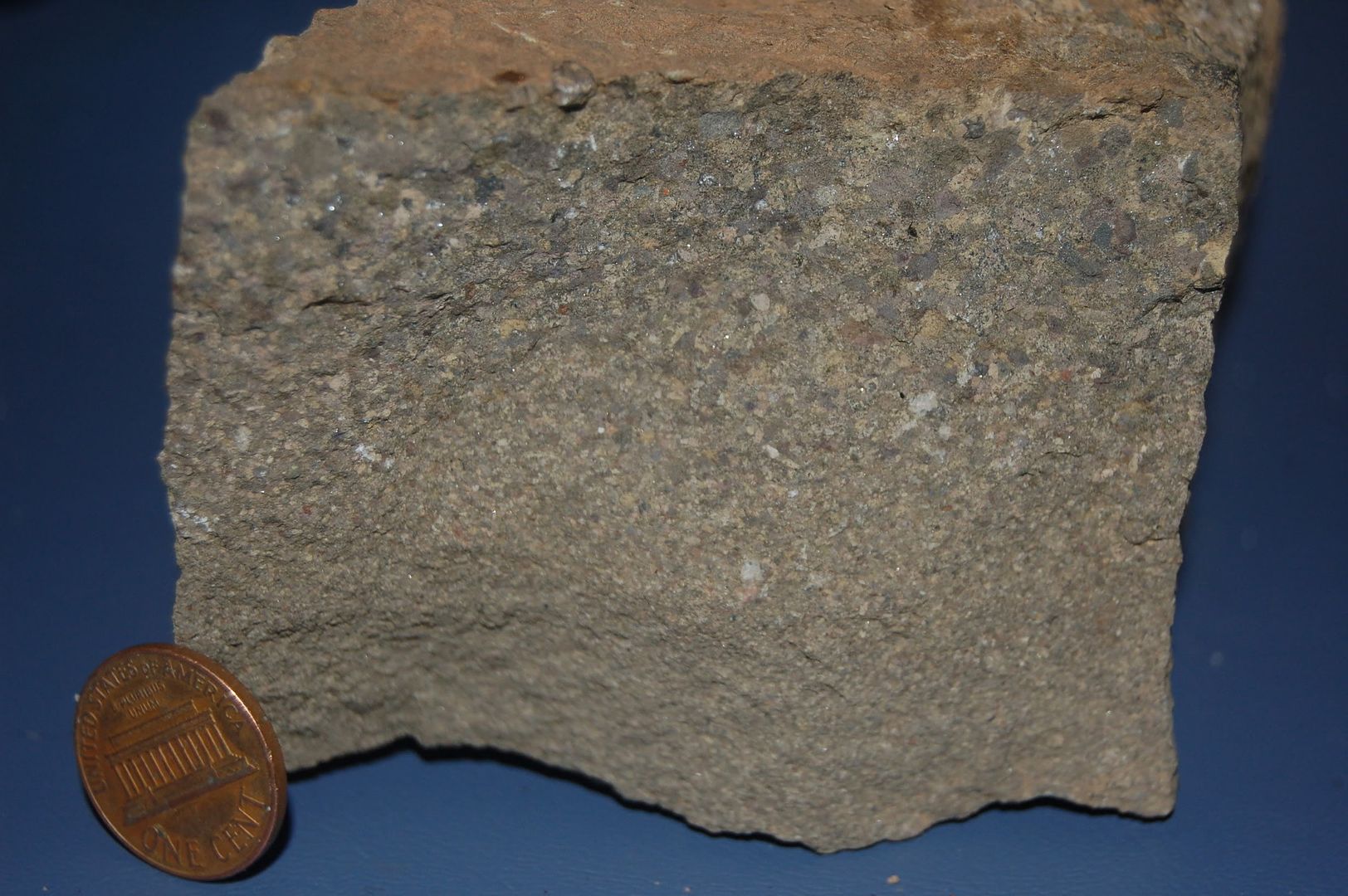
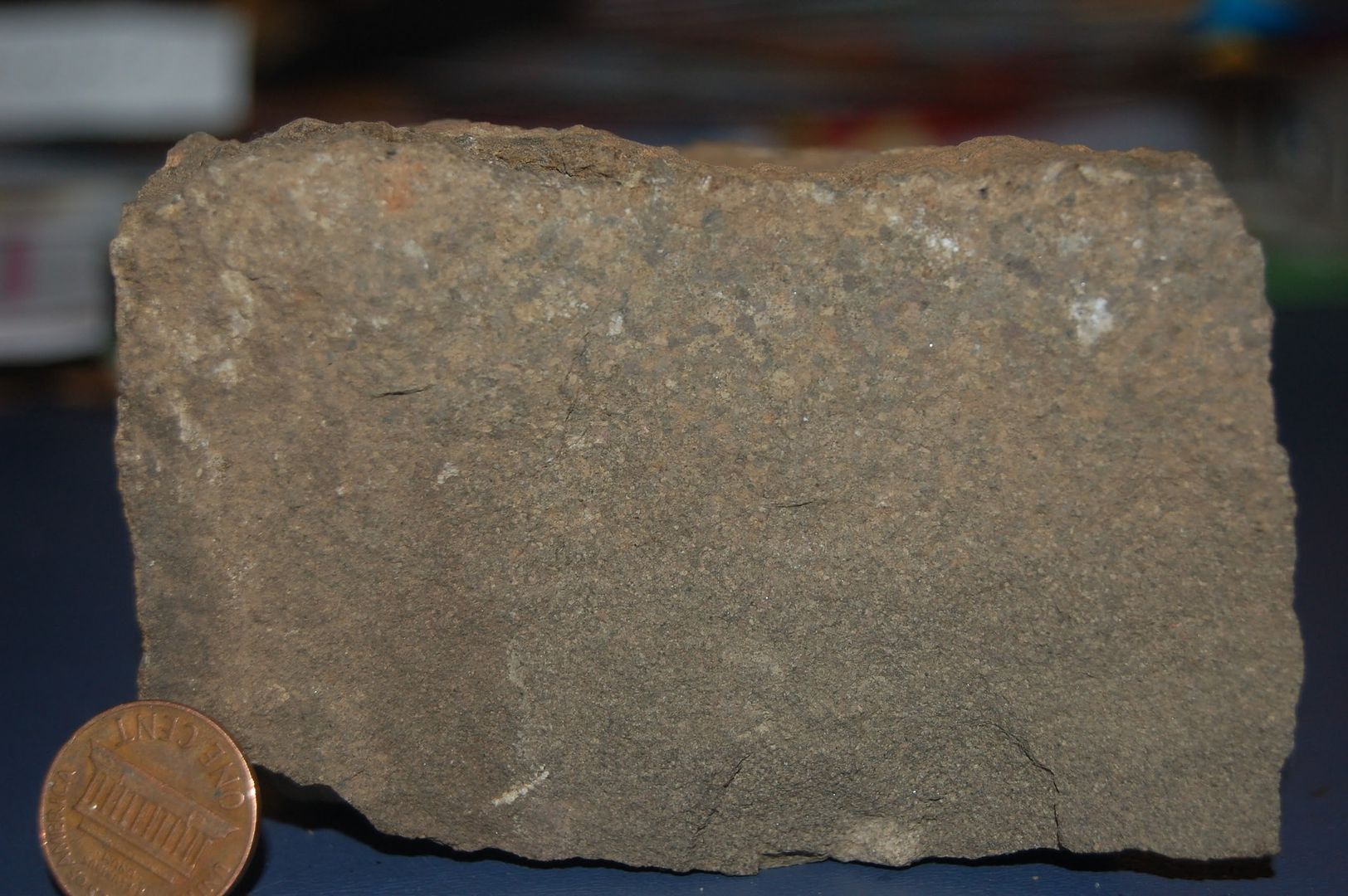
The rock is a sample of the King's Valley Siltstone (Tkv), a volcaniclastic sedimentary member of the Siletz River Volcanics (Tsr). The latter forms the "basement" of Siletzia, as described in the 3rd to last paragraph of this post. (The lowest and generally oldest rock in a regional sequence, "the basement" also sort of implies that it extends down into the earth far enough that for practical purposes, it doesn't really matter what's below it).

Tsr is mid to late Eocene in age, and I'll post on it some other time. It's thought to be, at its base, ocean ridge basalt. On top of that was formed a ridge of hot-spot, Hawaiian-style volcanoes. The importance of Tkv is that it shows these volcanoes emerged from the ocean and formed what must have been fairly substantial islands off the coast. (At the time, the coast would have been somewhere near the current axis of the Cascade volcanic arc, and these islands a little outboard of the current coastline) Had Tsr not emerged from the ocean, there couldn't have been enough erosion to produce these turbidites.

Tkv is intimately related to Tsr in a number of ways. First, near the contact, Tsr flows and pillows are interfingered with strata of Tkv. Second, as mentioned, the main source material of Tkv is weathered and eroded Tsr basalt. (At the site I collected this, there are also some interbeds of ashey rhyolitic tuff, which may be derived from the Challis volcanics of central Washington- but I can't vouch for that) As a result of the second point, the compositions of these two units are quite similar, and in weathered outcrops or drive-by geology, they can be difficult to distinguish.

The Kings Valley Siltstone member is fairly limited in areal extent, showing up in a band paralleling the Corvallis fault, another local feature I haven't discussed yet. It's also limited in terms of outcrops; I've only found a few, to the west on Marys Peak and to the north in Dunn State Forest (a unit of OSU's research forest land). Some of these outcrops, though, can knock your socks off. My favorite is a gravel quarry in Dunn SF, where one can clearly see the above mentioned interfingering, and I once found a most excellent feeding structure with radiating green phosphorite(?) worm poop. Carried the slab (~ 16x10x4 inches) home on my back too, about 10 miles. A friend of mine also found a magnificent turtle fossil in an outcrop near the town of Kings Valley- I tried to convince her that it might be an important fossil, and that she should show it to a researcher, but I couldn't get her to. It was about the size of a box turtle shell, but one corner had broken off, and you could see bone in the matrix. More mundane fossils (mostly mollusks, in my experience) can be found occasionally, but I've never seen a concentration of fossils anywhere.

From what I can remember, Tkv is a maximum of about 500 feet thick; that fits with my own trompings about. The top of the unit is pretty chaotic and unsorted, as is the bottom. The middle seems to be dominantly turbidites. Glassy basalt (sideromelane) and palagonite are abundant in the bottom of the unit, but absent from much less abundant in the middle, and then more near the top, though not as well preserved as at the bottom. I interpret these features to indicate less transport near the top and bottom, and from a more weathered source at the top.

So despite the lack of much research on this unit, I personally suspect it has a lot to offer, including a sedimentary record of the emergence, then erosion and submergence of a Hawaiian Island analogue, an admittedly spotty record of late Eocene life, but unique with respect to its location and time. It's also a beautiful area with overall good access- forestry (and the roads that go with it) rules a few miles to the west of my current position.

The pictures show three faces of the piece I have in my possesion at the moment, and show the graded bedding constituting the base of a single turbidity flow; the overlying finer sediments weather and crumble so fast they're very dificult to collect. And geo people should be able to see immediately that they're upside-down from the original deposition orientation- the "top" made a flatter, more stable position for photographing. Non-geo people should note that as you start from the top, the grains are larger, and as you move down, they get smaller. Turbidity currents (another thing I need to discuss in more detail at another time) start suddenly, then gradually slow over a period of hours to (maybe) a day or so. So the larger grains will drop out and settle first, then progressively smaller and smaller grains. The first deposited material is at the bottom of a sequence, later materials will be above, on top of, earlier materials, so the largest grains are at the bottom. Which happens to be on top in this picture, because the rock is "upside down."

Now here's the treat: I've learned how to upload big pictures, so the link below each will take you into a fantasy land of explicit geological detail.

BTW, this post is dedicated to BrianR, because he's always going on about turbidites, and I think he'll get a kick out of these.
I wanna see!
Big as a House! (just realized the first two are actually the same face from slightly different angles. Oh, well)
Penny the size of a grapefruit! (This is a slightly weathered face, but still fresh enough to see the texture)

I also wanted to mention that the glittery bits you can see are mostly the zeolite cement and some patches of calcite. Location information for this sample can be gleaned from the GoogleEarth screen caps below, or leave a comment for further info.
(Outcrop is immediately west of where the power line (~straight n/s swath) crosses the lower road (winding, ~e/w swath at the bottom).

Monday, February 2, 2009

Monday Mineral: Natrolite

Starting with a crop from the first picture in last week's Monday Mineral, you can see the acicular (needle-like) crystals of natrolite in amongst the blocky crystals of apophyllite. Natrolite is a member of the zeolite group of minerals. They are hydrated alumino-silicates, meaning that there is water bound onto an aluminum and silicon oxide framework, along with various metallic ions; in the case of natrolite, the major metal is sodium.The name "zeolite" comes from the Greek "zein," meaning "to boil," and "lithos," meaning "stone." As a group, heating them causes them to swell and give off water vapor. Natrolite doesn't show this as well as some others, but it does show it. There are two reasons to start with this particular zeolite: first, I've got a couple of decent samples. : ) Second, it's the most common zeolite around here. As a budding geo undergrad, it was the first mineral I could dependably identify. Like apophyllite, it is tetragonal, It is orthorhombic (I really should look this stuff up rather than counting on my memory) but only a few samples I've ever found allowed me to actually observe that symmetry. The crystals are normally in dense, radiating clusters. They seem to start at a point of nucleation, then grow outward en masse. So the color (white to light pastels) and the radiating bundles, along with occurence (mafic to intermediate igneous rocks, as a secondary mineral in fractures and voids, especially in pillow basalts), are the features I find particularly useful for ID. The above picture shows the surface of a goup of clusters; below is an oblique view to show the side and top together. And below is a side view of the clusters. This is the bottom of the same sample; this would have been the surface from which the whole mass grew.
Since it's a very showy mineral, and contrasts with its darker host material, people out on hikes tend to pick it up and carry it home. Eventually it makes its way to the garden, as with this piece I pried out of a neighbor's yard this morning. I put it back before I ID'd the glassy mineral on top of this sample; trying to tell from the picture, I suspect it's either calcite (but the cleavage doesn't look right) or analcime (another fairly common zeolite). The sample pictured in the middle four images is from a quarry on McCulloch Peak in McDonald State Forest. The forest is a Oregon State Research facility, so you can't drive here without permission and a key to the gates. But you can hike, bike, or ride a horse; the public is allowed on the forest lands, they just can't drive onto them. And the built-up area to the lower right (SE) is my lovely home town- or a small corner of it. Pin coordinates are 44.634523° -123.346144°

Thursday, May 22, 2008

Scite of the Day

This is one that I've been intending to put up for a while. Today seems like a good day; there's a slew of interesting stories. Science Daily is a great site for keeping up with current news in science generally- that is, it doesn't focus on any single discipline in science. The stories are often just passing along or paraphrasing of press releases, which has some weaknesses. Press releases are simply a form of advertising, and advertising is a form of propaganda. Don't expect any real examination of the weaknesses of the discovery or study, and do expect emphasis of the potential benefits (especially with respect to anything having to do with medicine) as opposed to likely benefits.

Despite this weakness, these releases are a great way to keep up with breaking science news, whatever your particular interests may be. If you scroll down toward the bottom, you can sign up for a daily newsletter or an RSS feed. I haven't figured ot RSS yet, but I love newsletters than I can read as my schedule and interest permit. I generally read only a few articles out of each newsletter (maybe one in eight), but often the paragraph accompanying each headline and link is enough to give me enough info that I don't feel the need for more detail. For eaxmple, from today,

Increase In Drunk Driving Fatalities Followed Ban On Smoking In Bars (May 21, 2008) -- A ban on cigarette smoking in bars is meant to save lives by reducing patrons' exposure to secondhand smoke. But it may actually be having an unintended consequence. By comparing data from a variety of locations around the United States where laws requiring smoke-free bars exist with locations without bans, researchers found a relative increase in fatalities caused by drunk driving following ban enactment. It seems that smokers are willing to drive longer distances to an establishment that allows smoking. ... > full story

Now I really appreciate that: I've got the gist of the story and an explanation. I don't need to read the whole article. Someone more interested than me in these issues might want more detail and click to read the whole thing. So lets look at a couple that I did read...

Halting Methane Squanderlust: Catalyst Converts Methane To More Useful Compounds (May 22, 2008) -- The pipes that rise from oil fields, topped with burning flames of natural gas, waste fossil fuels and dump carbon dioxide into the air. Scientists have identified the structure of a catalytic material that can turn methane into a safe and easy-to-transport liquid. The insight lays the foundation for converting excess methane into a variety of useful fuels and chemicals. ... > full story

I've long been troubled by the amount of "flaring" that takes place in the petroleum industry. Producing crude oil often involves the production of a great deal of methane, the main component of so-called "natural gas." It is often economically unfeasable to deliver this methane to market, so it's simply pumped up a pipe and burned, or "flared." In this day and age, indeed since I first learned what was happening, this has struck me as unforgivably wasteful, though I do understand the economic imperatives at work. So the idea is that a zeolite mineral with molybdenum oxide on its surface can convert methane to benzene (which despite the paragraph above is not exactly safe: it's a potent carcinogen). Benzene is an extremely important industrial chemical, as a solvent and as a precursor for a whole lot of organic materials. Still (and to reiterate my point about news releases) the process/catalyst is not yet economically feasible. Nevertheless, this is an important step in research I hadn't heard of previously... news to me.

Observation Of X-rays From Birth Of Supernova Leads To All-out Effort To Record Stellar Death (May 21, 2008) -- NASA's Swift satellite caught the rare birth of a supernova earlier this year, allowing astronomers to rapidly deploy ground-based telescopes to follow its evolution and learn about normal stellar explosions. Astronomers have analyzed the data to conclude that the original star was more than 30 times the mass of the sun, but only slightly larger, when its core ran out of fuel and imploded, blowing the star to smithereens. ... > full story

OK, so I'm a sucker for anything supernova. They're only the most energetic events that take place in our extended neighborhood. (Gamma Ray Bursts seem to be restricted to the early universe, so we see them only in distant galaxies- which is a very good thing). This is kind of a geeky article, but through one of those rare happenstances that are so important for science (luck favors the prepared researcher), orbital observatories caught a supernova in a not-too-distant galaxy in the very first stages of the explosion.

Ancient Amphibian: Debate Over Origin Of Frogs And Salamanders Settled With Discovery Of Missing Link (May 21, 2008) -- The description of an ancient amphibian that millions of years ago swam in quiet pools and caught mayflies on the surrounding land in Texas has set to rest one of the greatest current controversies in vertebrate evolution. ... > full story

Turns out that frogs and salamanders did come from the same group, and later than previously thought. The last-known ancestor of both groups has been discovered. They have an interesting "artist's conception" picture of the beastie; I wish they had a photo or at least sketch of the skeleton.

So there you have it: whether you visit the site, which is constantly being updated, get the e-mail newsletter (as I do), or the RSS feed, Science Daily is a great place to get general science news days before the MSM picks up a fraction of the interesting stories.